
String Theory's Unified Timeline: From Loop Inflation to Axion Quintessence
Recent progress on inflation and dark energy from string theory
This paper reviews recent advancements in Type IIB string theory compactifications, focusing on the "Loop Blow-up Inflation" model for the early universe and "Axion Hilltop Quintessence" for late-time dark energy. It establishes a cohesive cosmological history where Kähler moduli drive inflation and axion-like fields explain the current accelerated expansion of the universe.
Executive Summary
TL;DR: This paper bridges the gap between the ultra-high energy scales of the early universe (Inflation) and the vanishingly small scales of today’s Dark Energy (Quintessence). By utilizing Kähler moduli in Type IIB string theory, the author presents a model where 1-loop corrections drive a smooth inflationary plateau, and poly-instanton effects allow ultra-light axions to mimic a cosmological constant without violating quantum gravity constraints.
Academic Context: This work is a high-level synthesis and refinement of the Large Volume Scenario (LVS). It positions itself as a robust alternative to the "Swampland" critiques by showing that even if stable de Sitter vacua are difficult to find, dynamical quintessence can be realized with numerical control.
The Problem: The Scales Don't Match
In string cosmology, the "Moduli Problem" is a constant shadow. To describe our universe, we need:
- Inflation: Potential energy high enough to drive expansion but flat enough to last ().
- Dark Energy: A vacuum energy density of —a scale so small it usually forces the entire string theory setup into a regime where we lose mathematical control (the boundary of moduli space).
- Consistency: We must avoid "fifth forces" from light scalars and ensure the Higgs mass remains stable.
Methodology: The Power of Loops and Axions
The author breaks the evolution into two distinct mechanisms within the Kähler sector of Type IIB string compactifications.
1. The Early Universe: Loop Blow-up Inflation
Instead of relying purely on non-perturbative effects for inflation, the author introduces 1-loop corrections to the Kähler potential. These corrections are power-law rather than exponential, meaning they vanish slowly enough to create an effectively single-field slow-roll potential.
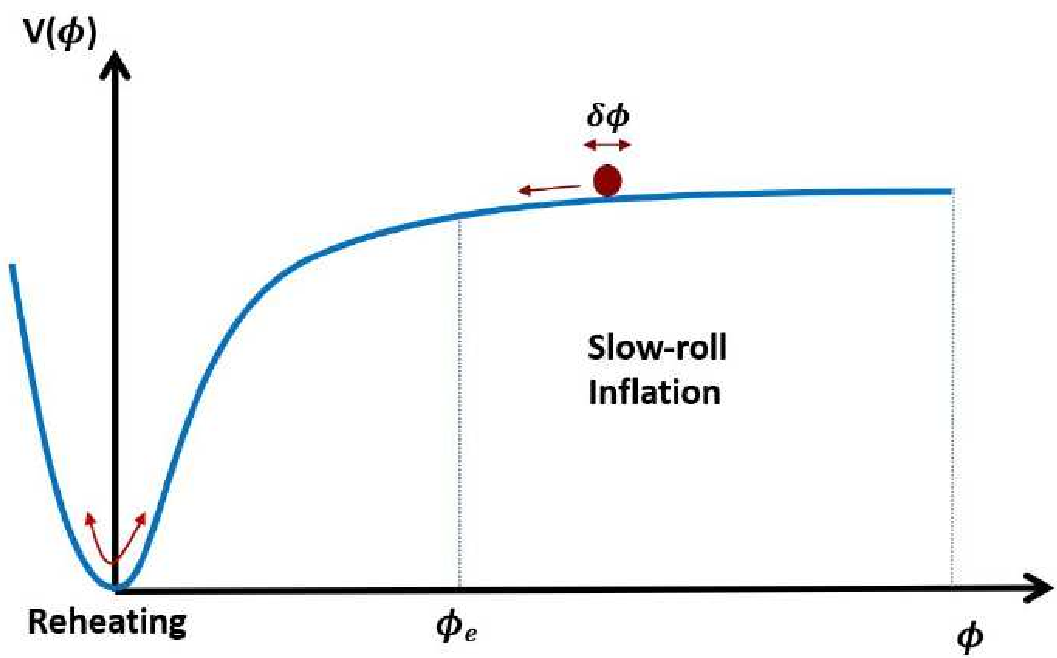
The potential takes the form: This "Loop Blow-up" model is an α-attractor realization in string theory, providing a natural mechanism for the flat plateau observed in CMB data.
2. Late Time: Axion Hilltop Quintessence
For Dark Energy, the "Inflaton" (a saxion) is too heavy. The author instead turns to Axions. Axions have a "Shift Symmetry," which is a fancy way of saying their physics doesn't change if you shift their value, protecting their mass from quantum "pollution."
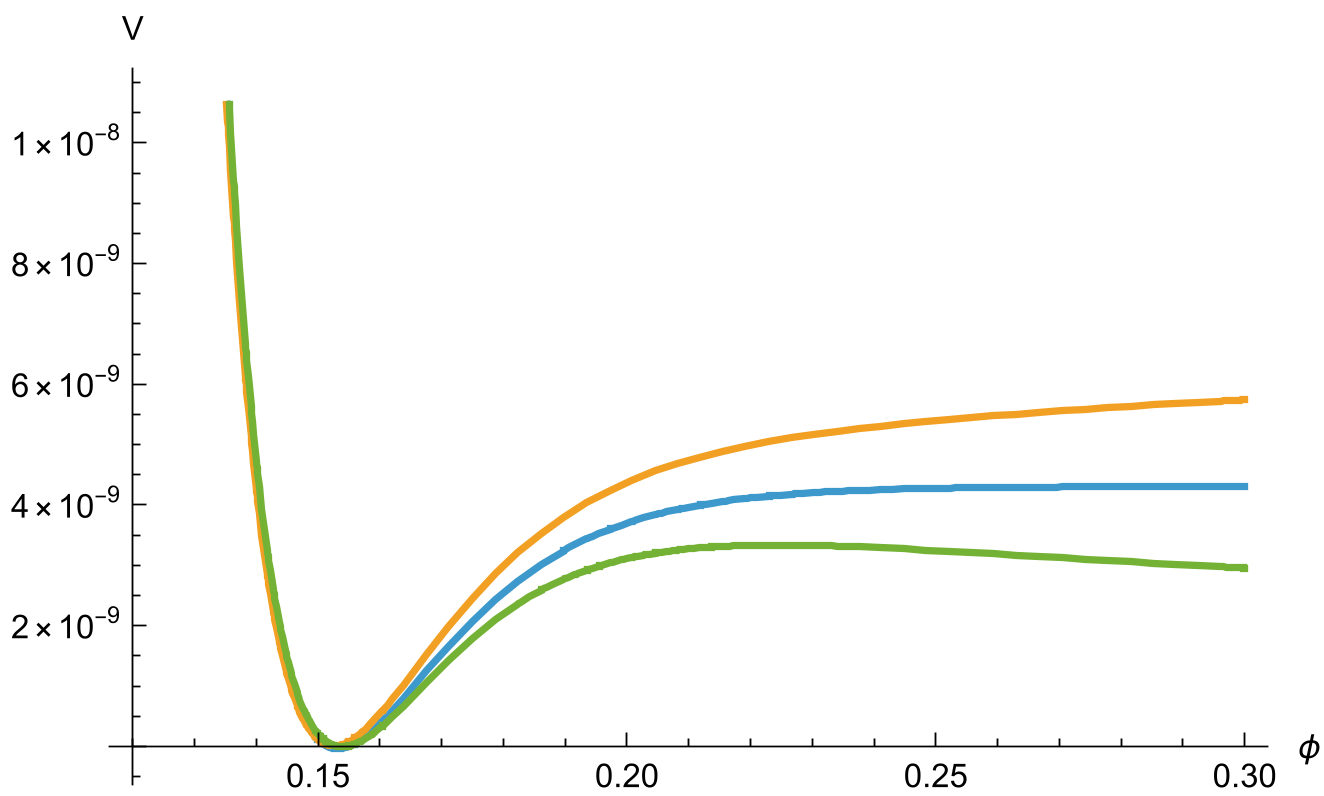
The specific insight here is the Hilltop Model. Instead of the axion rolling down a steep hill, it sits near the top of a potential generated by "poly-instantons"—corrections to corrections. This allows the energy scale to be suppressed enough to match the observed Cosmological Constant.
Experiments and Results
The paper calculates the standard cosmological observables against the latest data (Planck 2018 + BAO 2025).
- Spectral Index (): Predicted at 0.9757 - 0.9765, falling perfectly within the 68% confidence interval of current observations.
- Tensor-to-Scalar Ratio (): Predicted at , which is safely below current bounds but potentially detectable by future ultra-sensitive polarization missions.
- Dark Radiation (): Because the moduli eventually decay into axions, the model predicts an extra radiation density of 0 to 0.36.
Critical Analysis & Conclusion
Takeaway
The paper successfully constructs a "cradle-to-grave" cosmological narrative using only the building blocks of Type IIB string theory. It proves that Kähler moduli are the "Swiss Army Knife" of string cosmology, capable of driving both the Big Bang and the current acceleration.
Limitations
The primary challenge remains Initial Conditions. For the axion to act as Dark Energy today, it must have started very close to the "Hilltop" 13.8 billion years ago. While the author suggests "axion alignment" or "poly-instanton effects" can mitigate this, it still requires a degree of fine-tuning that critics of string theory often point to.
Future Outlook
As data from DESI and Euclid provide tighter constraints on the "evolving" nature of dark energy (the parameter), these axion hilltop models will face their ultimate test. If dark energy is truly dynamical (changing over time), stringy quintessence will be the primary theoretical framework left standing.