
[arXiv 2026] RefineAnything: Elevating Local Details via Focus-and-Refine Diffusion
RefineAnything: Multimodal Region-Specific Refinement for Perfect Local Details
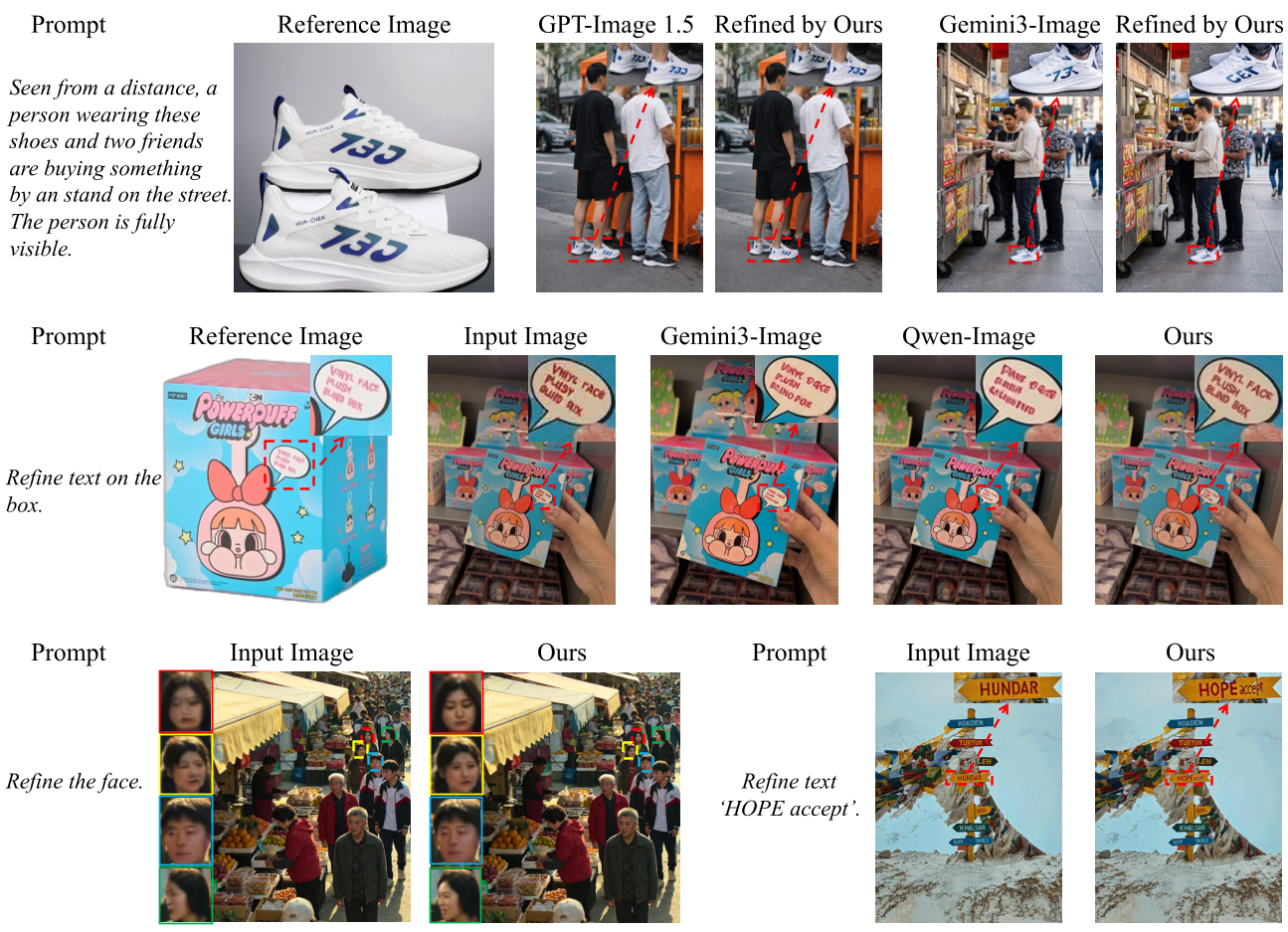
RefineAnything is a multimodal diffusion-based framework designed for region-specific image refinement using a "Focus-and-Refine" strategy. It effectively restores fine-grained details like text and logos in both reference-based and reference-free settings, establishing a new SOTA for local detail correction.
Executive Summary
TL;DR: RefineAnything is a specialized refinement framework that fixes "broken" local details—such as garbled text, distorted logos, or messy facial features—within a user-defined region. By utilizing a counter-intuitive "Focus-and-Refine" strategy, it achieves high-precision reconstruction while maintaining 100% background consistency, a feat existing instruction-based models like GPT-4o and Flux struggle to achieve.
Background Positioning: This work identifies a critical gap in the generative AI pipeline: while global composition is largely solved, local micro-accuracy remains a bottleneck for professional use. RefineAnything moves beyond "editing" (semantic change) towards "refinement" (restoration), positioning itself as an essential post-processing tool for high-stakes visual content.
The Problem: The "Resolution Budget" Dilemma
The primary reason current SOTA models (like SDXL or FLUX) fail at small details is the Variational Autoencoder (VAE) bottleneck. When an entire 1024x1024 image is compressed into a latent space, a tiny logo occupying only 50x50 pixels loses almost all its structural integrity.
Existing instruction-driven models suffer from:
- Weak Region Controllability: Promoting "fix the text" often changes the whole image.
- Background Drift: Latent diffusion naturally tends to update surrounding pixels to maintain global harmony, destroying original details that should remain untouched.
Methodology: Focus-and-Refine
The core "Aha!" moment of this paper is the observation that crop-and-resize substantially improves VAE reconstruction even without adding new information. By zooming into a region, the model's fixed latent capacity is dedicated entirely to local structures rather than the global background.
1. The Architecture
RefineAnything builds on the Qwen-Image backbone, utilizing a frozen Qwen2.5-VL as a multimodal encoder. It processes three types of inputs:
- High-level Context: VLM tokens for instructions and reference images.
- Low-level Visuals: VAE latents of the input and reference.
- Spatial Priors: Scribble masks or bounding boxes that guide the attention mechanism.
2. Focus-and-Refine Strategy
The workflow follows a tri-stage pipeline:
- Localization: Generating a tight crop around the target region with a small margin for context.
- Focused Generation: Denoising only the cropped region at full model resolution.
- Seamless Paste-back: Using a Gaussian-blurred mask and a Boundary Consistency Loss to stitch the refined crop back into the original image.

Experiments: Outperforming the Giants
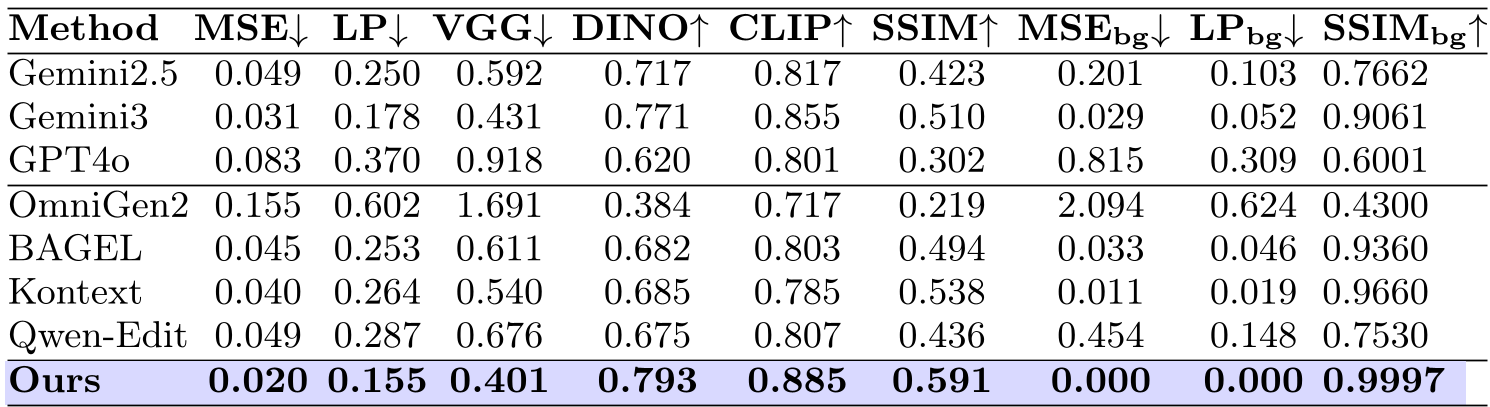
The authors introduced RefineEval, a benchmark specifically designed to measure both fidelity and background consistency.
Quantitative Superiority
RefineAnything doesn't just "look better"; it achieves mathematically superior results. It maintains a 99.9% SSIM for backgrounds, meaning the rest of the image is effectively a bit-perfect copy of the original, while competing models like Kontext or Qwen-Edit introduce significant noise (MSE_bg > 0.01).
Ablation Insight: The Boundary Consistency Loss
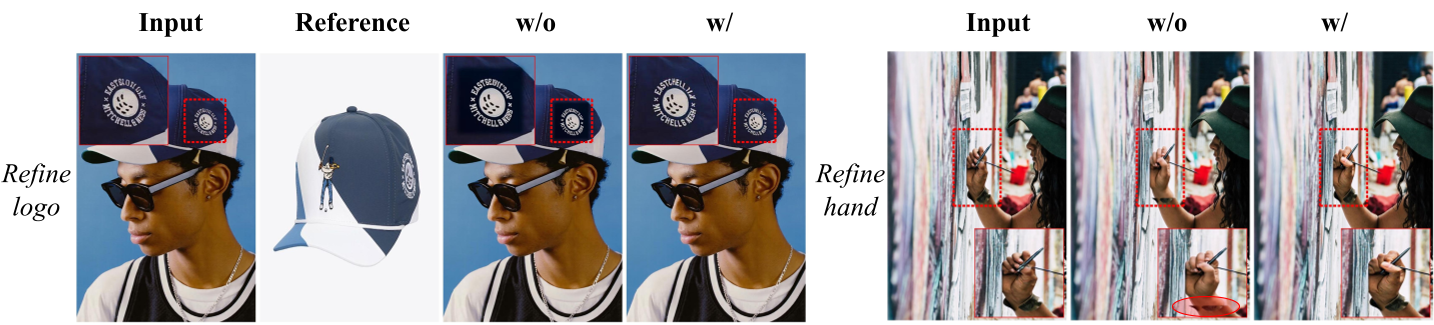
Without the proposed boundary loss, "pasted" regions often show visible seams or color shifts. The Boundary Consistency Loss upweights supervision at the edges of the edit, forcing the diffusion model to predict pixels that align perfectly with the unedited environment.
Critical Analysis & Conclusion
Takeaways
RefineAnything proves that local refinement is a resolution allocation problem. By decoupling the "understanding" phase from the "resolution" phase, we can fix micro-defects that were previously considered inherent limitations of VAE-based diffusion.
Limitations & Future Work
- Extreme Aspect Ratios: The current cropping strategy assumes relatively balanced bounding boxes. Extremely thin or long regions might still face distortion.
- Semantic Overlap: If the refinement instruction contradicts the surrounding unedited context too strongly, the boundary loss might create a sharp "clash" of styles.
Final Verdict: This is a highly practical contribution. For developers building AI-assisted design tools, the "Focus-and-Refine" methodology is likely to become the standard blueprint for high-precision local image manipulation.