
Conservative Confidence Betting: A Smarter Way to Align LLMs at Test-Time
On the Rejection Criterion for Proxy-based Test-time Alignment
The paper introduces a unified Probabilistic Graphical Model (PGM) for proxy-based test-time alignment, framing existing methods like Nudging and Implicit Reward as specific rejection criteria. It proposes a "Conservative Confidence Bet," a novel rejection rule that benchmarks the large base model's confidence against the proxy model's best possible prediction.
TL;DR
Aligning Large Language Models (LLMs) via RLHF or DPO is computationally expensive. Proxy-based test-time alignment offers a shortcut: using a small, aligned "proxy" model to guide a large "base" model during inference. This paper unifies diverse alignment methods into a single mathematical framework and introduces the Conservative Confidence Bet—a method that stops premature "deferral" to small models by comparing the base model's confidence to the proxy's best alternative.
The Core Problem: The Confidence Trap
Most current "proxy-based" methods follow a simple rule: if the large model is "unconfident" (low probability), let the small aligned model take over.
The authors argue this is fundamentally flawed due to Linguistic Ambiguity. Consider the phrase: "Frameworks _____ PyTorch." A model might split its probability between "like" and "such as." Both are perfect, yet the probability for each might be low (e.g., 0.35). A naive system would see 0.35, panic, and reject the token, even though the model was perfectly aligned with human intent.
Methodology: Unifying Alignment through PGMs
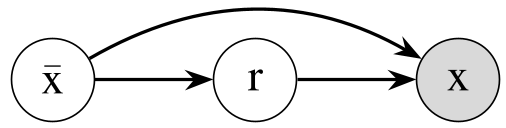
The researchers demonstrate that whether you are using Nudging (switching models based on entropy) or Implicit Rewards (weighting the distribution), you are essentially sampling from a Probabilistic Graphical Model (PGM).
The Generative Story
- Drafting: Draw a token from the large base model .
- Rejection: Decide whether to keep or reject it ().
- Finalization: If rejected, sample a new token from the aligned proxy .
The "Conservative Confidence Bet"
The innovation lies in the rejection criterion. Instead of a fixed threshold, the authors use a relative one: In plain English: "Only reject the large model's token if its confidence is significantly worse than the best possible guess the small model could make."
Experiments & Results
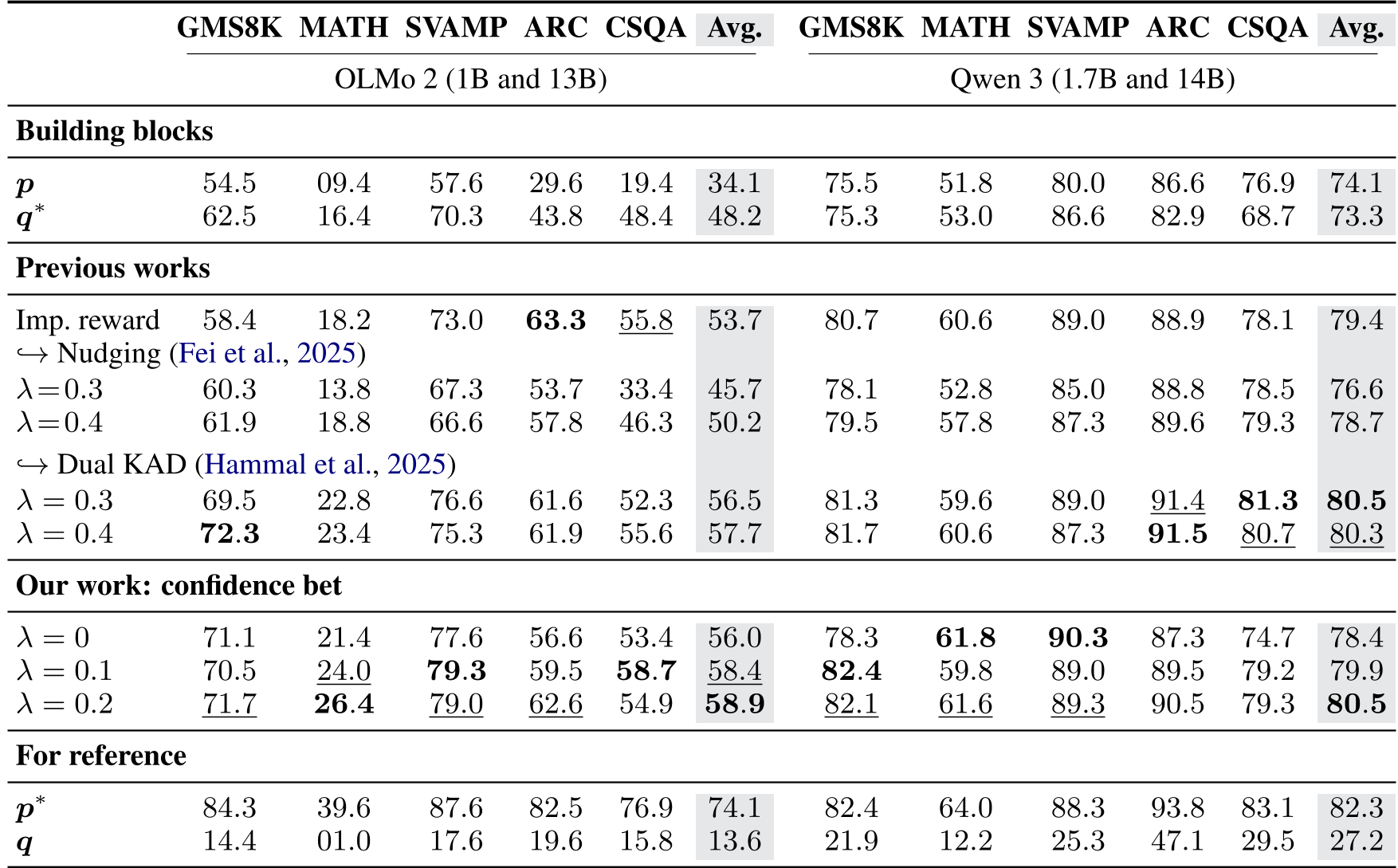
The authors tested this on Math (GSM8K, MATH500) and Commonsense Reasoning (ARC, CSQA) using OLMo 2 and Qwen 3 families.
Performance Gains
The results prove that "betting" on the large model pays off. By avoiding unnecessary deferrals during naturally ambiguous phrasing, the conservative approach achieved higher average accuracy than previous SOTA methods like Dual KAD and Nudging.
Key Insights from the Data:
- Mathematical Reasoning: The method showed significant jumps in MATH500 (from 18.8% to 26.4% in some configurations).
- Generality: It works across different model families (OLMo and Qwen), bridging the gap between base models and their fully aligned counterparts without the massive cost of preference fine-tuning.
Critical Analysis & Conclusion
Takeaway
The paper shifts the focus from absolute confidence to relative utility. It proves that a large "unaligned" model often has the right intuition but perhaps the wrong "style." By using a proxy only when the proxy is objectively more "sure" than the base model, we get the best of both worlds: the reasoning power of a large model and the alignment of a small one.
Limitations
- Hyperparameters: The margin still needs tuning on a validation set.
- Proxy Quality: If the proxy model is significantly worse than the base model (as seen in some Qwen 3 commonsense tasks), the benefits start to diminish.
Future Perspective
This PGM framework provides a sandbox for designing even more complex rejection rules. We might soon see "ensemble rejection," where multiple small proxies (one for safety, one for style, one for math) decide collectively whether to intervene in a large model's generation.