
Deciphering the Cosmic Death Toll: How Metallicity and Binarity Dictate Supernova Diversity
Relative frequencies of core-collapse supernovae as a function of metallicity: observations vs theoretical predictions
This study presents a comprehensive analysis of the relative frequencies of core-collapse supernova (CCSN) subtypes as a function of host-galaxy metallicity. Using a combined dataset of literature records and modern transient surveys (2019–2024), the authors confirm that the ratio of stripped-envelope supernovae (SESNe) to hydrogen-rich Type II supernovae increases with metallicity, with the latest un-targeted data reaching SOTA statistical reliability.
TL;DR
Why do some massive stars explode while retaining a thick cloak of hydrogen, while others are stripped bare before their final collapse? By analyzing nearly 4,000 supernovae from 2019–2024 alongside historical literature, this study proves that metallicity is a key driver of supernova types, but it isn't acting alone. Binary star interactions and rotation are the critical "invisible hands" that allow stars to shed their envelopes, especially in metal-rich environments.
The Problem: Are Our Supernova Samples Biased?
For decades, astronomers have debated whether the environment—specifically metallicity (the abundance of elements heavier than Helium)—dictates what kind of supernova a star becomes. There are two main camps:
- Type II SNe: Hydrogen-rich, coming from stars that kept their envelopes.
- SESNe (Stripped-Envelope SNe): Types IIb, Ib, and Ic, which lost some or all of their hydrogen/helium layers.
The "Targeted Survey Bias" has long plagued this field. Historical searches focused on big, bright galaxies, naturally skewing our data toward metal-rich environments. This study finally tackles this by leveraging un-targeted surveys like ZTF, providing a much "fairer" look at the universe.
Methodology: Local vs. Global Insights
The researchers didn't just look at one metric. They performed a massive cross-calibration of how we measure a galaxy's "metal content":
- Local Measurements: Spectroscopic data taken exactly where the star exploded (the most accurate but hardest to get).
- Global Measurements: Estimating metallicity based on the host galaxy's total mass or brightness.
By comparing these, they found that global measurements are surprisingly robust, though they tend to slightly overestimate metallicity compared to site-specific data.
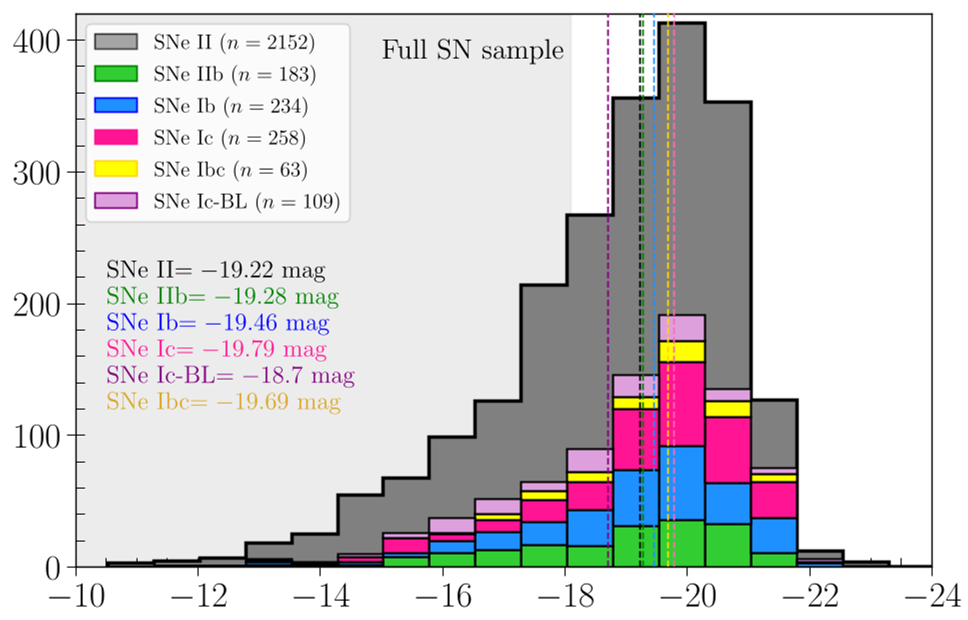 Figure: The shift in host galaxy brightness across different samples. Note how the 50 Mpc sample (bottom) includes many more faint, metal-poor galaxies than the biased literature sample (top).
The Core Discovery: The Binary Connection
The most striking result comes from comparing actual observations to theoretical models.
- Single-star models (non-rotating): Total failure. They cannot produce enough stripped-envelope supernovae to match what we see in the sky.
- Rotating stars & Binary systems: Success. Models that include binary interactions (where a companion star "steals" the envelope) or rapid rotation (which enhances stellar winds) provide a much better fit.
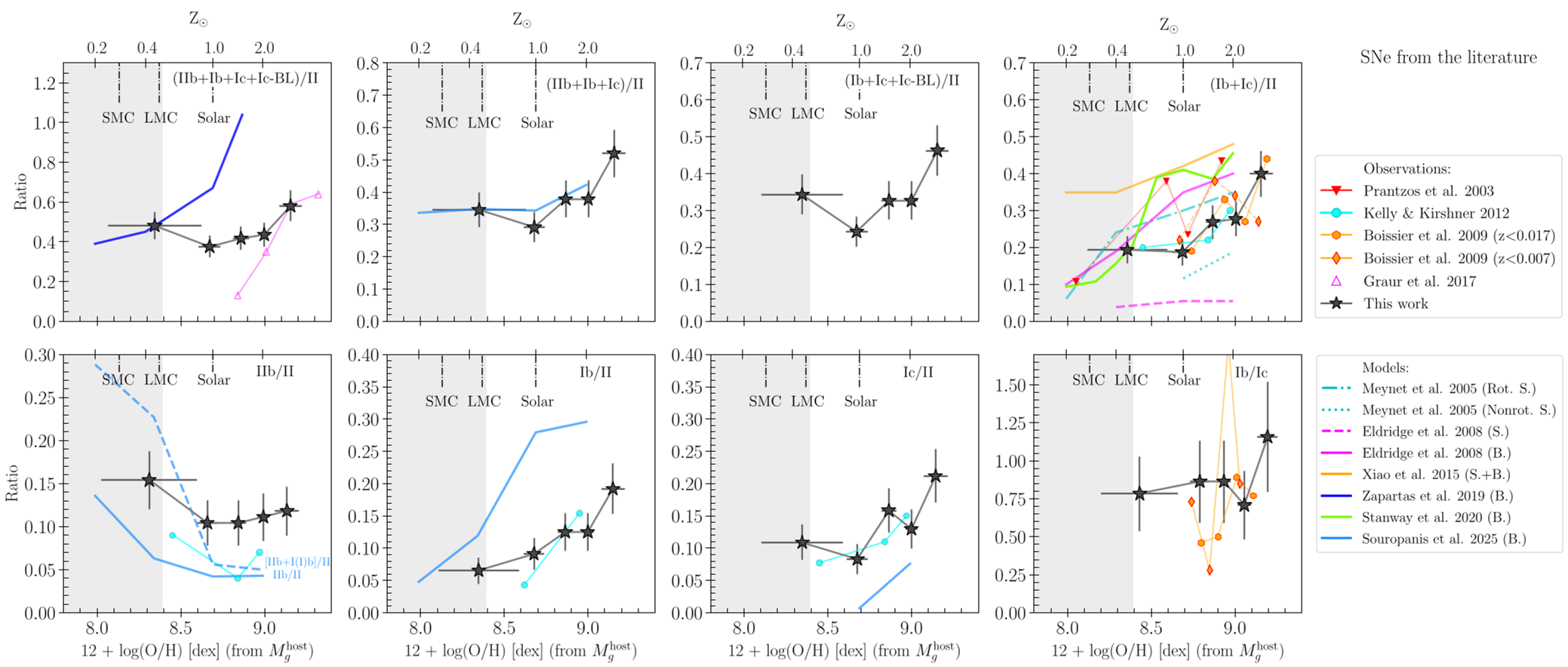 Figure: The ratio of Stripped-Envelope SNe to Type II SNe increases as metallicity goes up. The markers represent real data, while the lines represent various theoretical models.
Key Quantified Insights:
- Type II SNe are the "commoners," making up ~70% of the population.
- In metal-rich environments, the fraction of SESNe increases significantly.
- Distance-Limited Accuracy: Within 50 Mpc, the team found a much higher proportion of supernovae in dwarf galaxies, which are the "missing link" in understanding low-metallicity stellar evolution.
Critical Analysis & Conclusion
This paper serves as a vital bridge between the "old" era of targeted astronomy and the "new" era of big-data, wide-field surveys.
Takeaway: If you want to predict how a star dies, you must look at its neighbors. Metallicity facilitates mass loss through stellar winds, but binary interactions are the primary mechanism for stripping stars of their envelopes across the majority of the cosmic timeline.
Limitations: Even with modern surveys, we still struggle to find the very "faintest" supernovae in distant galaxies. Furthermore, "saturation" in mass-metallicity relations at high masses remains a technical hurdle for precision measurements.
Future Work: As the Vera C. Rubin Observatory (LSST) comes online, we will move from thousands of supernovae to millions, allowing us to see if these trends hold in the most extreme, metal-poor environments of the early universe.