
[PRB 2026] Nucleating the Chaos: How 1D Localized States Forge SYK Clusters
Nucleation of Sachdev-Ye-Kitaev Clusters in One Spatial Dimension
The paper proposes a real-space phenomenological theory for the "Nucleation of SYK Clusters" in 1D systems. It demonstrates how localized single-particle states with internal phase structure can generate the complex-Gaussian disorder law of the Sachdev-Ye-Kitaev (SYK) model and organizes these interactions into emergent topological clusters through a pair-space graph representation.
TL;DR
The Sachdev-Ye-Kitaev (SYK) model is the "Holy Grail" for studying many-body chaos and holography, but its requirement for all-to-all random coupling is a nightmare for experimentalists. This paper provides a way out: it proves that localized states in 1D—when they have enough internal "phase texture"—naturally nucleate into SYK clusters. By mapping interactions to a pair-space graph, the authors show how these clusters merge and eventually mimic the dense mixing required for strange-metal physics.
The Gap: From Math to Matter
The SYK model is mathematically elegant because of its circular complex-Gaussian disorder law. However, in a real lab (like a 1D nanowire or a graphene edge), things are messy:
- Locality: Orbitals only interact if they overlap.
- Correlated Disorder: The same orbital centers and widths appear in multiple coupling terms.
- Sparsity: Most couplings are zero because the orbitals are too far apart.
The authors ask a fundamental question: Can the "active" part of a spatially local system actually behave like a canonical SYK model?
Methodology: The Two-Step Transformation
1. Gaussianization through "Phase Texture"
The authors move beyond simple "blobs" of charge. They resolve each localized orbital into smaller pieces, each with a random phase. As increases, the Central Limit Theorem kicks in. Even though the geometry is constrained, the sum of many independent phases forces the distribution of nonzero couplings to become Gaussian.
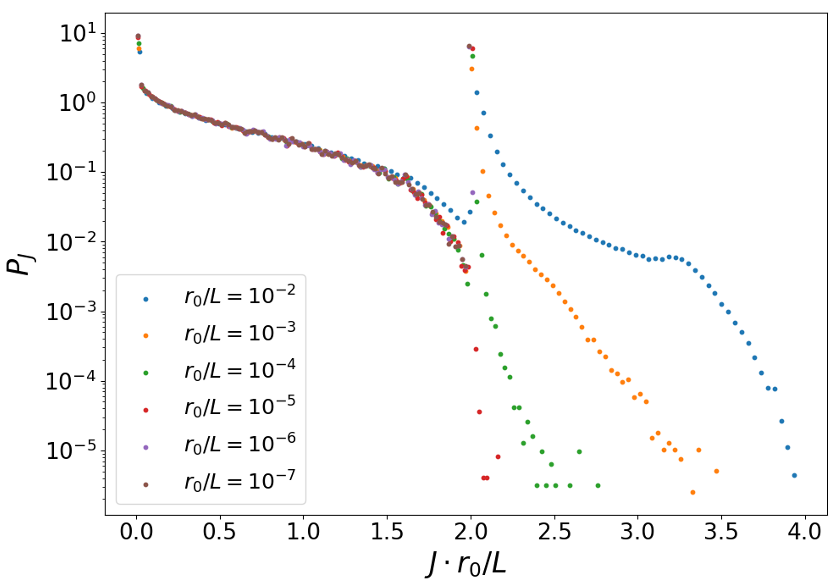
Figure: The transition from simple overlap geometry to complex SYK-like tensors through internal phase structure.
2. The Interaction Graph
To understand how these orbitals "talk" to each other, the authors map the tensor to a pair-space graph. Each node is a pair of orbitals , and each edge is a scattering event.
- Nucleation: At low density, small "droplets" of interacting pairs form.
- Percolation: As the system grows, these droplets merge (jumps in the graph) into a giant connected component—a saturated SYK cluster.
Experimental Criteria: How to Build One
The paper provides a checklist for realizing this in the lab:
- Effectively 1D Geometry: Use boundaries, filaments, or multichannel quasi-1D systems.
- Orthonormal Overlap: Orbitals must overlap in space but remain mathematically orthonormal.
- Complex Phase Texture: Broken time-reversal symmetry (e.g., via a magnetic field) is crucial to ensure the internal phases are complex and randomized.
Key Results & Visualization
The most striking result is the Simplex Scaling. In a perfect SYK model, every pair can scatter into every other pair (a complete graph). The authors measured the "SYK-likeness" of their 1D clusters by counting cliques (-simplexes).
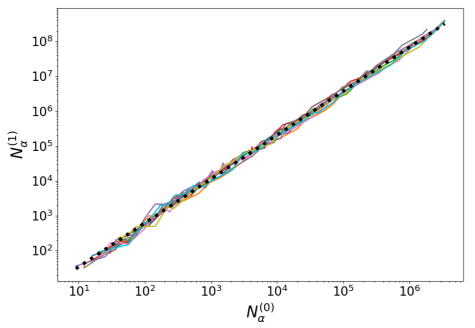
Figure: In the saturated regime, the scaling exponents ( to ) approach complete-graph benchmarks, proving that these 1D systems eventually replicate all-to-all SYK mixing.
Deep Insight: Why This Matters
For years, researchers thought SYK physics required high-dimensional global randomness. This work demonstrates that topology and internal resolution can compensate for a lack of global connectivity. By simply having "enough" internal degrees of freedom () within a localization volume, a 1D chain can exhibit the same chaotic spectral statistics as a black hole’s holographic dual.
Conclusion
This paper shifts the focus from "finding a system that is SYK" to "engineering the conditions for SYK nucleation." It provides a minimal, robust roadmap for detecting SYK behavior through transport noise and tunneling spectra, specifically targeting current-generation solid-state devices.
Technical Terms: SYK Cluster, Pair-space Graph, Simplex Scaling, Gaussianization, Active Sector, Stochastic Percolation.