
SASVD: Conquering the Curse of Saturation in Blind Image Deblurring
Saturation-Aware Space-Variant Blind Image Deblurring
The paper introduces SASVD (Saturation-Aware Space-Variant Deblurring), a novel framework for blind image deblurring that specifically handles overexposed regions. By combining a pre-estimated Light Spread Function (LSF) with a Dark Channel Prior (DCP), it restores true radiance in saturated pixels and achieves SOTA performance in high dynamic range and low-light scenarios.
TL;DR
Restoring motion-blurred images is hard; it is nearly impossible when the image is also overexposed (saturated). SASVD (Saturation-Aware Space-Variant Deblurring) solves this by using the physics of light scattering to "guess" the lost information in bright spots. By combining a Light Spread Function (LSF) with the Dark Channel Prior, it cleans up saturated regions before deblurring, effectively eliminating the dreaded "ringing artifacts" that plague traditional methods.
Background: Why Saturation Breaks Deblurring
In the standard world of image restoration, we assume a linear model: . But when a pixel hits its maximum value (e.g., 255), the data is clipped. This clipping is a non-linear process that violates the fundamental math behind most Point Spread Function (PSF) estimations.
Furthermore, in real cameras, bright lights don't just stay in one pixel; they "leak" into neighbors due to internal lens reflections (scattering) and diffraction. This paper identifies that blurring and scattering are two different physical processes that both contribute to light spread, and trying to reverse one without accounting for the other leads to catastrophic failure.
Methodology: The Core Intuition
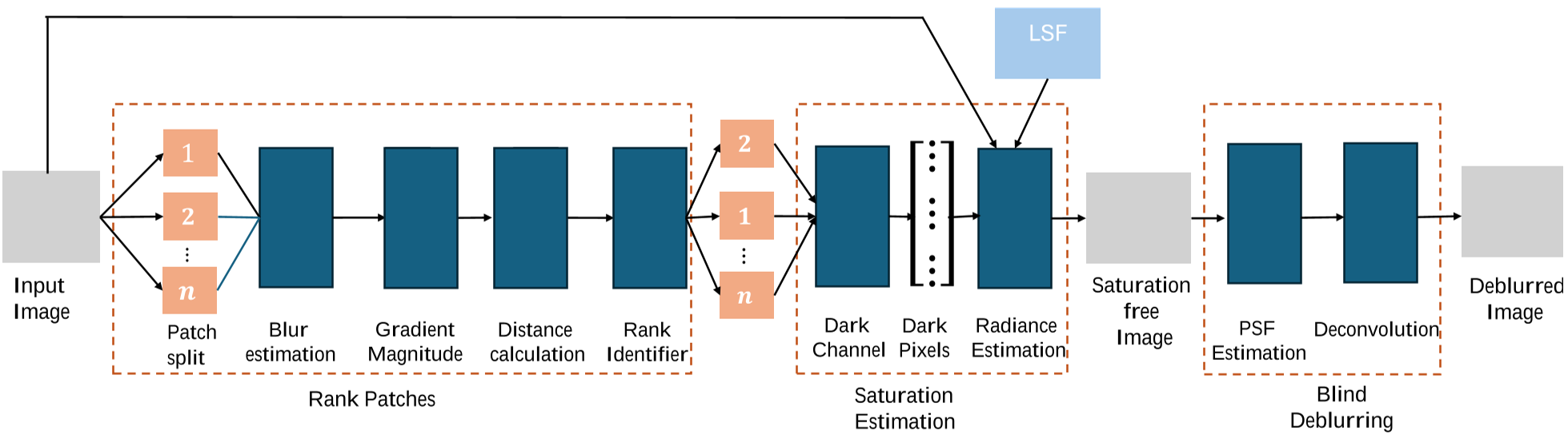
The authors propose a clever two-stage framework that treats saturation as a radiance estimation problem rather than an outlier problem.
1. Finding the "Pristine" Evidence
The algorithm first seeks out patches that are close to saturated regions but are minimally blurred. By isolating these patches, the system can more accurately observe the Light Spread Function (LSF) in isolation, without it being "smeared" by motion blur.
2. The Radiance Recovery (DCP to the Rescue)
The framework utilizes the Dark Channel Prior (DCP). In natural, non-saturated images, dark pixels usually have nearly zero intensity in at least one channel. If those dark pixels show some intensity near a bright light, that intensity is likely "stray light" from the saturated source. By modeling this stray light with a parametric LSF: The authors can back-calculate the "true" radiance hidden behind the clipped 255-value pixels.
Experiments and Benchmarks
The authors integrated their framework with various backends, such as the classic Xu et al. [28] and Wen et al. [30].
SOTA Comparisons
The results are particularly striking in nighttime scenarios (e.g., car headlights in a tunnel). While general-purpose methods like Restormer or LoFormer struggle with the non-linearities of overexposure, SASVD maintains structural integrity.
| Metric | Proposed (SASVD) | Chen et al. [10] | Zamir et al. (Restormer) |
|---|---|---|---|
| Avg. SSIM-Weighted PSNR | 27.40 | 23.08 | 26.26 |
| Total Runtime (720p) | 126s | 124s | - |
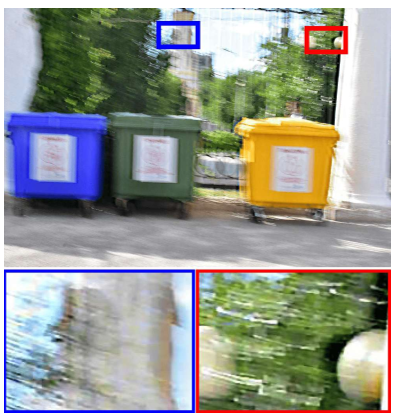 Figure: SASVD (a, b) preserves fine details and structural integrity where other methods (c, d) introduce severe noise and artifacts.
Deep Insight: Is LSF Camera-Specific?
A brilliant part of this study is the sensitivity analysis of the LSF. One might worry that you need a custom LSF for every single lens/camera combination. However, the authors found that even with different camera setups, the parametric model is robust enough that minor variations in do not significantly degrade the final deblurring quality (as shown in Figure 5 of the paper). This suggests the framework is highly practical for general-purpose applications.
Critical Analysis & Conclusion
Takeaway
SASVD bridges the gap between low-level optical physics and high-level image restoration. Its ability to "uncanned" the clipped information in saturated regions makes it an essential pre-processing step for any robust deblurring pipeline.
Limitations
- Extreme Saturation: If more than 50% of the image is overexposed, there are simply not enough dark pixels to provide "evidence" for the radiance estimation.
- Patch Search: In cases of extreme, uniform blur across the entire frame, finding "minimally blurred patches" becomes a heuristic struggle.
Future Outlook
The authors plan to release a Python implementation integrating SASVD with modern Deep Learning backends, potentially combining the physical rigor of LSF with the generative power of Diffusion Models.