
Beyond the Face: Decoding Sentiment in German Sign Language Fairy Tales
Sentiment Analysis of German Sign Language Fairy Tales
The paper introduces DGS-Fabeln-1-SE, a novel dataset and explainable machine learning model for sentiment analysis in German Sign Language (DGS). By leveraging LLM-based text labeling and MediaPipe-extracted skeleton data, it achieves a 0.631 balanced accuracy in classifying three valence levels (negative, neutral, positive).
TL;DR
Researchers from DFKI have developed a system to automatically detect "Valence" (positive vs. negative) in German Sign Language (DGS). By combining the linguistic intuition of Large Language Models with explainable XGBoost classifiers, they discovered that sentiment isn't just in the smile—it's in the hips, shoulders, and the "energy" of the signs.
Context: Why Fairy Tales?
Most Sign Language (SL) datasets focus on dry domains like weather forecasts (PHOENIX-2014-T). However, to study sentiment, you need drama. Fairy tales provide high emotional variability, moving from conflict to "happily ever after," making them the perfect sandbox for testing affective computing.
The Pain Point: The "Robotic" Avatar Problem
Current SL synthesis is often criticized for being "robotic." This isn't just a lack of detail; it's a lack of intent. In SL, grammar and emotion are inextricably linked. If a system doesn't understand the sentiment of a sentence, it can't perform the signs with the correct "texture," leading to a loss of meaning for the Deaf community.
Methodology: LLMs Meet Motion Capture
The researchers addressed the data bottleneck using a two-pronged pipeline:
- Linguistic Ground Truth: Instead of slow manual labeling, they used four LLMs (including GPT-5 and Sonic) to label German text segments. With an inter-annotator agreement of 0.78 (Krippendorff’s alpha), this created a reliable "silver standard."
- Feature Engineering: Using MediaPipe, they extracted 396 features per segment. These weren't just raw coordinates but "interpretable" metrics:
- Velocity/Acceleration of wrists and nose.
- Joint Distances (e.g., how far apart are the elbows?).
- Facial Blendshapes (e.g., mouth smile, eyebrow furrowing).
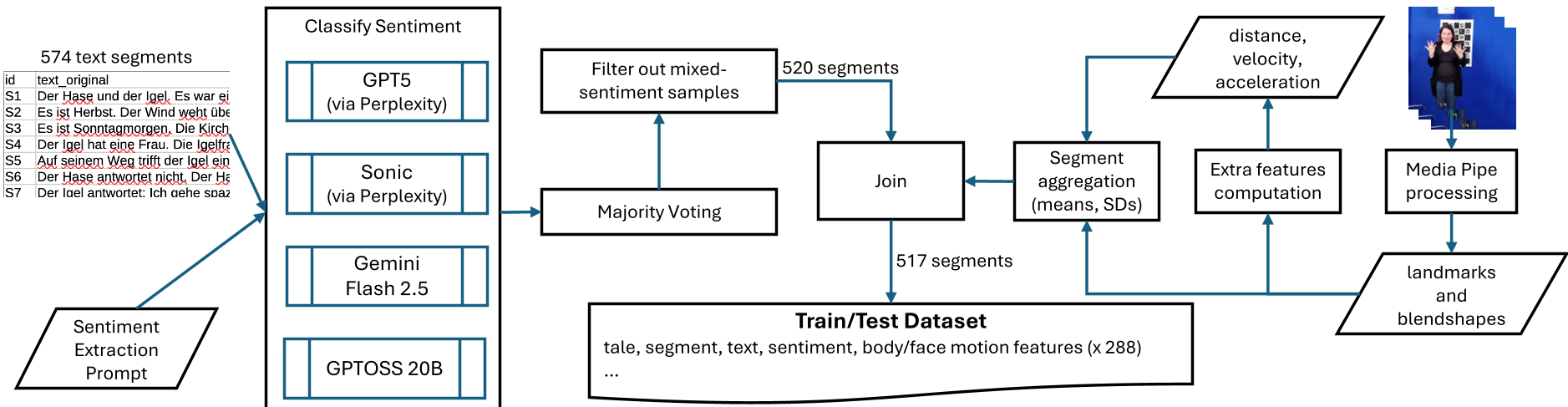 Figure: The pipeline from text-based LLM voting to video feature extraction.
Key Insights: What Makes a Sign "Negative"?
The use of XGBoost wasn't accidental—it allowed the team to see why the model made its decisions.
- The "Jumping" Hips: One of the most fascinating findings was that vertical motion of the hips (standard deviation of position and velocity) was a strong predictor of negative sentiment. In the videos, the interpreter literally "jumped" or moved more erratically during troublesome plot points.
- The Width of Positivity: Positive sentences correlated with a greater distance between elbows, suggesting that positive emotions lead to "wider," more open signing spaces.
- Role-Shifting: The model picked up on torso rotations, which signers use to "become" different characters (role-shift). This indicates that sentiment in SL is often tied to narrative perspective.
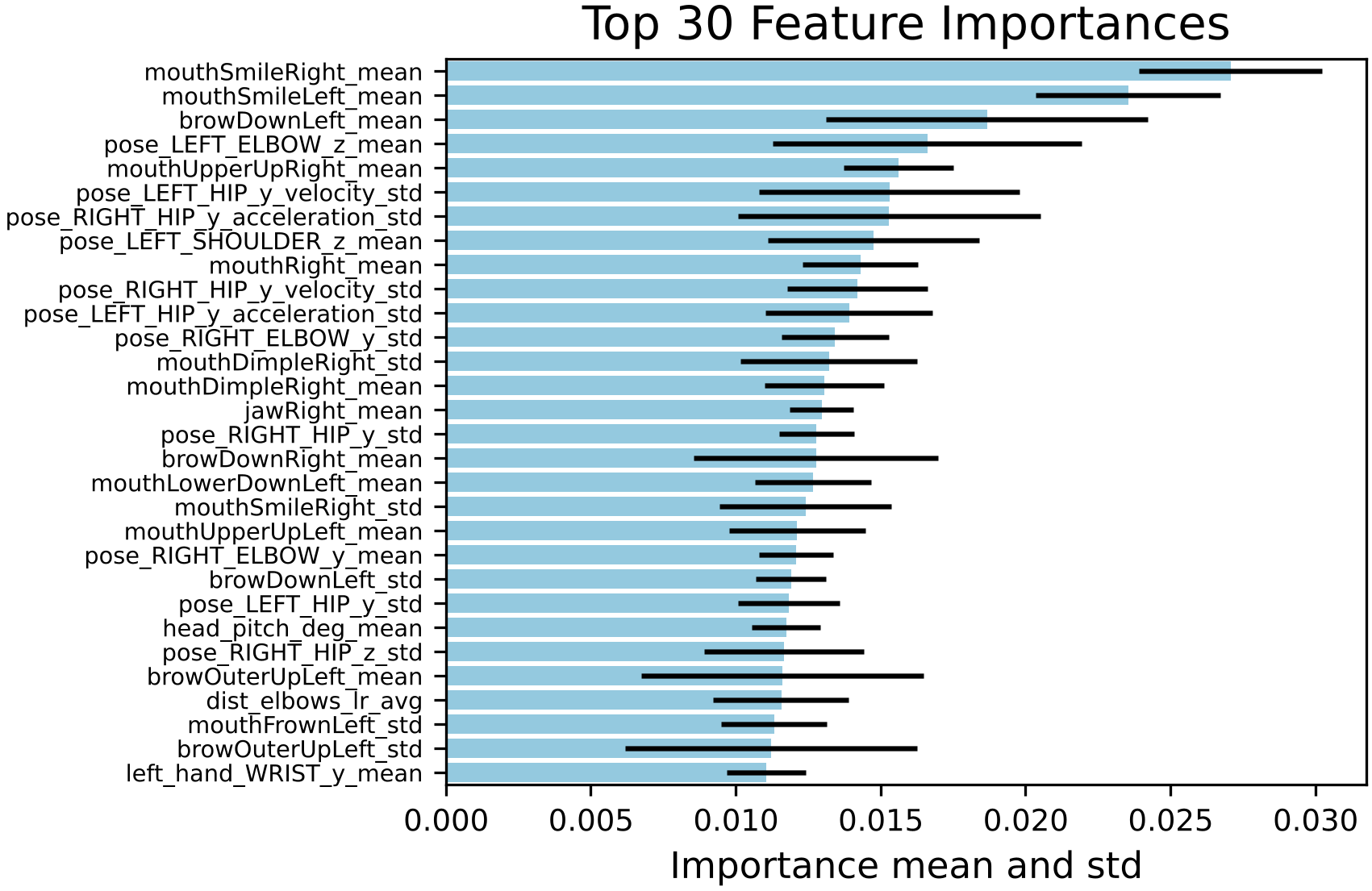 Figure: Analysis showing that while facial features (mouthSmile) are top, skeletal features (pose_LEFT_ELBOW, pose_LEFT_HIP) are equally critical.
Critical Analysis & Conclusion
While the 63.1% balanced accuracy is a solid baseline, it highlights the complexity of the task. Sentiment in SL is nuanced and often "absorbed" over long sequences.
Limitations: The model relies on frontal video and MediaPipe, which can struggle with fast motion blur during intense signing. Furthermore, the lack of native Deaf annotators for the video-side validation remains a barrier to "Gold Standard" status.
Future Outlook: This work moves us away from "black-box" neural networks toward Explainable AI (XAI) in linguistics. By proving that the body communicates as much as the face, it sets a new requirement for future SL avatars: they must use their whole bodies to "feel" what they are saying.