
[Theoretical Insight] The Geometry of Overparameterization: How Flat Manifolds Trivialized the ReLU Loss Landscape
Sharp description of local minima in the loss landscape of high-dimensional two-layer ReLU neural networks
This paper presents a sharp characterization of the population loss landscape for high-dimensional two-layer ReLU networks using a summary-statistics framework. By mapping local minima to discrete families of symmetry-breaking student configurations, the authors demonstrate how overparameterization triggers a topological phase transition from isolated spurious minima to connected flat manifolds.
Executive Summary
TL;DR: Researchers have finally provided a mathematically "sharp" description of why adding width to a neural network makes it easier to train. By reducing complex weight matrices to "summary statistics," this study shows that overparameterization triggers a phase transition: it melts away high-loss barriers, merging isolated traps into connected, flat manifolds that lead straight to the global minimum.
Academic Positioning: This work bridges the gap between the statistical physics of learning and optimization geometry. It moves beyond the local view of Hessian eigenvalues to provide a global topological map of the loss landscape in finite-width, high-dimensional ReLU networks.
The Motivation: Why Width Matters
Training a neural network is a non-convex optimization problem, yet in practice, "wide" networks almost always converge to a good solution. The central mystery has been: How does overparameterization actually change the landscape?
Previous works suggested that "spurious" local minima (traps) are common in narrow networks. While some theorists argued that these traps become saddles in infinite-width limits, we lacked a quantitative understanding of the transition in finite models. This paper explores the "Compensation Mechanism"—where aligned neurons adjust to offset the error of "anti-aligned" neurons—to explain how these traps are formed and eventually destroyed.
Methodology: Reducing Dimensions to Gain Clarity
The researchers used a Teacher-Student framework with Gaussian inputs. Instead of tracking thousands of individual weights, they tracked the Order Parameters—weight overlaps between student neurons and the teacher.
The Summary Statistic Representation
The population loss is expressed entirely through these overlaps ( and ). This allowed the authors to derive exact ODEs (Ordinary Differential Equations) that describe how the landscape behaves in the high-dimensional limit.
Key Visual: The Topological Shift
The most striking result is the difference between a "well-specified" network (where the student width matches the teacher) and an "overparameterized" one.
 A: In the well-specified case (Left), minima are isolated points. In the overparameterized case (Right), barriers dissolve into continuous manifolds.
Core Findings: Quantized Loss and Flat Manifolds
1. The Discrete Hierarchy of Traps
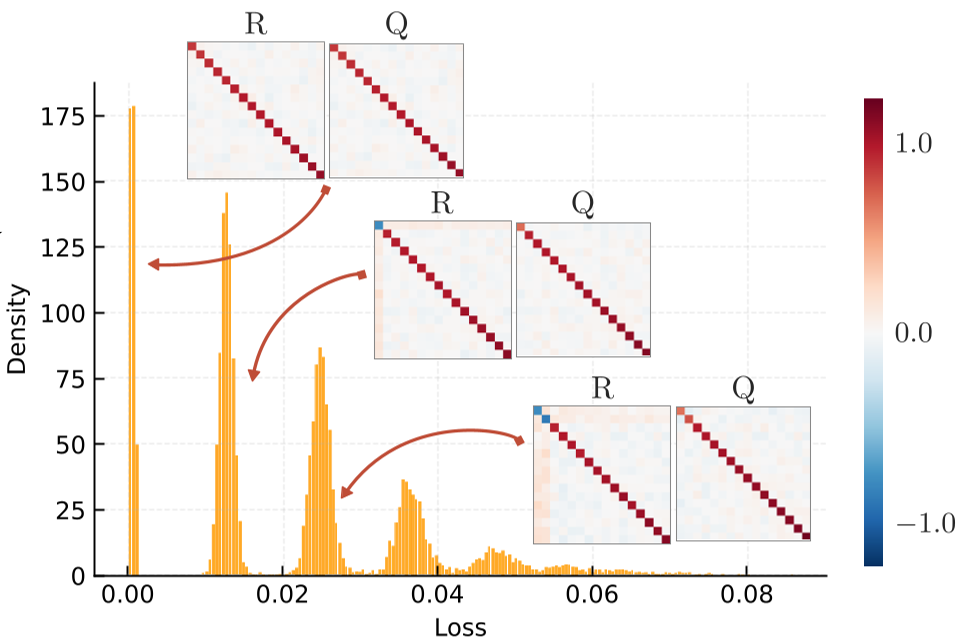
In narrow networks (), the loss doesn't settle anywhere; it concentrates in quantized bands. Each band corresponds to a specific number of "anti-aligned" neurons (). These are stable attractors that prevent the network from reaching zero error.
2. The String Method and Connectivity
Using the string method, the authors found the "Minimum Energy Path" between solutions. In narrow networks, moving from one minimum to another requires crossing a massive "mountain" of high loss.
However, when , something magical happens: the barrier vanishes. The purple line in the chart below shows a perfectly flat path between solutions, indicating that the landscape has developed "flat directions."
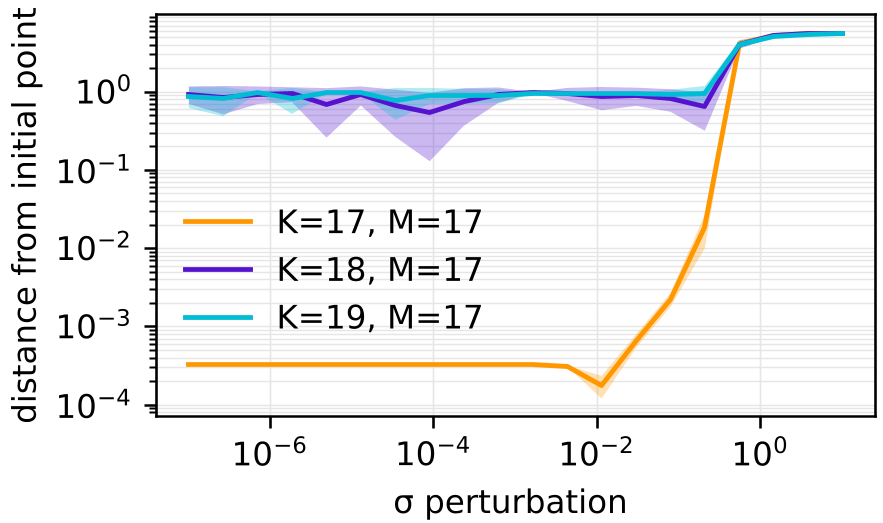 B: String method analysis showing that overparameterization (purple) creates barrier-free paths compared to the well-specified regime (orange).
3. Verification of Dynamical Benefit
The theory predicts that overparameterization makes these traps unstable. The experimental data confirms this: for , moving from to hidden units increased the global convergence rate from 13.09% to 99.63%.
Deep Insight: The "Compensation Mechanism"
The paper explains that local minima in ReLU networks are the product of a cooperative effect. When one neuron is wrong (anti-aligned), the others try to "compensate" for its error. In a narrow network, this creates a stable trap. In a wide network, the "extra" neurons provide enough degrees of freedom to break this symmetry, turning the stable trap into an unstable saddle point that the optimizer can easily bypass.
Critical Analysis & Conclusion
Takeaway: This work proves that the "magic" of deep learning is a topological one. Overparameterization doesn't just give the model more "capacity" to memorize; it fundamentally re-wires the geometry of the search space, replacing discrete obstacles with a "superhighway" of flat manifolds.
Limitations:
- The analysis assumes Gaussian inputs, which may not capture the complex manifold structure of real-world data (like images).
- It focuses on two-layer networks; the interaction of these flat manifolds in deeper architectures (many-layer) might lead to even more complex dynamics like "saddle-to-saddle" transitions.
Future Outlook: This framework provides a rigorous path toward understanding more complex architectures. If we can characterize these "summary statistics" for Transformers, we might finally explain why they are so robust to initialization and scale.