
[CVPR 2026] GeoSkill: Self-Evolving Skill-Graphs for Hallucination-Free Geolocation
Skill-Conditioned Visual Geolocation for Vision-Language
GeoSkill is a training-free, self-evolving framework for global visual geo-localization that utilizes an evolving Skill-Graph to guide Vision-Language Models (VLMs). It transitions from "one-off" implicit reasoning to a structured, iterative process, achieving SOTA performance on benchmarks like GeoRC (F1: 60.31) and EarthWhere.
TL;DR
GeoSkill introduces a paradigm shift in visual geo-localization by replacing static model weights with a dynamic, self-evolving Skill-Graph. By distilling human expert heuristics and autonomously refining them through a "reasoning rollout" feedback loop, the system achieves SOTA spatial accuracy and reasoning faithfulness without a single parameter update.
The Cognitive Gap: Why "Black Box" Pinpointing Fails
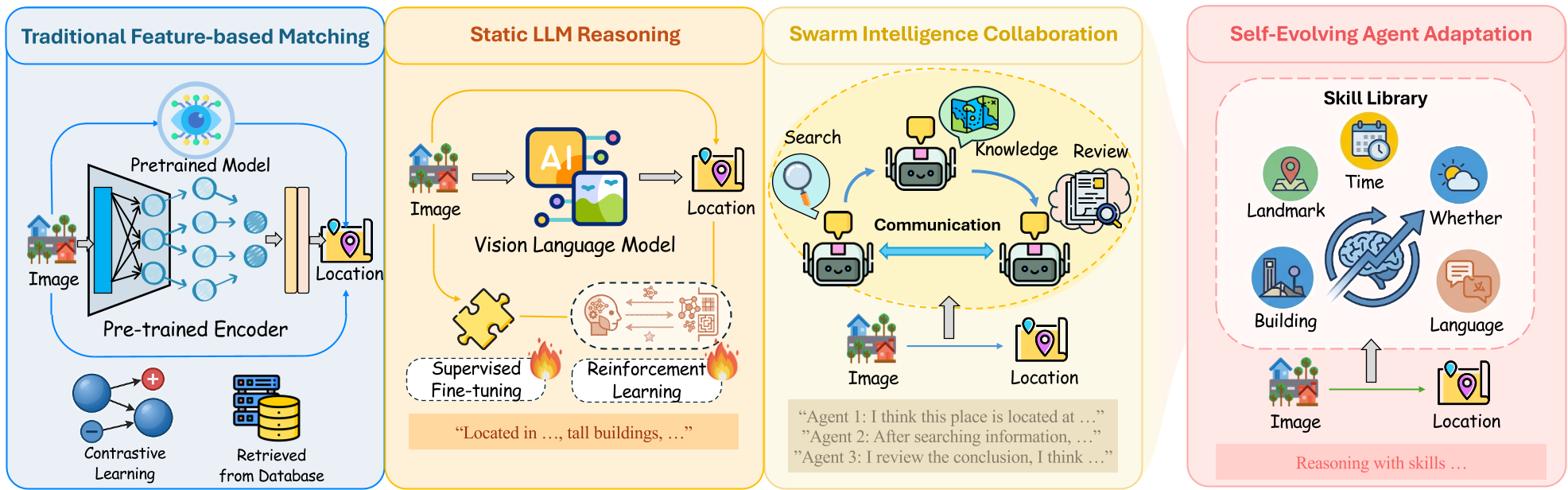
Visual geolocation—the task of identifying exact GPS coordinates from an image—is a nightmare for standard AI. Traditional Feature-based methods (Paradigm 1) treat it as a retrieval task, while VLM-based reasoning (Paradigm 2) often hallucinates. Even Agentic agents (Paradigm 3) are "one-off" learners; they don't get smarter after a mistake.
The fundamental issue? Implicit Parametric Memory. When a model "guesses" a location because its weights say so, it can't explain why. If it's wrong, it stays wrong.
GeoSkill: From Static Weights to Evolving Logic
GeoSkill proposes a fourth paradigm: Skill-Conditioned Evolution. It treats geographic knowledge not as frozen neurons, but as a library of Atomic Skills (e.g., "Recognizing Catalan signage indicates a high probability of Andorra or Catalonia").
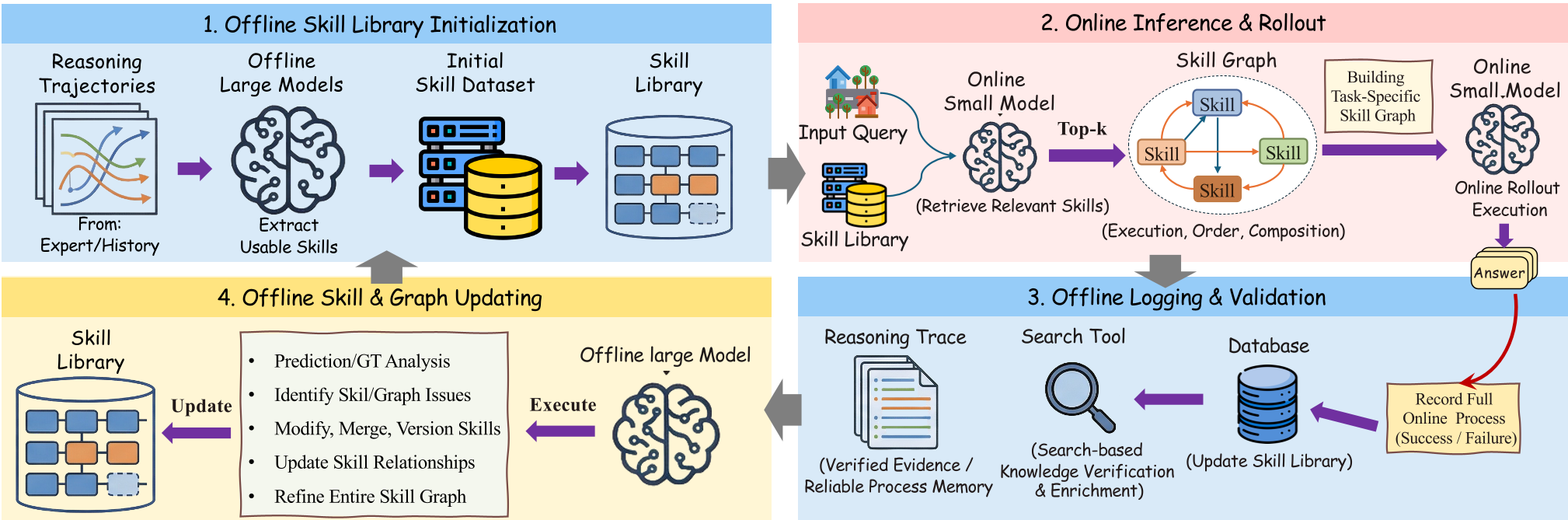
1. Expert-to-Skill Initialization
The system avoids "hallucination-on-hallucination" by starting with the best: human experts. By parsing the reasoning traces of GeoGuessr World Champions, the authors built an initial library of 1,080 foundational skills.
2. Autonomous Evolution (The Training-Free "RL")
The breakthrough lies in the feedback loop. Instead of traditional Reinforcement Learning (RL) which updates weights, GeoSkill uses Autonomous Evolution:
- Synthesis: When the model fails a location, a larger "teacher" model (GPT-5.2) analyzes the failure and synthesizes a new corrective skill.
- Merging & Pruning: Redundant skills are fused, and "hallucination-prone" logic that consistently leads to errors is deleted from the graph.
Methodology: The Skill-Graph in Action
During inference, the model doesn't just guess. It:
- Parses the Scene: Extracts JSON-style evidence (e.g., "Utility pole type: A-frame").
- Retrieves & Composes: Fetches relevant skills and builds a task-specific DAG (Directed Acyclic Graph).
- Reasoning Rollout: Executes a coarse-to-fine deduction path.
Experimental Prowess
The results on the GeoRC (Reasoning Chains) benchmark are telling. While models like GAEA might guess right, their logic is often flawed.
| Metric | GAEA (Fine-tuned) | GeoSkill (Ours) |
|---|---|---|
| 10km Accuracy | 0.115 | 0.141 |
| Reasoning F1 | 49.27 | 60.31 |
GeoSkill's F1 score—a measure of "right answer for the right reason"—is significantly higher, proving it is not just memorizing, but actually reasoning.
Ablation Insight: The Structure Matters
Shuffling the order of skills or using atomic skills without the graph structure drops performance significantly. Geolocation is inherently hierarchical—you find the continent, then the country, then the street. GeoSkill’s Skill-Graph enforces this logical flow.
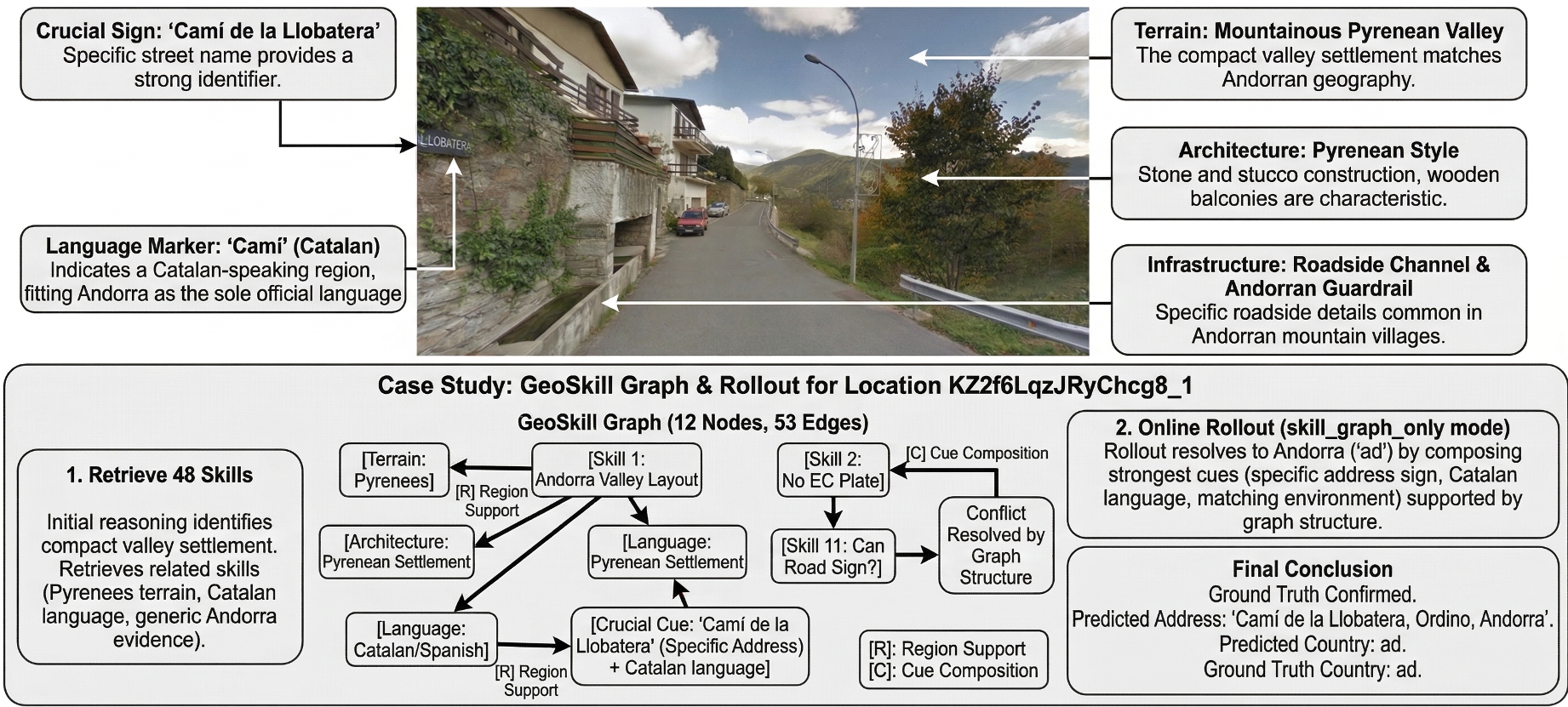
Case Study: Solving the "Andorra" Puzzle
In a representative test, the model parsed a "Camí" street sign (Catalan) and Pyrenean stone architecture. While some retrievals suggested Canada or Greece (semantic noise), the Consensus Mechanism within the Skill-Graph pruned the outliers and pinpointed the "Camí de la Llobatera" in Andorra with surgical precision.
Future Outlook: Symbolic Intelligence
GeoSkill proves that 2026-era AI agents don't always need bigger datasets or more compute hours—they need better external cognitive structures. By separating "Skills" from "Inference," we get a system that is transparent, auditable, and capable of learning from its own mistakes in real-time.
Senior Editor's Note: This work is a strong signal that the industry is moving toward "Symbolic RL." For practitioners, the takeaway is clear: If your VLM is hallucinating, stop fine-tuning your weights and start structuring your skills.