
Beyond Classical Ramsey: Solving Ordered and Cyclic Ramsey Numbers via SAT and RL
Some results on small ordered and cyclic Ramsey numbers
This paper investigates the calculation of small two-color ordered Ramsey numbers and introduces cyclic Ramsey numbers as a relaxation of the ordered case. Using the Kissat SAT solver, the authors determine new exact values and bounds for various graph classes, including monotone paths, cycles, alternating paths, and nested matchings, achieving state-of-the-art results for small orders.
Executive Summary
TL;DR: This paper tackles the "small-scale" frontier of Ramsey Theory. By combining advanced SAT solvers (Kissat) with Reinforcement Learning (RLGT), the authors calculate new exact values and bounds for Ordered Ramsey Numbers and introduce a fresh concept: Cyclic Ramsey Numbers. They show that while classical Ramsey theory is hard, adding "order" to the vertices creates a rich structural playground where SAT solvers currently reign supreme.
Positioning: This work is both a computational contribution (filling in the blanks of small Ramsey tables) and a theoretical framework-building paper (unifying Ramsey variants under a group-theoretic lens).
The Problem: When Order Matters
Classical Ramsey theory asks for the minimum group size such that any 2-coloring of the edges of contains a monochromatic subgraph . Ordered Ramsey Theory adds a constraint: the vertices of must appear in a specific total order. This simple restriction changes everything—path Ramsey numbers, which grow linearly in the classical case, can grow exponentially in the ordered case.
Existing research has struggled with:
- Search Space: Even for small , the number of possible colorings () is astronomical.
- Lack of Exacts: Most work is asymptotic, leaving "small" values (important for identifying patterns) largely unknown.
Methodology: Logic Meets Learning
1. Reduction to SAT (The Heavy Lifter)
The core insight is that Ramsey problems are essentially constraint satisfaction problems. For a graph of order , the authors define a Boolean variable for each edge.
- Monochromatic H1 (Color 1) avoidance:
- Monochromatic H2 (Color 2) avoidance:
By feeding these into Kissat, the solver either finds a coloring (proving a lower bound) or proves no such coloring exists (establishing an upper bound).
2. Reinforcement Learning (The Heuristic Searcher)
The authors use the RLGT (Reinforcement Learning for Graph Theory) framework. A deep cross-entropy agent acts as a "builder," placing one edge color at a time. The reward function is the negative count of forbidden monochromatic subgraphs.
 Table 1: Ordered Ramsey numbers for alternating paths, showcasing the precision achieved.
New Frontiers: Cyclic and Permutational Ramsey Numbers
The paper introduces Cyclic Ramsey Numbers , where the vertex order is preserved only up to a cyclic shift. This serves as a natural middle ground between the "rigid" ordered case and the "loose" classical case.
Mathematically, they show:
To unify these, they propose Permutational Ramsey Numbers , where is a subgroup of the symmetric group.
- Ordered: is trivial (identity only).
- Cyclic: is the cyclic group generated by a single shift.
- Classical: is the full symmetric group .
Key Experimental Results
Path and Cycle Patterns
The authors identified a striking structure in Nested Matchings (), proving that for even :
SAT vs. RL
One of the most interesting meta-results is the performance comparison. While RL (Deep Cross-Entropy) is exciting and finds valid lower bounds (e.g., for ), the SAT solver is more robust. SAT solvers can provide proof of non-existence (upper bounds), whereas RL can only provide "best effort" lower bounds.
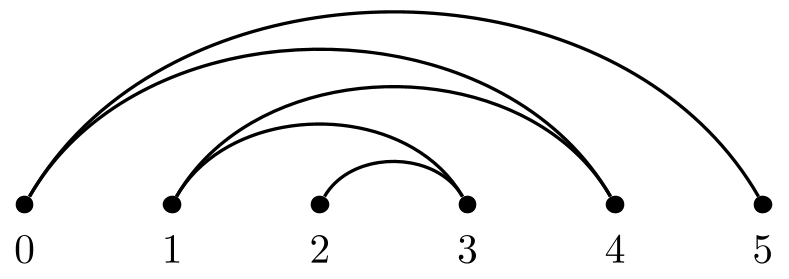 Visualizing specific ordered paths like the reverse alternating path .
Conclusion and Future Outlook
Takeaways:
- Cyclic Ramsey Numbers provide a new spectrum of problems for combinatorialists.
- SAT Solvers remain the "gold standard" for small-scale extremal graph theory, though RL shows promise for larger, less constrained searches.
- A plethora of Conjectures (4.7 through 4.36) are provided, offering a roadmap for future researchers to prove general formulas for these newly calculated values.
Limitations: The cyclic SAT instances are significantly more complex (more clauses) than ordered ones, making upper bounds for harder to verify as grows.
Future Work: Investigating the asymptotic behavior of Cyclic Ramsey numbers—do they scale like Ordered or Classical Ramsey numbers?