
SDVG: Breaking the Efficiency Bottleneck in Autoregressive Video Generation
Speculative Decoding for Autoregressive Video Generation
SDVG (Speculative Decoding for Autoregressive Video Generation) is a training-free framework designed to accelerate autoregressive video diffusion models. By pairing a 1.3B drafter with a 14B target model and using an ImageReward-based router, it achieves a 1.59× speedup while retaining 98.1% of the target-only visual quality on benchmarks like MovieGenVideoBench.
TL;DR
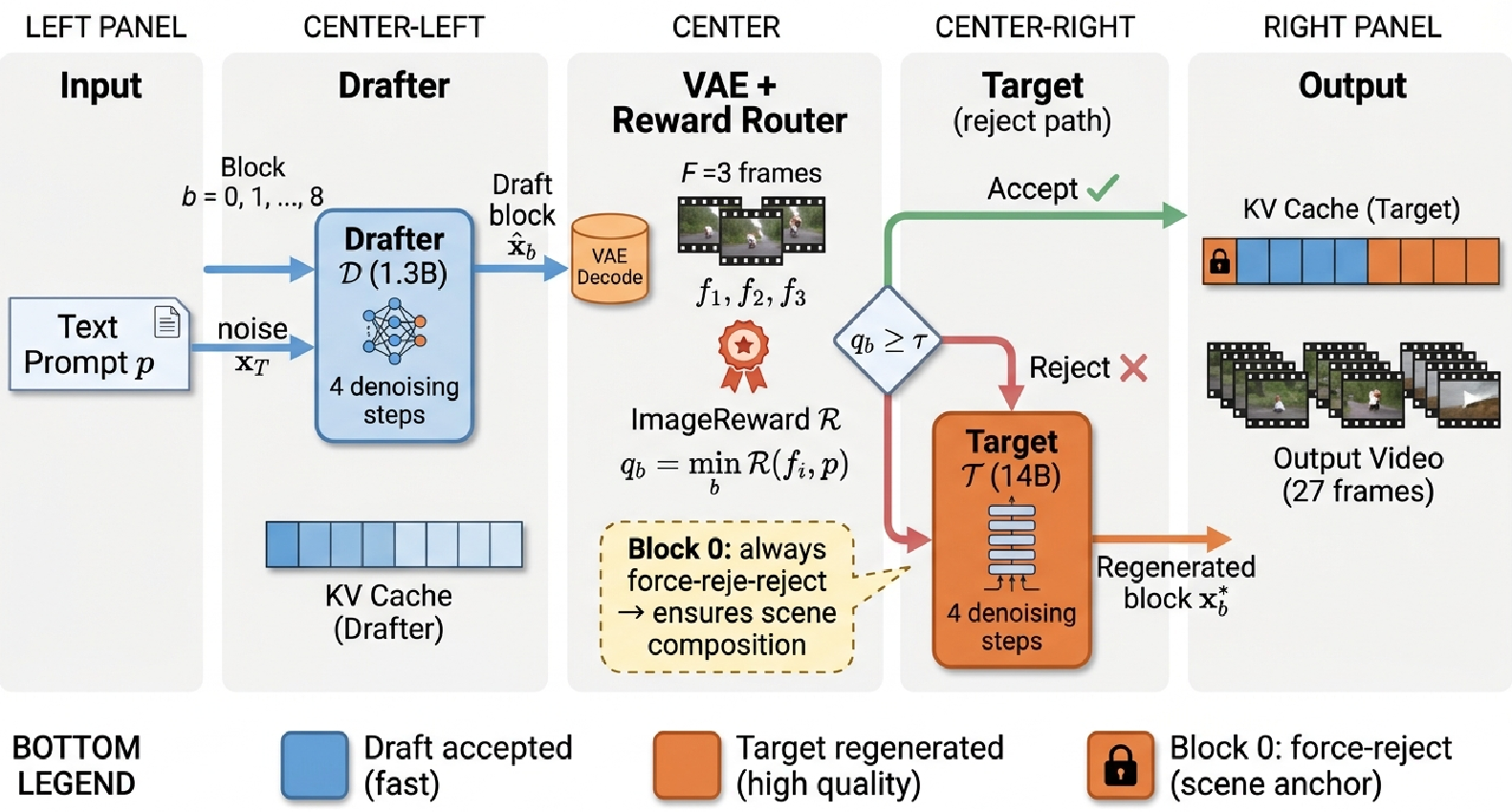
Autoregressive video generation—generating video block-by-block—is the new frontier for streaming synthesis, but it is notoriously slow. SDVG (Speculative Decoding for Video Generation) adapts the successful "speculative decoding" concept from LLMs to the video domain. By using a small 1.3B "drafter" to propose video blocks and a 14B "target" to verify/refine them via an image-quality router, SDVG slashes inference time by nearly 40% (1.59x speedup) with virtually no loss in perceptual quality.
The Problem: From Tokens to Tensors
In the world of Large Language Models (LLMs), speculative decoding is straightforward: a small model predicts a token, and the large model checks if that token's probability matches its own distribution.
Video is different. A video block is a continuous, high-dimensional spatiotemporal tensor. There are no "logits" or "tokens" to compare. Consequently, we cannot use exact rejection sampling. Previous attempts to speed up diffusion models (like T-Stitch) often relied on fixed step-level splits, which are "blind" to the content—they can't detect if the small model produced a garbled mess.
Methodology: Reward-Guided Routing
The core insight of SDVG is replacing probability-based verification with reward-model-based routing.
1. The Pipeline
For every new video block:
- The Drafter (1.3B) generates a candidate block in 4 denoising steps.
- The Router (ImageReward) evaluates the candidate.
- If the quality score is above a threshold , the block is accepted.
- If not, the Target (14B) takes over and regenerates the block.
2. Three Critical Design Choices
The authors identified three nuances that make or break speculative video decoding:
- Worst-Frame Aggregation: Instead of averaging scores across frames, SDVG takes the minimum score of any frame in the block. Why? Because a single flickering or distorted frame ruins a video, even if the other frames are perfect.
- Force-Reject Block 0: The first block of a video determines the entire scene's layout and style. SDVG always uses the large Target model for the first block to ensure a high-quality "anchor."
- Threshold as a Pareto Knob: The threshold acts as a single control for the user to trade speed for quality.
Experiments & Results: The Pareto Frontier
The authors tested SDVG on the MovieGenVideoBench (1003 prompts). The results show a clear win for the "Speculative" approach over "Draft-only" or "Fixed-split" baselines.
| Metric | Target-only | SDVG (τ=-0.7) | Draft-only |
|---|---|---|---|
| VisionReward (Quality) | 0.0788 | 0.0773 (98.1%) | 0.0644 |
| Time per Video (s) | 97.0 | 60.9 | 25.7 |
| Speedup | 1.00x | 1.59x | 3.77x |
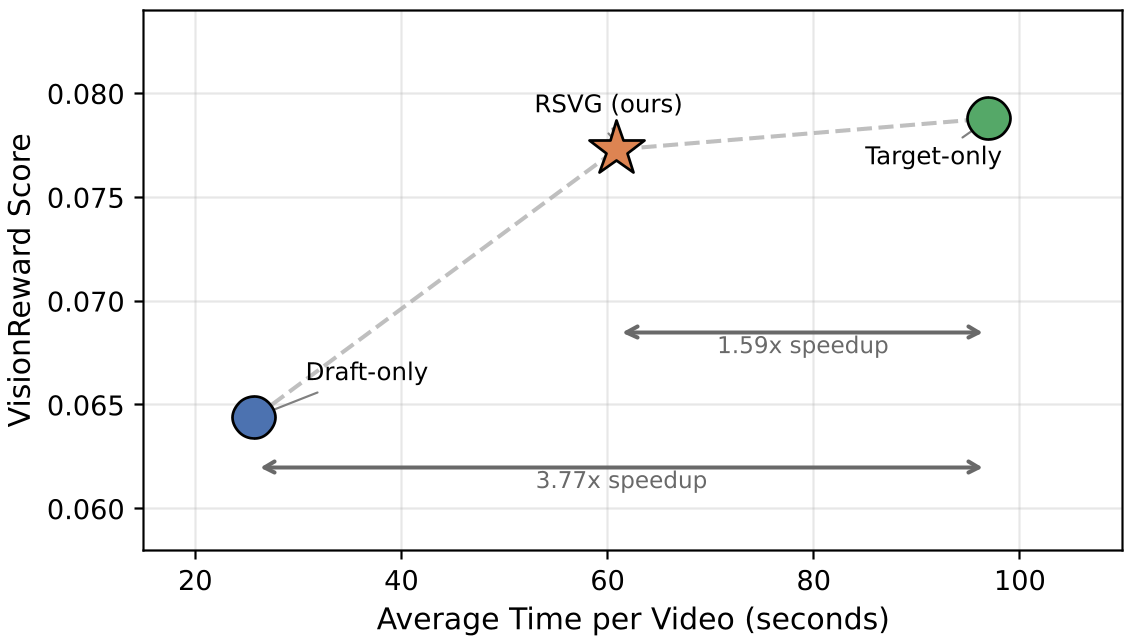
As shown in the graph, SDVG occupies the "sweet spot" on the curve, providing significant speed gains while hovering just below the maximum possible quality.
Deep Insight: Why This Matters
SDVG shifts the conversation from "how to make models smaller" to "how to use compute more wisely."
In many video sequences, there are frames with simple motion or static backgrounds where the 1.3B model is "good enough." SDVG identifies these moments in real-time. By only invoking the 14B "heavy lifter" when the draft quality dips, it treats inference as an adaptive process.
Limitations & Future Work:
Currently, SDVG uses ImageReward, which evaluates frames independently. It doesn't "see" motion jitter. A future shift toward Video Reward Models (VRMs) could make the routing even more precise. Additionally, the computation used by the drafter is "wasted" if the target rejects the block—fixing this through parallel execution or batching is an obvious next step for engineering.
Conclusion
SDVG is a plug-and-play, training-free framework that effectively brings speculative decoding to the video era. It proves that we don't need complex mathematical proofs of "exact distribution matching" to build faster, high-quality generative systems. Sometimes, a high-quality "judge" (the router) is all you need to let a small model run fast.