
StepPO: Aligning RL Optimization with the Pulse of Agentic Interaction
StepPO: Step-Aligned Policy Optimization for Agentic Reinforcement Learning
This paper introduces StepPO, a reinforcement learning framework that shifts the optimization of LLM agents from token-level to step-aligned sequences. By redefining the Markov Decision Process (MDP) and credit assignment at the interaction-step level, it achieves superior performance in multi-turn agentic tasks, specifically outperforming standard token-level PPO on HotpotQA.
TL;DR
Current LLM training (RLHF/PPO) focuses too much on individual tokens. StepPO argues that for agents, the fundamental unit of action isn't a token, but a Step (one complete round of thought, tool use, and environment feedback). By aligning the MDP, credit assignment, and training systems to the step level, StepPO avoids noisy gradients and "retokenization drift," leading to more capable and stable AI agents.
The Cognitive Mismatch: Tokens vs. Decisions
In the world of standard Large Language Models (LLMs), we treat everything as a sequence of tokens. While this works for writing an essay, it falls apart when an agent is trying to solve a complex coding problem or navigate a database.
The Pain Point: Current RL methods (like PPO or GRPO) often suffer from a granularity mismatch. If an agent calls a search tool correctly but the final answer is buried 500 tokens later, a token-level optimizer struggles to "reward" the specific decision to call that tool. Furthermore, most systems suffer from Retokenization Drift: they save interactions as text, but when they re-tokenize them for training, the token boundaries shift, breaking the math of the policy gradient.
The Core Insight: The Step-Level MDP
StepPO proposes a paradigm shift: move from a Token-level MDP to a Step-level MDP.
In this view:
- State (): The prompt and environment observation provided at the start of a turn.
- Action (): The entire response generated by the model (thought + tool call/result).
- Transition: The environment's response to that specific action.
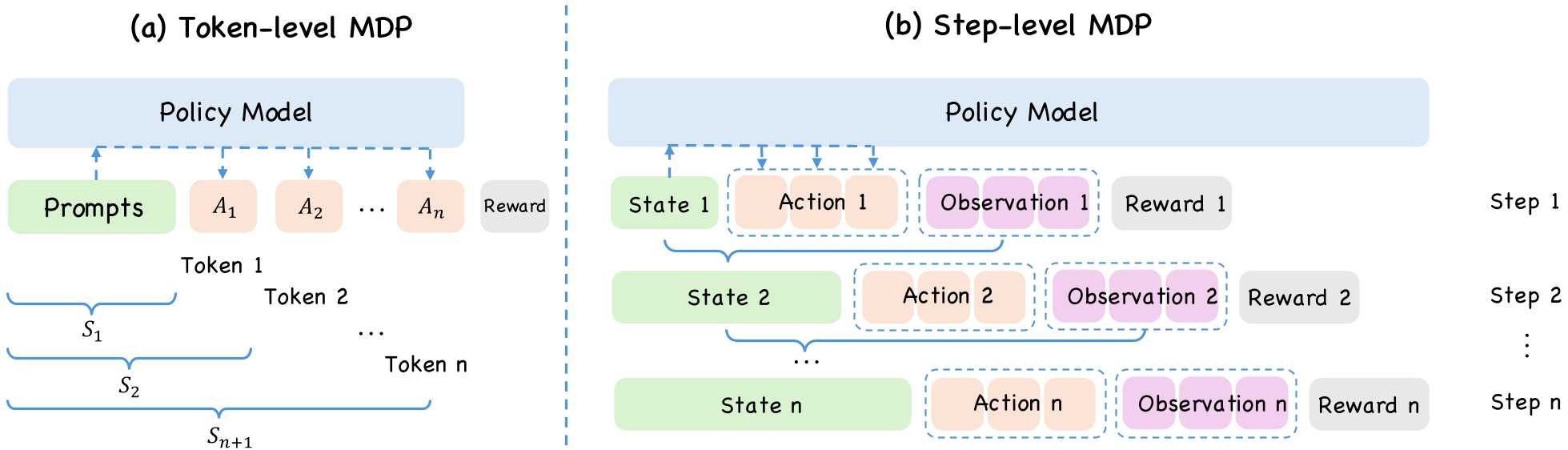
By modeling the process this way, the "Credit" (the reward) is assigned to the Decision rather than being diluted across thousands of surface-level tokens.
Methodology: Step-Aligned Credit Assignment
The technical "secret sauce" of StepPO is Step-level Generalized Advantage Estimation (GAE). In traditional PPO, advantages are calculated per token. In StepPO, the importance ratio () is computed for the entire step's token sequence, and the reward propagation () measures whether that specific interaction step improved the trajectory's future.
Formalizing the Objective
The actor objective is rewritten as a clipped surrogate over these steps:
This ensures that the model learns the "Strategy" (e.g., "I should search now") rather than just the "Syntax" (e.g., "The next token should be 'the'").
Systems Architecture: From Agent-R1 to Claw-R1
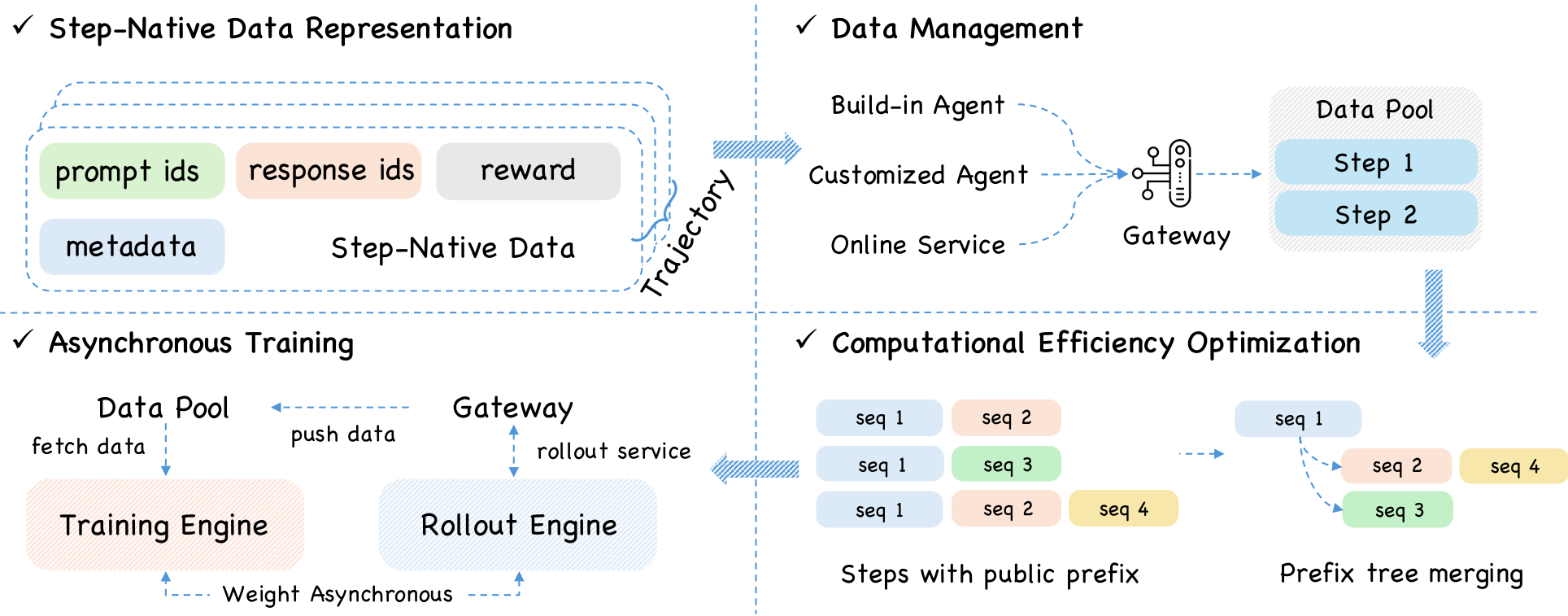
Implementing this requires more than just a new loss function; it requires a new data infrastructure. The authors highlight two key systems:
- Agent-R1: Focuses on training consistency, ensuring that what the model sees during the "Rollout" matches exactly what it sees during "Training" (No drift!).
- Claw-R1: A gateway and datapool system that allows heterogeneous agents (different models, different environments) to feed data into a centralized RL training loop.
Experimental Proof: HotpotQA
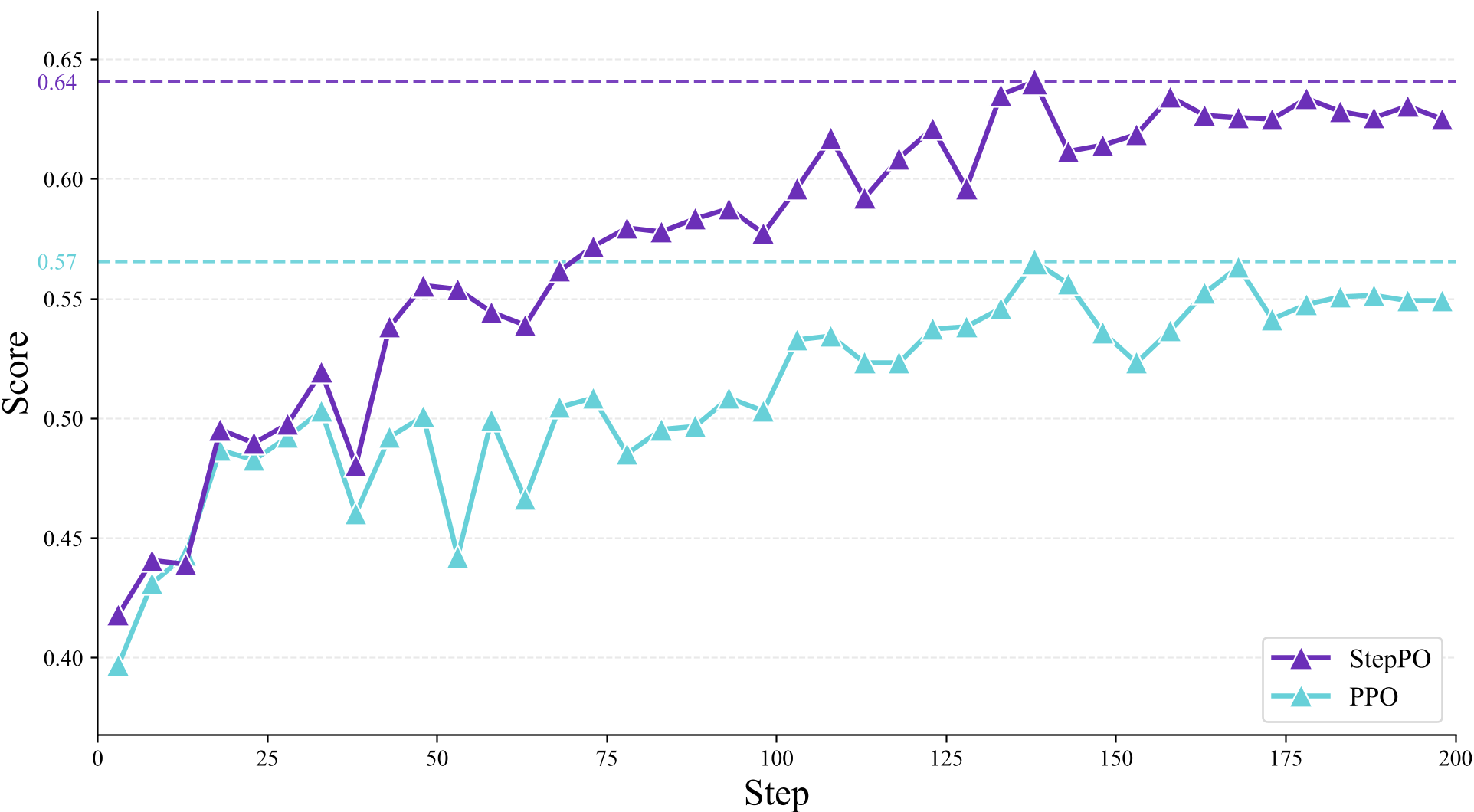
To prove the theory, the researchers tested StepPO against standard PPO on HotpotQA, a multi-hop reasoning task that requires agents to gather evidence over several steps.
The Result: StepPO didn't just win; it was more stable. The training curve shows StepPO maintaining a higher accuracy plateau compared to the noisy, less efficient token-level baseline.
Critical Analysis & Conclusion
Takeaway: StepPO provides the proper "lens" for Agentic RL. By treating interactions as atomic units, it aligns RL with the reality of how agents actually operate in the world.
Limitations:
- Off-policy Drift: Asynchronous training can lead to data staleness (training on a policy that is too old).
- Heterogeneity: Managing rewards from diverse environments remains a challenge for the gateway system.
Future Work: This research paves the way for "Self-Evolving Agents" that can refine their decision-making logic through interaction without the need for dense, token-by-token human labeling. The shift to step-level optimization is likely the "North Star" for the next generation of agentic foundations like Claude Code or OpenClaw.