
[CVPR 2024] SFGS: Beyond the Body – Achieving Expressive Hand and Face Details in 3D Gaussian Avatars
Structure-Aware Fine-Grained Gaussian Splatting for Expressive Avatar Reconstruction
The paper introduces Structure-aware Fine-grained Gaussian Splatting (SFGS), a novel framework for reconstructing expressive 3D human avatars from monocular videos. By integrating SMPL-X/MANO priors with a hybrid Triplane-Hexplane representation, it achieves SOTA results in rendering high-fidelity facial expressions and hand movements.
TL;DR
Reconstructing a digital human that can both move naturally and express subtle emotions has been the "holy grail" of monocular 3D vision. SFGS (Structure-aware Fine-grained Gaussian Splatting) breaks new ground by moving beyond coarse body tracking. By leveraging skeletal joint priors and a hybrid Triplane-Hexplane architecture, it captures the intricate "wobble" of clothing, the dexterity of fingers, and the nuance of facial expressions—all while rendering at a silky-smooth 30 FPS.
The "Coarseness" Problem: Why Current Avatars Look Stiff
Most existing human reconstruction pipelines (like HUGS or Video2Avatar) rely on the SMPL model. While great for general body shape, SMPL's hand and face representation is notoriously "low-poly." When these are used as seeds for 3D Gaussian Splatting, the resulting avatar often suffers from:
- Hand Meltdown: Fingers often blur together or disappear during fast movements.
- Temporal Jitter: Faces "flicker" because the model treats each frame as a semi-independent reconstruction effort.
- Structural Disconnect: The Gaussians don't "know" they belong to a specific joint, leading to artifacts when the arm bends or the wrist rotates.
Methodology: The SFGS Secret Sauce
The authors solve these issues through three key architectural shifts:
1. Hybrid Coherent Mesh Representation
Instead of relying purely on spatial features, SFGS uses a Hexplane (capturing XY, XZ, XT, YZ, YT, ZT) alongside a standard Triplane. By sampling features across both space and time, the model "remembers" where a point was in the previous frame, drastically reducing temporal flickering.
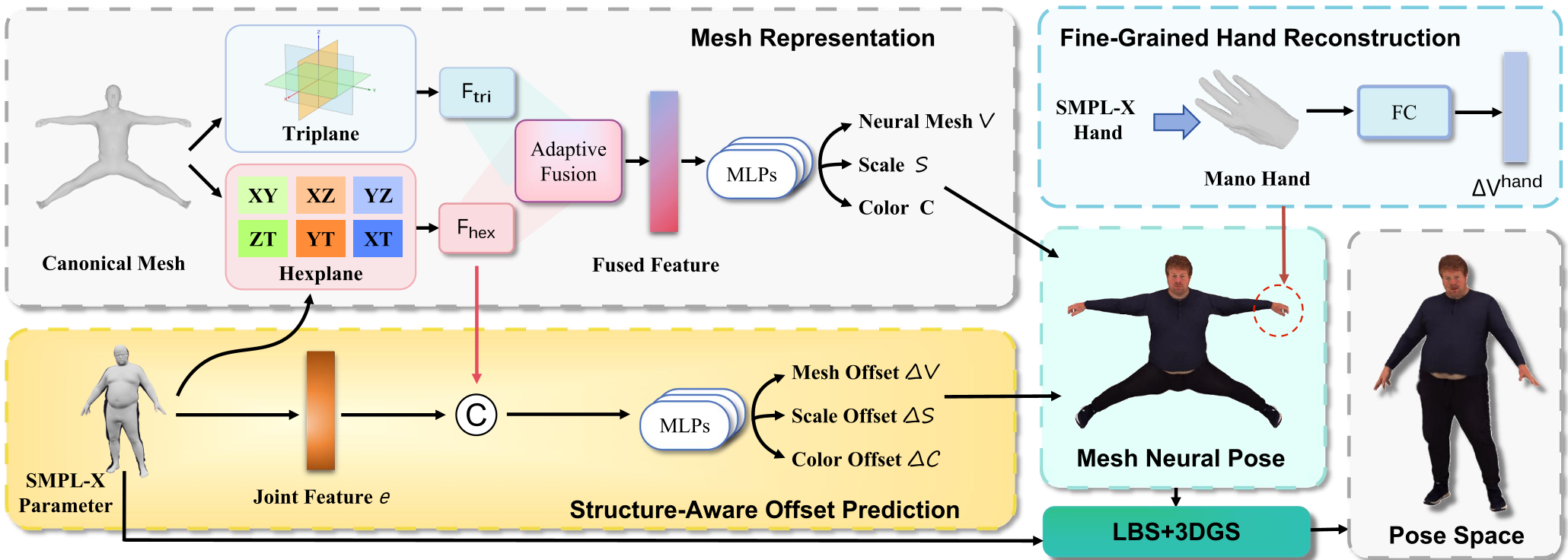 Figure 1: The SFGS Framework. Notice how the SMPL-X mesh is enhanced by dual-plane features and joint-aware offsets before being rendered.
2. Structure-Aware Offset Prediction
The most "academic" insight here is the Joint-Aware Feature. For every Gaussian point, the model identifies the most influential skeletal joint. It then concatenates the point's feature with the joint's 6D rotation and 3D position. This forces the Gaussian's deformation and color to be structurally consistent with the underlying anatomy.
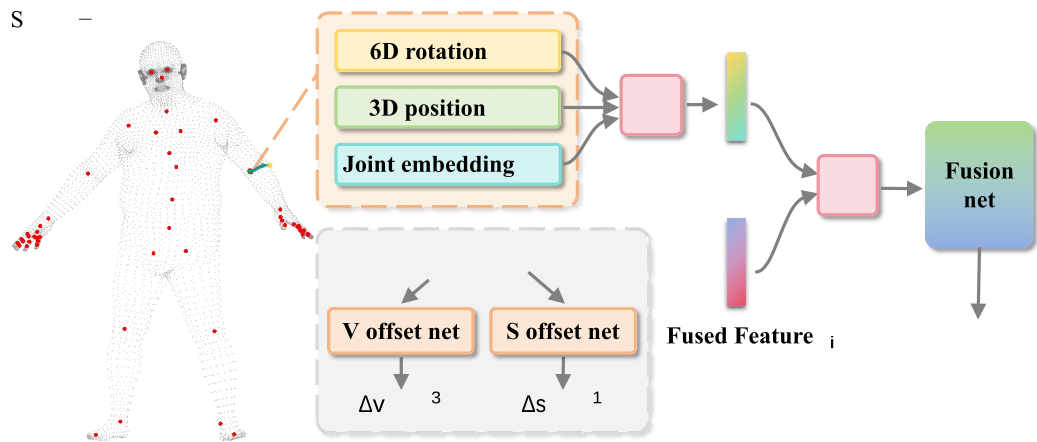 Figure 2: By assigning each Gaussian a "parent joint," the model learns pose-dependent movements (like muscle bulging) much more effectively.
3. Fine-Grained Hand Residuals
The authors realized that SMPL-X hands are still not detailed enough. They use the MANO model—a specialized hand-only parametric model—to calculate "geometric residuals." By training an MLP to refine these residuals based on current hand pose, they bridge the gap between a generic mesh and a person's specific hand geometry.
Experimental Performance: SOTA Results
SFGS was tested on the NeuMan and X-Humans datasets.
- Quantitative: It achieves a PSNR of 35.34 on NeuMan, a significant jump over the previous best (ExAvatar at 34.80).
- Qualitative: As seen in the visualizations, SFGS handles "extreme" cases—like a person on a bicycle or performing complex gestures—without the typical "smearing" of hands.
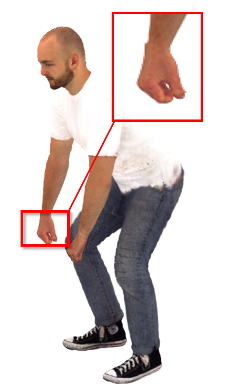 Figure 3: Qualitative comparison on X-Humans. SFGS (middle) preserves hand silhouettes and shadows far better than the previous SOTA (right).
Critical Insight & Future Outlook
The brilliance of SFGS lies in its simplicity. Unlike previous methods that required complex, multi-stage training or manual part segmentation, SFGS achieves fine-grained detail through joint-conditioning.
Limitations: The model still struggles with extremely baggy clothing (like a flowing cloak), where the Gaussian density isn't high enough to cover the "void" between the body and the fabric.
Takeaway: If you are building VR/AR telepresence systems, the SFGS approach suggests that the path to realism is not just "more Gaussians," but smarter Gaussians that understand the skeleton they are attached to.
Conclusion
SFGS represents a significant step towards truly expressive digital twins. By combining the rendering speed of 3DGS with the structural intelligence of parametric human models, it sets a new standard for what can be achieved from a simple monocular video.