
Molecular Property Prediction: Breaking the Fine-Tuning Bottleneck with Tabular Foundation Models
Tabular foundation models for in-context prediction of molecular properties
The paper introduces a novel paradigm for molecular property prediction by combining Tabular Foundation Models (TFMs like TabPFN and TabICL) with frozen molecular representations. This training-free, in-context learning approach achieves state-of-the-art results on Polaris and MoleculeACE benchmarks, outperforming task-specific fine-tuned models.
TL;DR
Predicting molecular properties usually requires specialized deep learning expertise and expensive "fine-tuning." This paper flips the script: by using Tabular Foundation Models (TFMs) like TabPFN in an in-context learning mode, researchers achieved SOTA performance on pharmaceutical and engineering datasets—without any task-specific training—while running up to 46x faster than traditional methods.
Background: The Problem with Tiny Data
In the world of drug discovery and chemical engineering, "Big Data" is a myth. Most datasets consist of hundreds, not millions, of samples because experiments are expensive. Molecular Foundation Models (MFMs) were supposed to solve this via pretraining, but they have a "fine-tuning tax":
- Overfitting: Small datasets cause large models to "memorize" noise.
- Complexity: Fine-tuning requires GPU clusters and hyperparameter tuning.
- Fragility: MFMs often lose to simple Random Forests in low-data regimes.
The Insight: Amortized Inference via TFMs
The authors propose a "two-step" workflow:
- Step 1: Use a frozen molecular encoder (like CheMeleon) to turn a molecule into a fixed vector (embedding).
- Step 2: Feed that vector into a Tabular Foundation Model (TFM).
The TFM doesn't "learn" the task by updating weights. Instead, it uses In-Context Learning (ICL): it looks at the provided training examples as part of the input and uses a Transformer's attention mechanism to "interpolate" the answer for a new molecule.
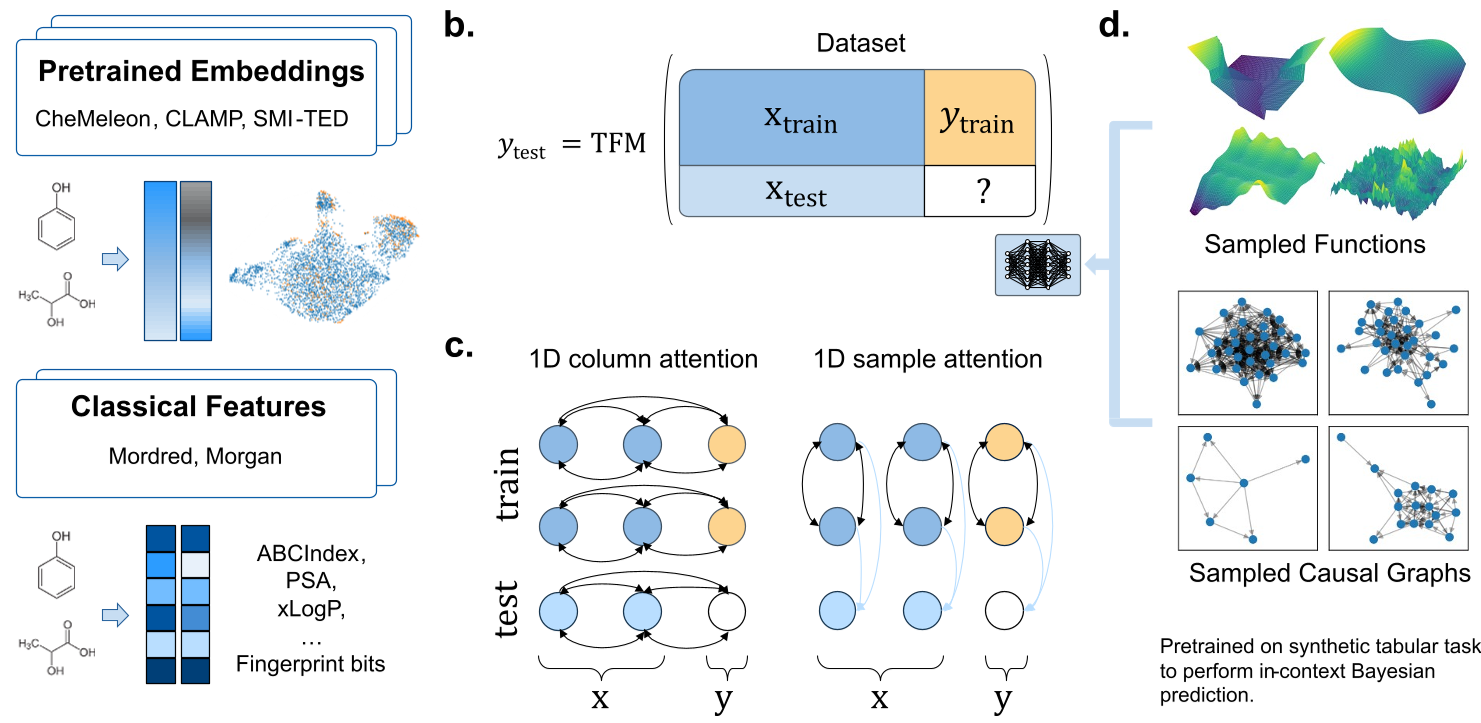 Figure 1: The proposed pipeline—featurizing molecules and passing them to TFMs for zero-training prediction.
Methodology: The Power of Context
TFMs are pretrained on millions of synthetic tabular datasets. They learn the "spirit" of how data relates to labels. By treating molecular descriptors (like RDKit2d or Mordred) as simple table columns, the TFM applies its general-purpose reasoning to chemistry.
The study evaluated 12 different featurizer-model configurations. A key finding: Representation matters. Unlike previous claims that TFMs are representation-agnostic, this study shows that pairing TFMs with expressive foundation model embeddings (CheMeleon) or rich descriptors (Mordred) is essential for top-tier accuracy.
Results: SOTA without Training
The results on the MoleculeACE and Polaris benchmarks were striking:
- Win Rates: TabPFN-CheMeleonFP achieved a 100% win rate on MoleculeACE tasks, meaning it was the best or statistically tied with the best on every single challenge.
- Efficiency: Because there is no backpropagation, the model is incredibly fast. Runtimes saw speedups of 27x on CPU and 46x on GPU.
- Engineering Transfer: The method wasn't just good at "drug" data; it matched or beat highly-tuned, domain-specific models for fuel ignition and polymer properties.
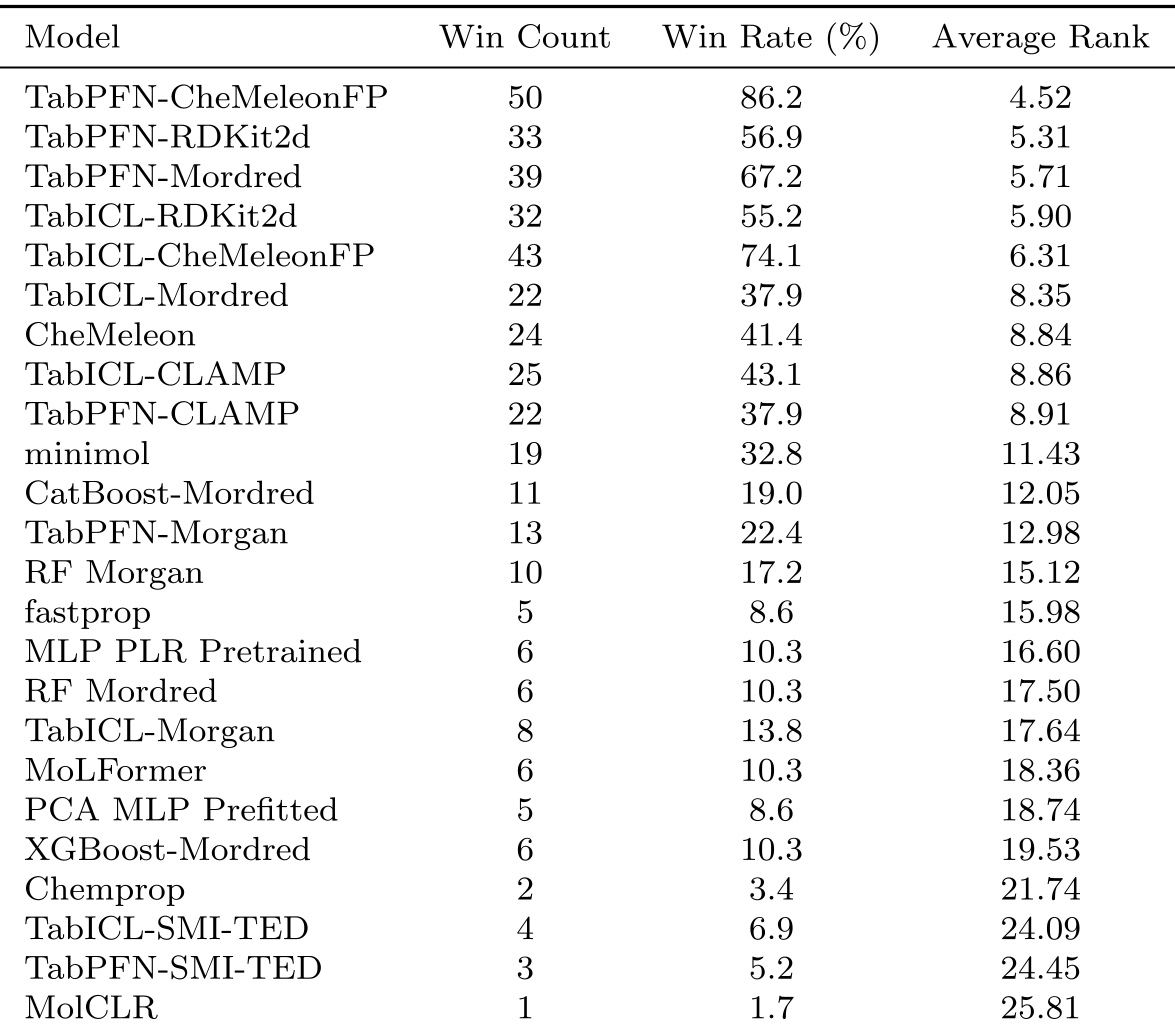 Table 1: Benchmark performance showing TabPFN variants dominating traditional baselines and fine-tuned MFMs.
Critical Analysis: The Pareto Front of Speed vs. Accuracy
The "Pareto Plot" below highlights the true value proposition. Most models choose between being fast (XGBoost) or accurate (Fine-tuned MFMs). TabPFN-based models occupy the ideal top-left corner: highest accuracy reduction in error (RMSE gap) at the lowest computational cost.
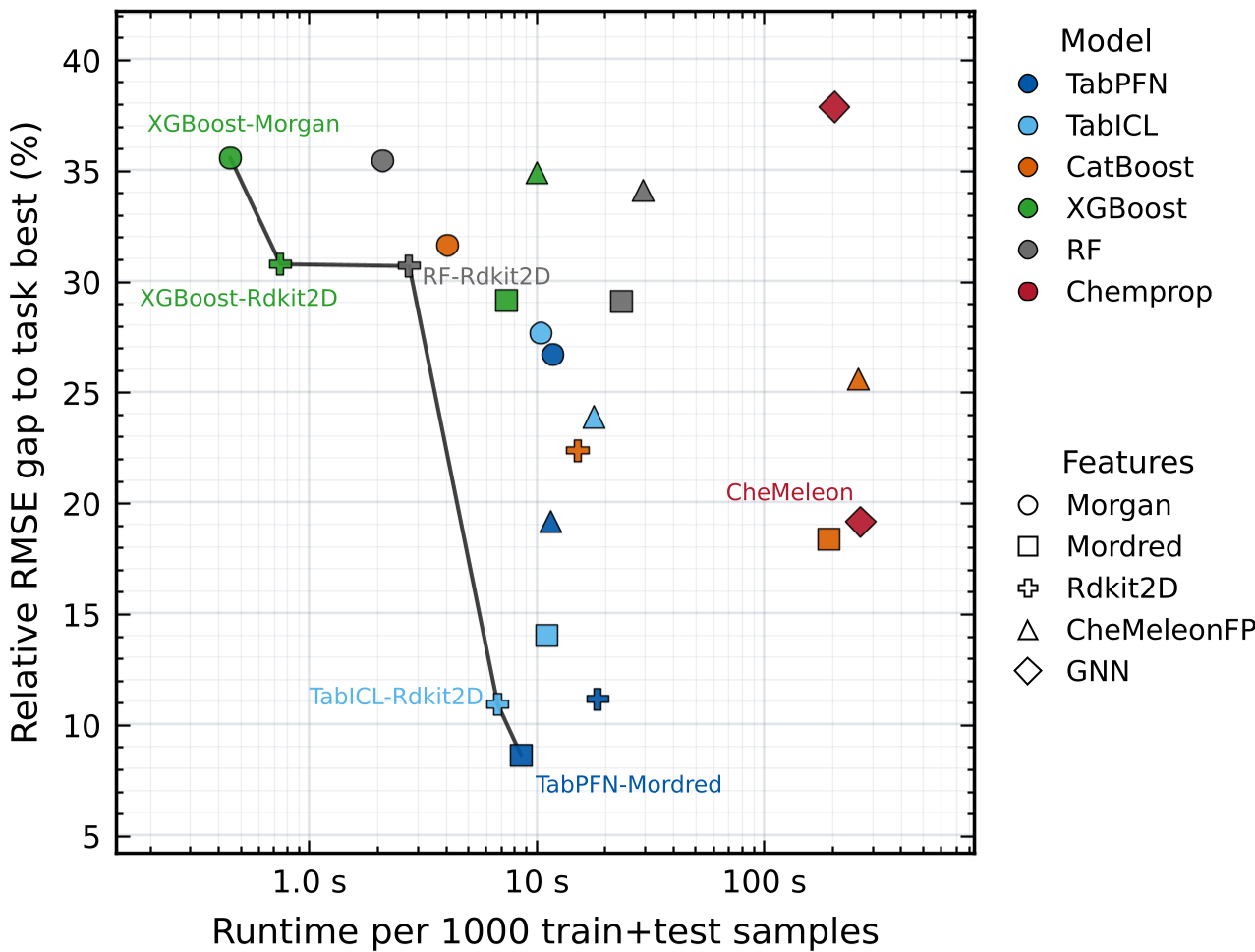 Figure 3: TabPFN configurations provide the best trade-off between speed and error reduction.
Limitations
- Memory Limits: As datasets grow beyond ~20,000 samples, the TFM's KV-cache (attention mechanism) becomes memory-intensive.
- Mixtures: The current study focuses on single molecules; complex chemical mixtures remain a frontier.
Conclusion and Future Outlook
This work signals a shift in Molecular AI. We may be moving away from the "Fine-Tune Everything" era toward an "In-Context Era." For practitioners, this means high-performance molecular property prediction is now accessible on a standard laptop without a single line of training code.
The next frontier? Uncertainty Calibration. If TFMs can tell us when they are unsure (via their built-in Bayesian nature), they will become the ultimate tool for Active Learning, guiding scientists to the next breakthrough experiment with surgical precision.