
The Symphony of Love: Decoding Tidal Responses in Black Holes and Neutron Stars
Tidal Response of Compact Objects
This paper provides a comprehensive review of tidal effects in compact objects, focusing on the theoretical derivation and phenomenological implications of tidal Love numbers (LNs) and dissipation coefficients for black holes (BHs), neutron stars (NSs), and exotic compact objects (ECOs). It synthesizes recent breakthroughs in hidden symmetries, worldline effective field theory (EFT), and gravitational-wave (GW) modeling to characterize the structural response of these objects to external gravitational fields.
TL;DR
Tidal interactions are no longer just about the Earth and the Moon—they are the key to unlocking the internal secrets of the most extreme objects in the universe. This review clarifies why black holes (BHs) appear rigid under bosonic fields but "soften" under fermionic ones, how neutron stars (NSs) reveal nuclear density through their deformability, and why the next decade of gravitational-wave (GW) astronomy will turn "tidal Love numbers" into a precision diagnostic for quantum gravity and exotic physics.
Background: The Physical Intuition of "Love"
In 1909, Augustus Love introduced dimensionless numbers to describe how the Earth deforms under the Sun and Moon's gravity. In General Relativity, this concept is heightened: tidal forces are encoded in the Riemann curvature tensor. For a compact object in a binary, the companion's gravity creates a "multipole moment"—a bulge. The ratio of this bulge to the external field is the Love Number (LN).
Problem & Motivation: The Mystery of the Rigid Black Hole
For decades, theoretical calculations showed that for a black hole in 4D General Relativity, the static bosonic Love numbers vanish. To an effective field theorist, this is "unnatural"—usually, everything that isn't forbidden is mandatory. Why should a black hole, a region of intense gravity, have zero deformability?
The paper explores this through the lens of Hidden Symmetries. It turns out that BH perturbations satisfy an SL(2,R) "Love Symmetry" in the near-zone, effectively acting as a selection rule that kills off any decaying (response) mode.
Methodology - The Core
The authors bridge the gap between abstract mathematical physics and observational phenomenology using four pillars:
- Black Hole Perturbation Theory: Solving the Teukolsky equation for spinning BHs.
- Ladder Symmetries: Using operators to move between multipole states (), showing that if the mode is regular only for the growing branch, all higher modes must follow.
- Membrane Paradigm: Describing the object surface as a viscous fluid. This provides a brilliant physical intuition: a BH acts like a fluid with specific shear viscosity (), while ECOs act as reflecting mirrors.
- Worldline EFT: Modeling the object as a point particle with "finite-size" operators in the action.
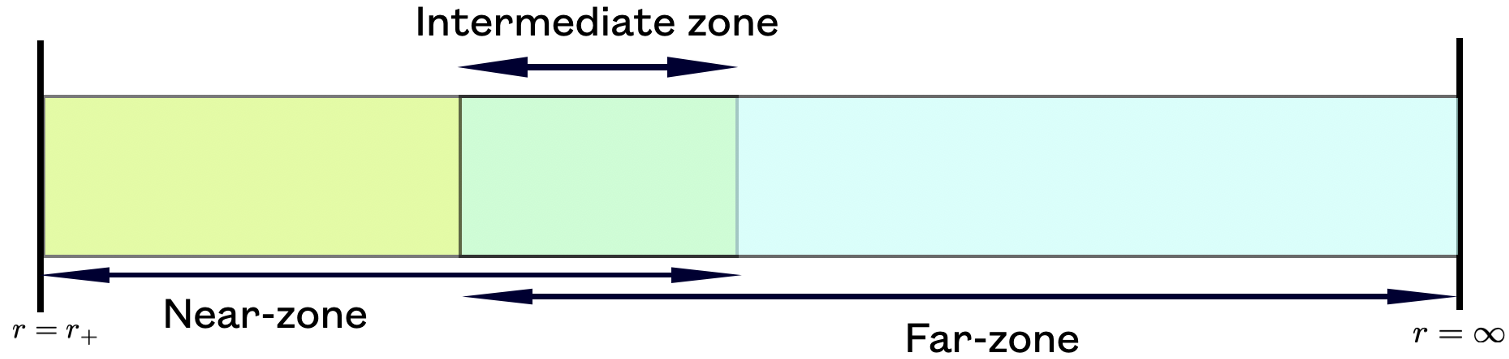 The interaction occurs across zones: the near-zone (near the horizon), the intermediate zone (where the tidal field lives), and the far-zone (asymptotic infinity).
Deep Insight: Bosons vs. Fermions
A revolutionary finding highlighted in the review is the Bosonic-Fermionic Split.
- Bosonic (Scalar, EM, Gravity): Static LNs vanish.
- Fermionic (Neutrinos, Gravitinos): Static LNs are nonzero.
Why? Because the "Love Symmetry" that protects bosonic rigidity is broken by the half-integer spin of fermions. This suggests BHs could actually support "fermionic hair," challenging the classic No-Hair Theorems.
Numerical Revelations
For Neutron Stars, the story is about the Equation of State (EoS). The LNs are highly sensitive to how "squishy" nuclear matter is.
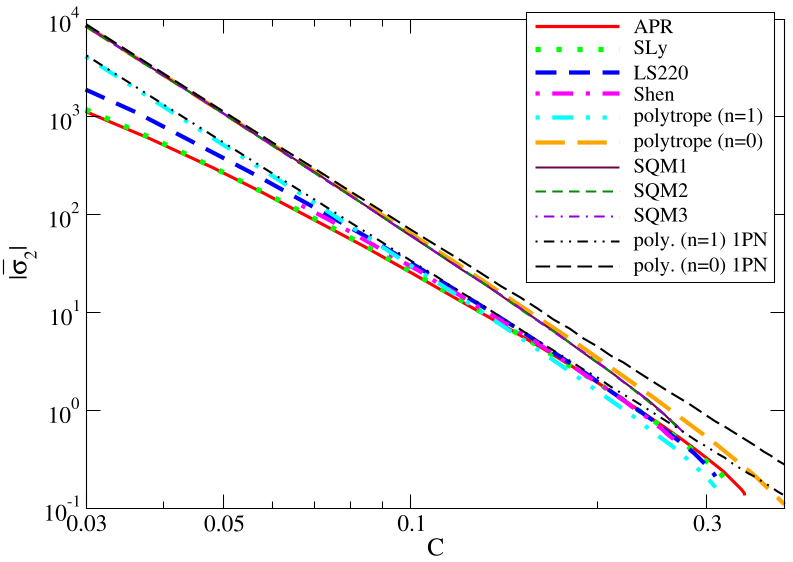 Top panels show the quadrupolar electric LN () as a function of mass. GW170817 (the first BNS merger) placed an upper limit of , effectively ruling out the stiffest EoS models.
The paper also introduces the I-Love-Q relations: approximately EoS-independent links between the moment of Inertia, Love number, and Quadrupole moment. These are the "holy grail" for breaking degeneracies in GW data.
The Case for Exotic Compact Objects (ECOs)
If we detect a non-zero LN for a massive object (), it's not a BH—it's an ECO (like a Boson Star or Gravastar) or a BH surrounded by Dark Matter.
- The "Logarithmic Scaling": For nearly all ECOs, the LN stays non-zero but scales as , where is the distance from the would-be horizon. This provides a "magnifying glass" for Planck-scale physics.
Applications: Gravitational-Wave Astronomy
The tidal phase contribution enters the GW signal at 5PN (Post-Newtonian) order. While formally a high-order correction, it is enhanced by the compactness factor ( for NS), making it the primary tool for EoS constraints in the late inspiral.
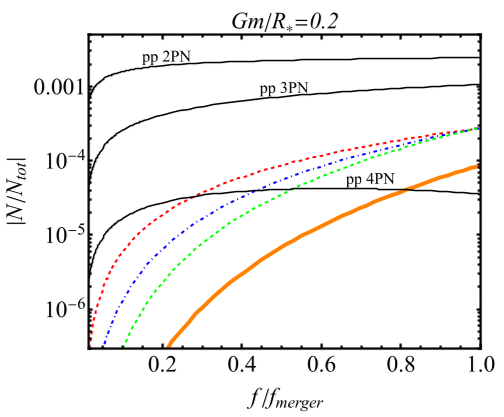 A comparison of cycles accumulated: at higher frequencies (late inspiral), the leading tidal LN (red) and even quadratic LNs (orange) become dominant over lower-order point-particle effects.
Conclusion & Critical Analysis
The review successfully unifies disparate threads of research into a singular narrative: Tidal response is the ultimate probe of the "Nature of Compactness."
Limitations: The current framework relies heavily on Post-Newtonian expansions, which fail near the merger. We still lack a fully non-linear relativistic theory for dynamical tides in neutron stars.
Future Work: With the Einstein Telescope (ET) and LISA, we will move from "upper bounds" to "precision spectroscopy." Measuring the Dissipation Numbers (tidal heating) will allow us to "hear" if an object has a surface or an event horizon, potentially providing the first experimental test of horizon thermodynamics and area quantization.