
[CVPR 2025] Tora3: Bridging the "Kinematic Gap" in Audio-Video Generation via Trajectory Guidance
Tora3: Trajectory-Guided Audio-Video Generation with Physical Coherence
Tora3 is a trajectory-guided audio-video (AV) generation framework that establishes object trajectories as a shared kinematic prior. Built on a twin-DiT architecture, it achieves state-of-the-art physical coherence and synchronization, outperforming baselines like LTX-2 and Ovi in motion-sound alignment.
TL;DR
Unifying sight and sound in AI has long been a game of semantic guessing. Tora3 shifts the paradigm by introducing Object Trajectories as a shared "kinematic skeleton." By feeding second-order motion data (velocity/acceleration) into the audio branch and using trajectory-aligned latent injection for video, Tora3 generates content where a car's roar or a hammer's strike is perfectly synced to its visual momentum.
Problem & Motivation: The "Loose Coupling" of Sight and Sound
Current state-of-the-art models like Sora or LTX-2 are visually stunning but often "acoustically deaf" to the physics of the scene. Sounds often trigger too late, or the volume fails to match the speed of the object.
The authors identify two core gaps:
- Visual Instability: Objects drift from intended paths because motion isn't anchored to the latent space.
- Acoustic Detachment: Audio models rely on text prompts rather than the "how" and "where" of movement.
The Insight: Since trajectories describe where an object is and how it moves, they are the perfect common language for both pixels and wavelets.
Methodology: The Shared Kinematic Prior
Tora3 utilizes a twin Diffusion Transformer (DiT) architecture, but the "secret sauce" lies in how it processes the input trajectory .
1. Video Branch: Trajectory-Aligned Motion Representation
Instead of adding a heavy motion encoder that might shift the data distribution, Tora3 uses a "neat" trick: it propagates the latents from the first frame along the prescribed trajectory. If a car moves from to , the latent features of that car are explicitly placed at the corresponding coordinates in the subsequent frames.
2. Audio Branch: Kinematic-Audio Alignment
This is where Tora3 truly shines. It extracts "Second-Order Kinematic States" from the trajectories:
- Position (): Provides context (is it near the ground?).
- Velocity (): Determines the mode (sliding vs. falling).
- Acceleration (): Pinpoints the exact moment of impact.
These features are injected via a gated cross-attention mechanism, allowing the audio branch to "hear" the visual physics.
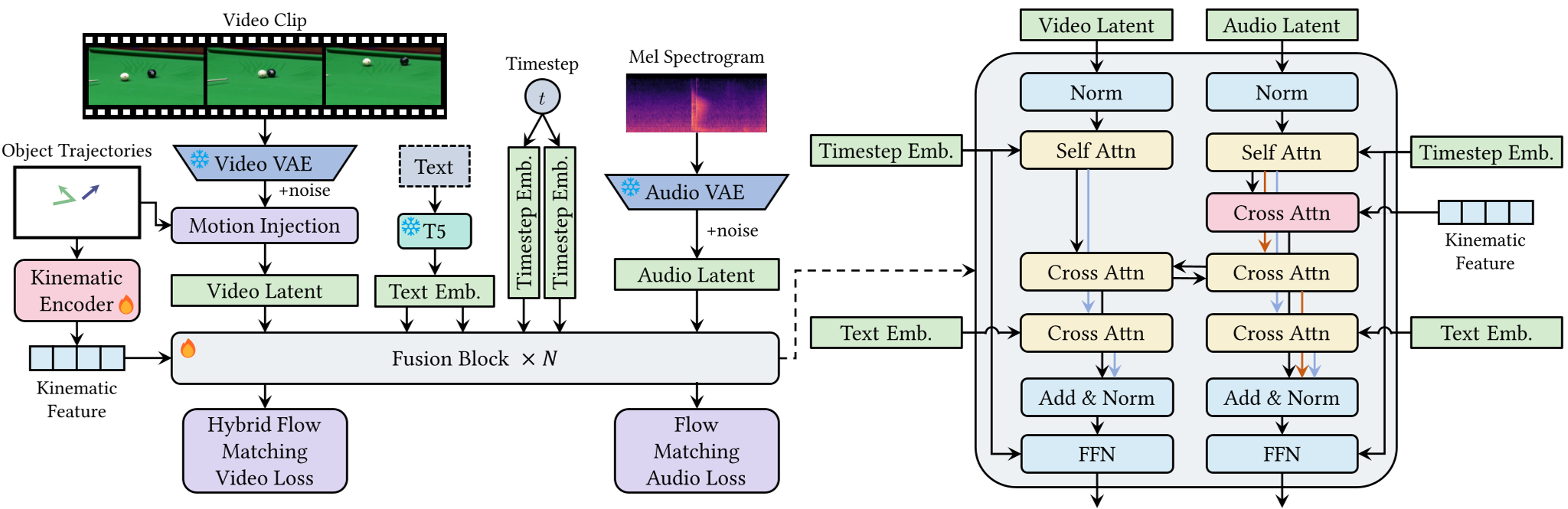
3. Hybrid Flow Matching (HFM)
To prevent the background from becoming "mushy" while following a sharp trajectory, Tora3 uses HFM. It applies a standard probability flow for the background and an anchored flow for the trajectory-conditioned regions, ensuring the object stays sharp while its movement remains fluid.
Experiments: Measuring Physical Coherence
The researchers introduced two novel metrics to capture what standard FVD scores miss:
- Event Timing Error (ETE): Measuring the millisecond gap between a visual hit and an audio pop.
- Motion-Audio Intensity Correlation (MAIC): Checking if the sound gets louder as the object speeds up.
| Method | Trajectory Error (TE) ↓ | AV Sync (FGAS) ↑ | Event Timing (ETE) ↓ |
|---|---|---|---|
| Ovi (Baseline) | - | 0.156 | 0.301 |
| AVControl | 19.95 | 0.209 | 0.214 |
| Tora3 (Ours) | 12.13 | 0.234 | 0.181 |
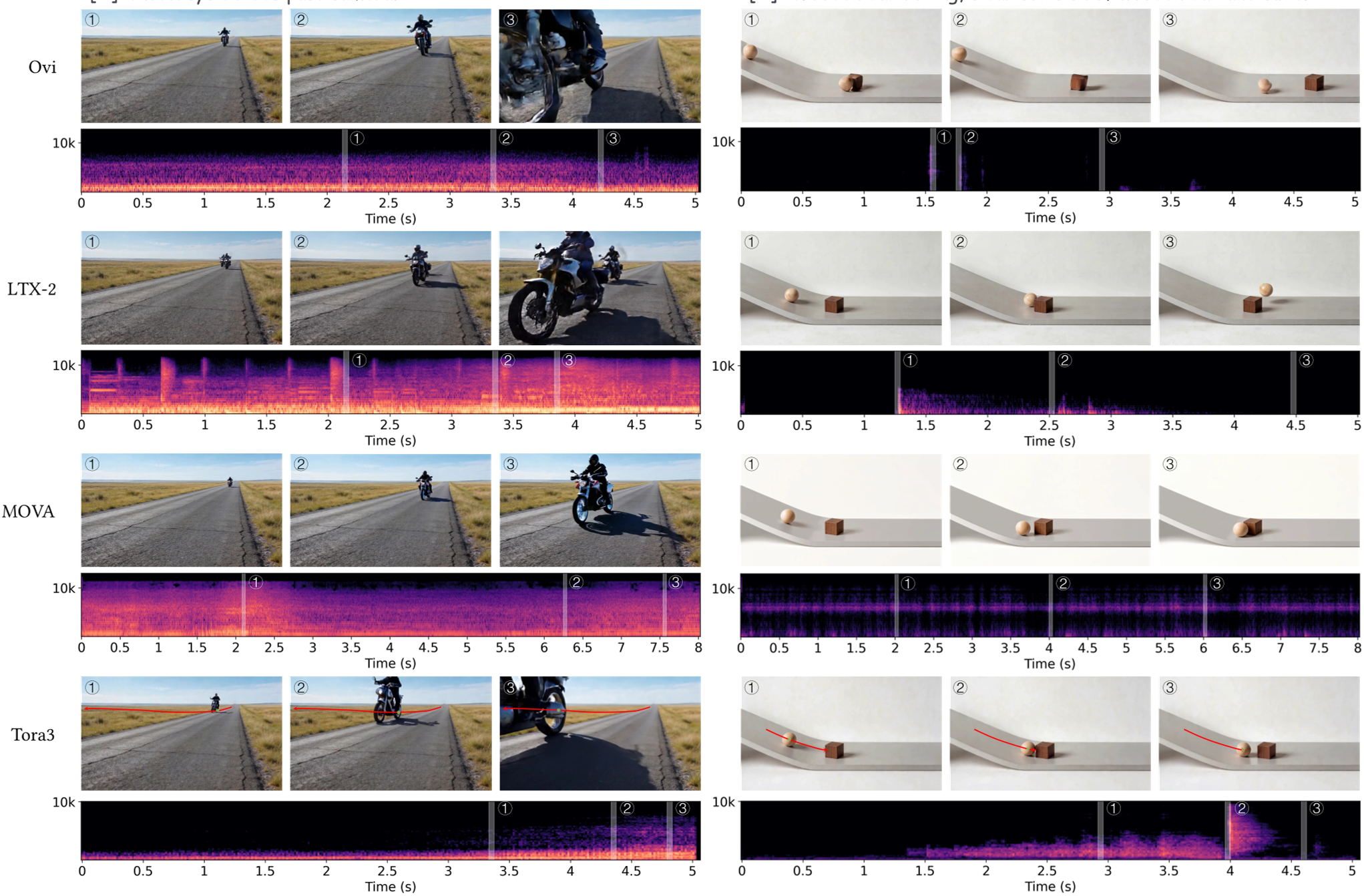 Visual Evidence: In the rolling ball example, Tora3 is the only model that accurately captures the 'thud' at the exact frame of collision.
Deep Insight & Conclusion
Tora3 proves that Physics-by-Proxy (via trajectories) is often more effective and scalable than trying to bake a full physics engine into a neural network. By using simple derivatives of motion data, the model learns the "loudness of velocity" and the "timing of acceleration."
Takeaway: The future of multimodal AI isn't just about bigger datasets; it's about finding the right structural priors—like trajectories—that force different modalities to respect the same laws of motion.
Limitations: While kinematic priors are powerful, they don't yet account for material properties (e.g., the difference in sound between a glass ball and a wooden one hitting a floor). This remains the next frontier for "World Models."