
Unlocking Nonlinear Spectroscopy on NISQ Devices: A Unified Quantum Framework
A unified framework for efficient quantum simulation of nonlinear spectroscopy
The paper introduces a unified quantum algorithmic framework for computing n-th order nonlinear spectroscopies using the Generalized Parameter-Shift Rule (GPSR). This approach avoids costly high-order commutators and ancilla qubits, achieving high-order (up to 5th) response functions on the 12-qubit IBM Kobe processor for the XXZ spin-chain.
TL;DR
Researchers have developed a new quantum algorithm that uses the Generalized Parameter-Shift Rule (GPSR) to compute high-order nonlinear spectroscopic responses without the need for ancilla qubits or complex commutator expansions. Validated on a 12-qubit IBM quantum processor, the method successfully captures multi-body dynamics, fractionalized excitations in spin liquids, and spectral cross-peaks, bridging the gap between theoretical quantum chemistry and near-term quantum hardware.
Problem: The Complexity of the "Nonlinear"
Nonlinear spectroscopy is the "gold standard" for probing quantum matter, revealing hidden couplings and coherence that linear methods miss. However, simulating these responses is a nightmare. Classically, the Hilbert space explodes exponentially. On quantum hardware, the traditional approach involves evaluating high-order nested commutators (Kubo formulas), which requires deep circuits, ancilla qubits, and controlled operations—features that are highly susceptible to noise in the NISQ (Noisy Intermediate-Scale Quantum) era.
The Insight: From Commutators to Derivatives
The core "Aha!" moment of this paper is realizing that an -th order response function is mathematically equivalent to the -th order derivative of a system's expectation value with respect to its perturbation (pump) amplitude.
Instead of building a circuit for a complex commutator , we can simply:
- Apply a "kick" (pump) with amplitude .
- Measure the observable .
- Use the Generalized Parameter-Shift Rule (GPSR) to compute the derivative.
By evaluating the system at a few discrete "shifted" amplitudes, the high-order response is reconstructed as a weighted sum of simple real-time evolutions.
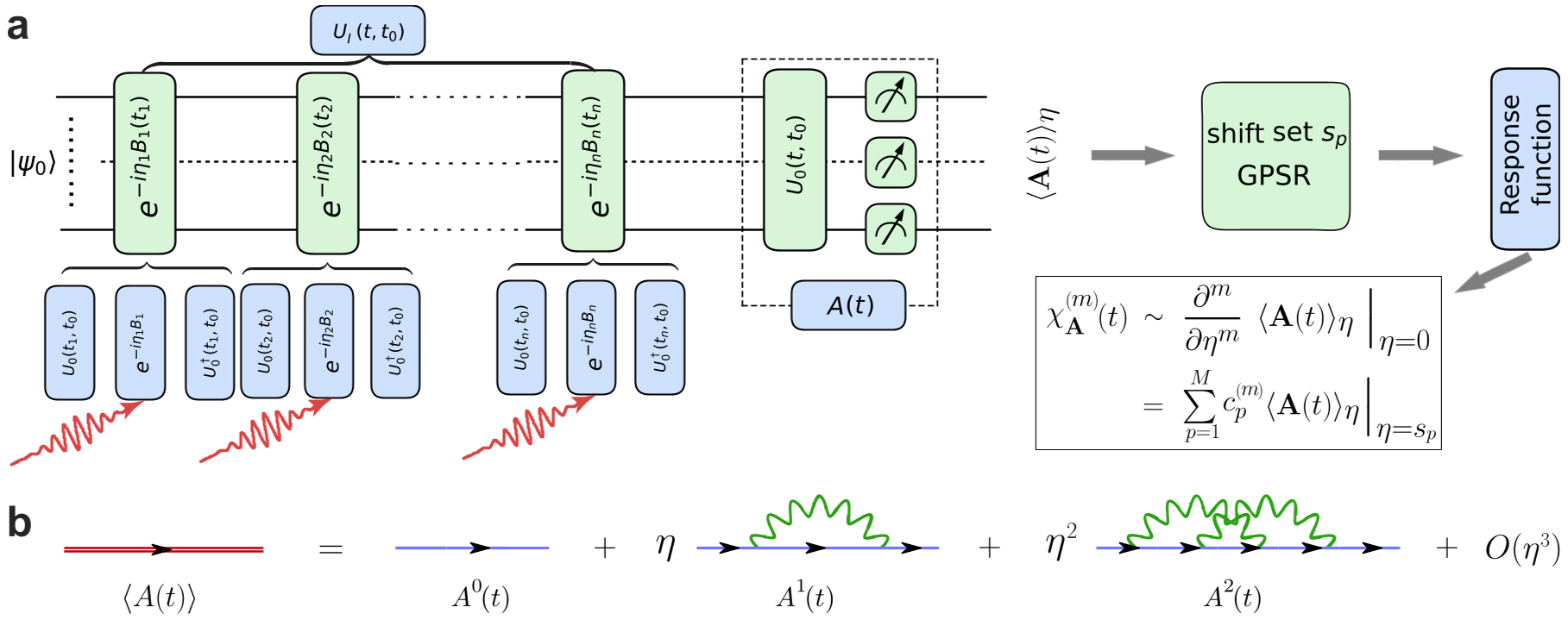 Fig 1. The workflow: from impulsive pumps and shifted measurements to the reconstruction of 2D spectra and quasiparticle signatures.
Methodology: Exact Reconstruction via GPSR
The GPSR works because most physical pump operators (like Pauli or ) have finite discrete spectra. This turns the expectation value into a finite Fourier series of the pump amplitude.
The algorithm follows these steps:
- Finite Shifts: Solve a linear system to find the optimal shift points and weights .
- Real-Time Evolution: Execute standard evolution circuits on the QPU.
- Zero Truncation Error: Unlike finite-difference methods (e.g., ), the GPSR is mathematically exact regardless of the "step size" if the spectrum is known.
Experimental Results: 12-Qubit Validation
The team tested this on the ibm_kobe processor using a 12-qubit XXZ spin chain. They extracted 4th and 5th-order responses of spin currents and magnetization.
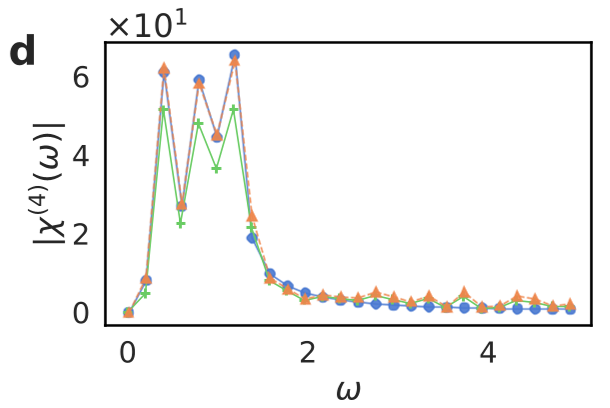 Fig 2. Comparison between raw hardware data (green), noise-mitigated data (orange), and noiseless simulation (blue) for 4th and 5th-order responses.
Crucially, the higher-order signals (which are much smaller and harder to detect) matched the theoretical predictions remarkably well after empirical error mitigation, proving the robustness of the derivative-based approach.
Exploring Quantum Spin Liquids (QSL)
The framework isn't just for spin chains. The authors applied it to the Kitaev Toric Code to find signatures of anyonic excitations. By analyzing the 3rd and 5th-order responses, they could distinguish between different pump geometries (XXX vs XZZ) through "point cloud" analysis of the response functions. This demonstrated that high-order responses are far more sensitive to the underlying topological phase transitions than linear ones.
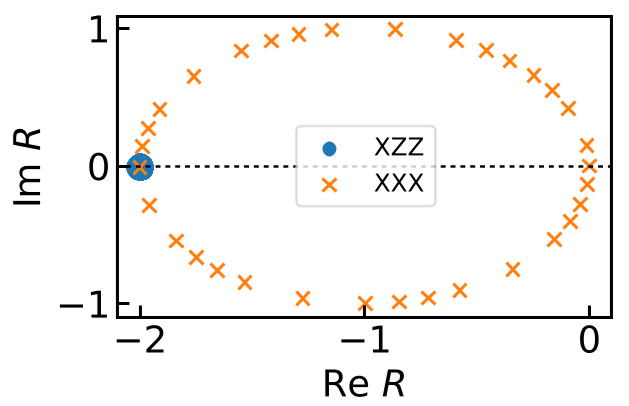 Fig 3. Using PCA and spectral diagonal/off-diagonal power to identify phase transition points (g=0) in topological models.
Critical Insight & Conclusion
This work shifts the burden of nonlinear simulation from circuit depth to measurement sampling.
- Efficiency: The cost depends on the spectral gaps of the pump operator, not the size of the total Hilbert space. Since most physical pumps are local, this method scales polynomially.
- Limitations: While it bypasses ancilla qubits, it still requires many "shots" to resolve the tiny signals of high-order terms. Noise mitigation remains essential.
By turning a "hard" quantum physics problem (commutator expansion) into a "smart" signal processing problem (GPSR reconstruction), the authors have provided a viable roadmap for using today's quantum computers to do real-world spectroscopy in chemistry and materials science.