
UniT: Cracking the Humanoid Data Bottleneck with a Unified Physical Language
UniT: Toward a Unified Physical Language for Human-to-Humanoid Policy Learning and World Modeling
UniT is a cross-embodiment foundation model framework that introduces a Unified Latent Action Tokenizer via Visual Anchoring to bridge the human-humanoid gap. By mapping heterogeneous kinematics into a shared discrete latent space, it achieves SOTA data efficiency in policy learning (VLA-UniT) and high-fidelity controllable world modeling (WM-UniT).
TL;DR
Humanoid robots are hard to train because robot-specific data is rare. UniT (Unified Latent Action Tokenizer) solves this by creating a "common language" between humans and robots. By anchoring different bodies to their shared visual outcomes, UniT allows robots to learn directly from massive human video datasets, achieving SOTA performance in policy learning and world modeling, including emergent zero-shot capabilities.
The Chasm: Why Robots Can't Just "Watch and Learn"
The primary hurdle in humanoid robotics is the heterogeneous state-action space. A human wrist moves differently than a GR1 or IRON-R01 robot's wrist. Traditional methods try "Motion Retargeting"—painstakingly mapping human joints to robot joints—which is labor-intensive and often physically inconsistent.
Previous attempts at latent action spaces fell into two traps:
- Action-Only: They ignore the world, focusing only on joint angles, leading to massive distribution shifts.
- Vision-Only: They infer intent from pixels but get confused by lighting, shadows, or background textures (appearance confounders).
Methodology: Visual Anchoring via Tri-Branch Reconstruction
UniT’s core insight is philosophical: Heterogeneous kinematics share universal visual consequences. If a human hand moves a cup or a robot gripper moves a cup, the visual "before and after" are identical.
The Architecture
UniT employs three parallel encoders:
- Visual Branch: An Inverse Dynamics Model (IDM) using DINOv2 features to see "what changed."
- Action Branch: Encodes the raw motor commands of the specific embodiment.
- Fusion Branch: Combines both to find the underlying intent.
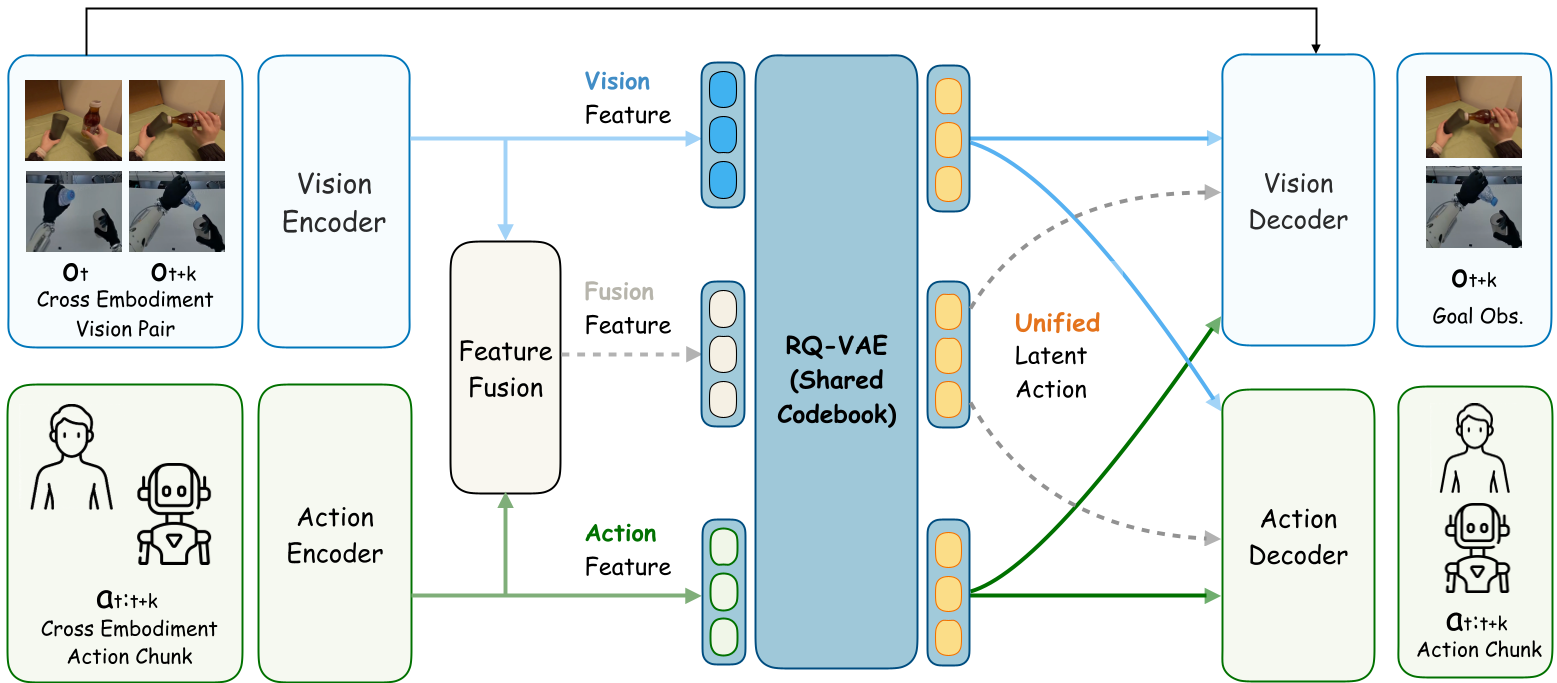
The secret sauce is Cross-Reconstruction. The model is forced to reconstruct actions from visual features and vice-versa. This filters out "noise"—actions that don't cause visual changes (proprioceptive jitter) are discarded, and visual features that don't relate to actions (lighting shifts) are ignored. What remains is a purified physical intent stored in a shared discrete codebook.
Proving the Language: VLA and World Modeling
The authors validated this "unified language" across two major AI paradigms:
1. VLA-UniT (Policy Learning)
By predicting these unified tokens instead of raw motor values, the Vision-Language-Action (VLA) model becomes much more efficient. In simulation, using only 10% of robot data, VLA-UniT matched the performance of a standard model trained on 100% data.
2. WM-UniT (World Modeling)
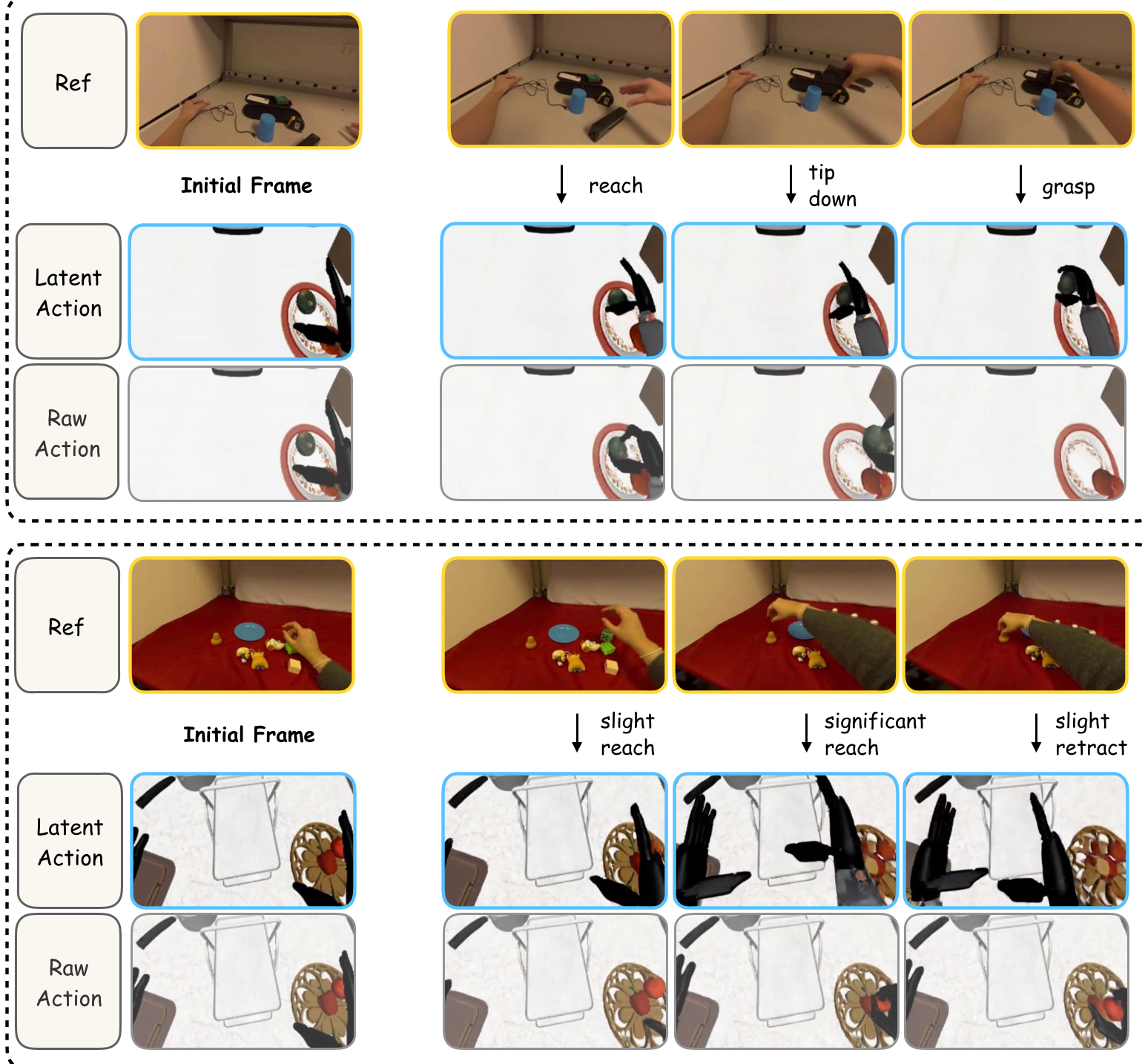
In video generation, using UniT tokens as conditions allowed for Cross-Embodiment Transfer. You can feed human action tokens into a robot world model, and it will generate a video of the robot performing the human's specific task with remarkable semantic and geometric consistency.
Key Results & Experimental Evidence
UniT was tested on the RoboCasa benchmark and real IRON-R01-1.11 humanoids:
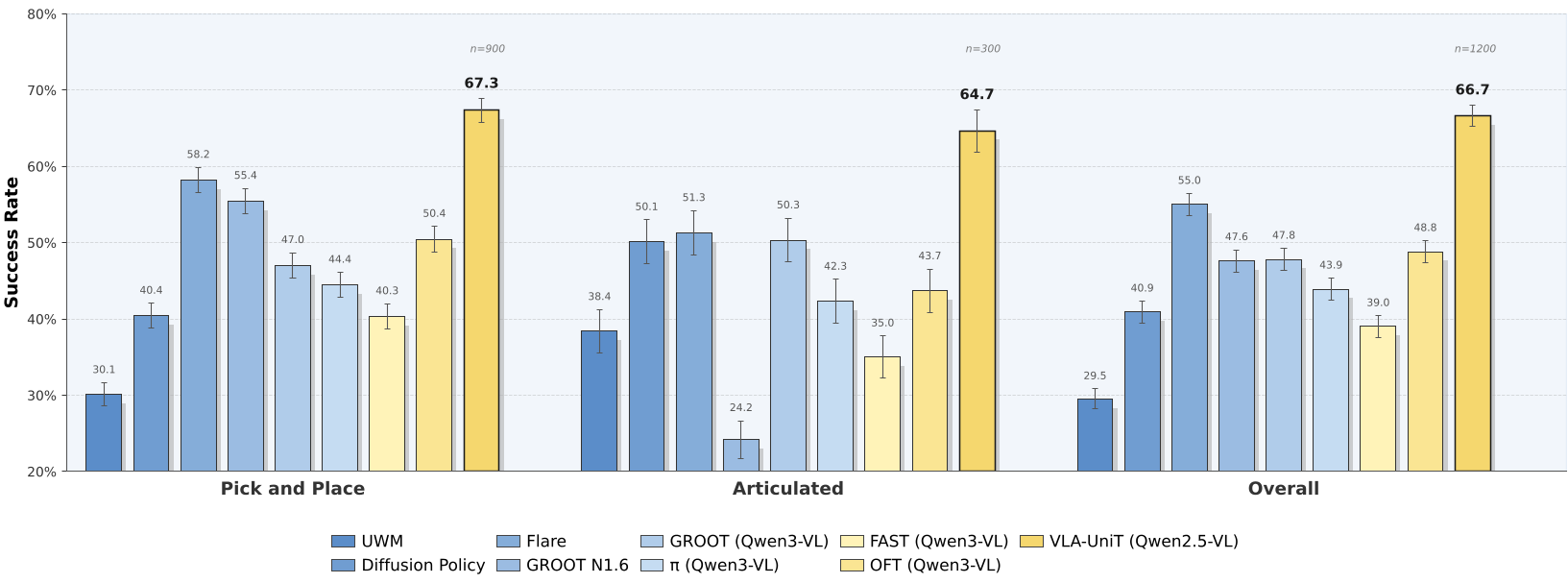
- SOTA Achievement: +11.7% success rate over previous top-tier models (FLARE).
- Zero-Shot Success: The robot learned to "stack bowls" (a task never seen in robot training) by observing human videos. It even developed emergent behaviors like waist rotation and head-turning to improve its view.
- Denoising: UniT is incredibly robust. When 20% noise was added to actions, UniT's reconstruction error barely budged, while standard tokenizers (like FAST) saw error rates jump 10x.
Critical Insight & Future Outlook
The t-SNE visualizations in the paper are perhaps the most striking evidence. They show human and humanoid action distributions—normally two distinct "islands"—completely merging into a single, unified manifold after UniT tokenization.
The Takeaway: UniT effectively turns "Human Data" into "Robot Fuel." This framework suggests a future where we stop worrying about specific robot hardware and instead focus on scaling a universal "Physical Foundation Model" trained on the ocean of human videos available on the internet.
Limitations
While powerful, UniT currently relies on high-quality visual features (DINOv2). In environments with extreme occlusion or very subtle movements (like micro-electronics assembly), the visual anchor might weaken, requiring even higher-resolution temporal modeling.