
XEmbodied: Empowering Foundation Models with Intrinsic Geometry for Scalable Embodied AI
XEmbodied: A Foundation Model with Enhanced Geometric and Physical Cues for Large-Scale Embodied Environments
XEmbodied is a cloud-side foundation model designed for autonomous driving and robotics VQA within data closed-loop systems. It integrates 3D geometric awareness and physical cues into Vision-Language Models (VLMs) using a novel 3D Adapter (3DA) and an Efficient Image-Embodied Adapter (EIEA), achieving state-of-the-art results across 18 public benchmarks.
TL;DR
XEmbodied is a groundbreaking foundation model designed to act as a "cloud-side annotation engine" for autonomous driving (AD) and robotics. By moving beyond flat 2D representations, it introduces a 3D Adapter (3DA) for endogenous spatial sense and an Efficient Image-Embodied Adapter (EIEA) to digest physical signals (like occupancy and 3D boxes). It doesn't just see pixels; it understands the 3D physics of the scene, outperforming GPT-4o across 18 specialized benchmarks.
The Problem: The "Flat World" Limitation of VLMs
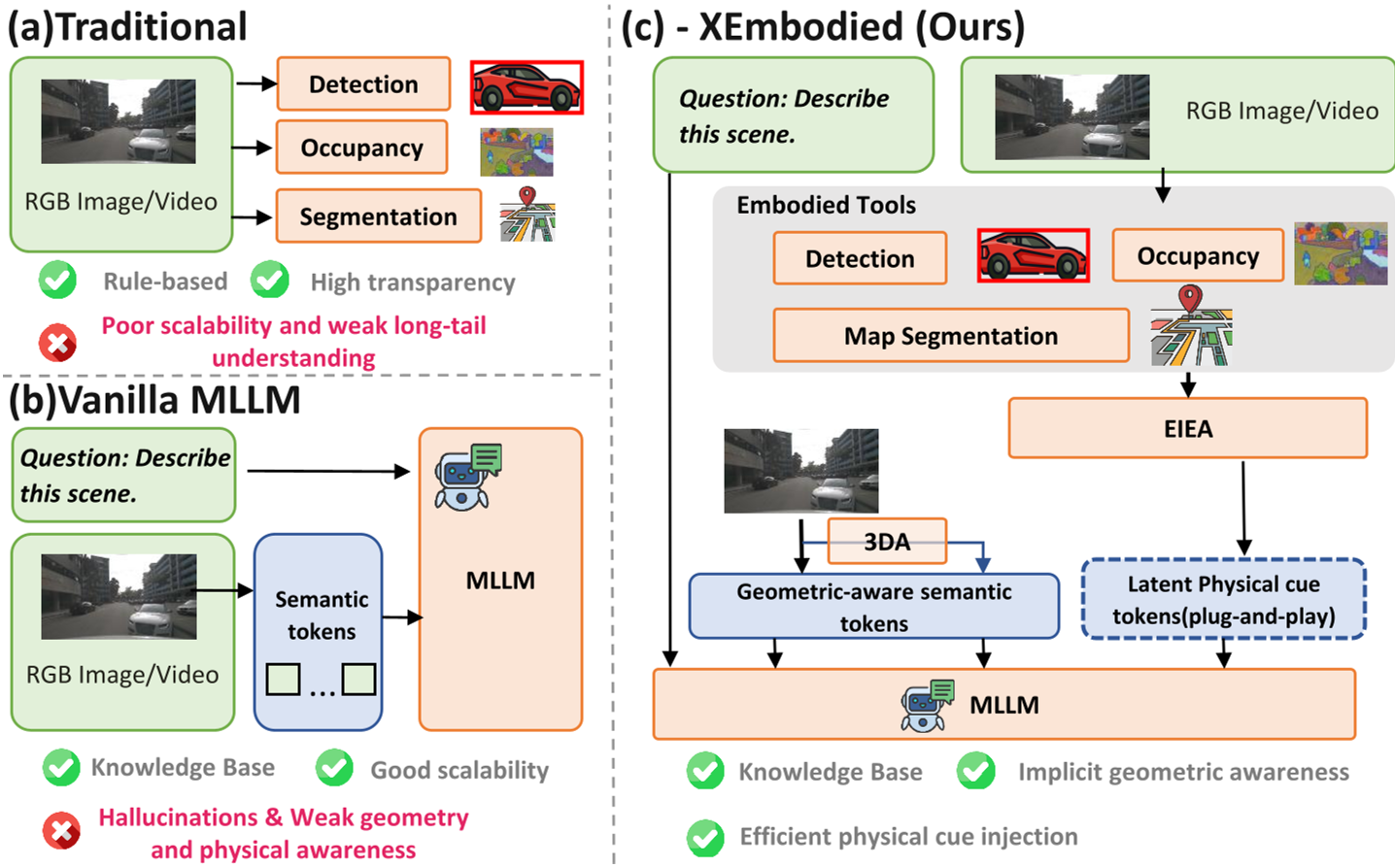
The industry is currently in the AD 3.0 era, where a "data closed-loop" is vital. We collect massive amounts of driving logs, but generic Vision-Language Models (VLMs) like LLaVA or Qwen-VL are fundamentally "flat-world" thinkers. Pre-trained on Internet-scale 2D images, they fail to grasp:
- 3D Topology: Lane connectivity and metric distances.
- Physical Consistency: How to verify a semantic hypothesis using an occupancy grid or a trajectory.
- Efficiency: Appending raw depth maps or long tool outputs into the VLM context slows down reasoning and often leads to catastrophic forgetting.
Methodology: Bridging Semantics and Geometry
The authors argue that human spatial cognition doesn't rely on exact depth values but on a structured spatial sense. XEmbodied mimics this via two key innovations:
1. The 3D Adapter (3DA)
Instead of adding geometry as an auxiliary "channel," 3DA injects geometric representations directly into the semantic stream. It uses a Geometry Stream (based on VGGT) to extract 3D tokens. These are aligned with 2D semantic tokens via a cross-attention mechanism.
- Q (Query): 2D Semantic Tokens ("What is in the scene?")
- K/V (Key/Value): 3D Geometric Tokens ("Where is it in 3D space?")
2. Efficient Image-Embodied Adapter (EIEA)
To make the model "physical-cues-aware," EIEA uses a Mamba-based interpreter. It takes raw signals—Detection boxes, BEV occupancy, and Map segmentations—and distills them into 64 compact tokens. This "plug-and-play" module allows the VLM to "verify" its reasoning against physical evidence without the massive computational overhead of typical tool-augmented CoT.
Experimental Results: SOTA in the Real World
XEmbodied was trained using a Progressive Domain Curriculum, moving from simple scene grounding to complex spatio-temporal understanding.
Performance Highlights:
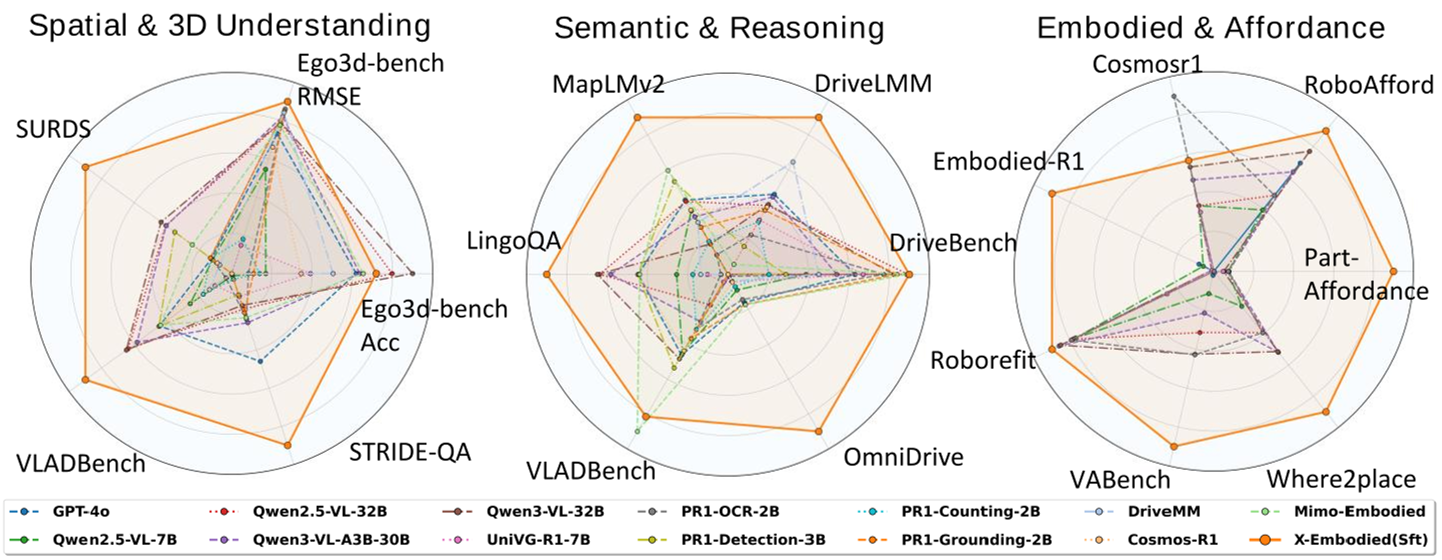
- Spatial Reasoning: On Ego3DBench, XEmbodied achieved a SOTA RMSE of 9.25, significantly more accurate than Qwen2.5-VL and proprietary models.
- Semantic Reasoning: On DriveLMM-o1, it reached a score of 77.01, proving its ability to explain complex driving decisions.
- Efficiency: The EIEA-based inference is 6.89x faster than the explicit "AgentThink" baseline.
The Power of Reinforcement Learning (GRPO)
In Stage 4, the model underwent Group Relative Policy Optimization (GRPO). This RL post-training ensures the model follows the correct format and produces factually correct answers, specifically regarding point positioning and box regression in 3D space.
Critical Insights & Future Outlook
The success of XEmbodied highlights a shift from Visual Reasoning (pixels to text) to Physical Reasoning (geometry to action). However, the authors admit several limitations:
- Long-term Temporal Reasoning: The model still struggles with continuous multi-frame spatio-temporal causal links.
- Edge Case Generalization: While it handles "Y-shaped intersections" well, extreme weather and rare interactive scenarios still pose a challenge.
Conclusion: XEmbodied sets a new standard for cloud-side annotation engines. By endowing VLMs with an "inner eye" for 3D geometry and a high-speed interpreter for physical cues, it bridges the gap between semantic understanding and physical reality, paving the way for more reliable autonomous systems.