
NGC 4151: Decoding the 0.9 Ms XRISM/Resolve Spectrum — A New Map of the AGN Central Engine
The 0.9 Megasecond XRISM/Resolve Spectrum of the Seyfert-1 AGN NGC 4151
This paper presents an analysis of a 0.9 Megasecond (893 ks) time-averaged X-ray spectrum of the Seyfert-1 AGN NGC 4151, obtained using the XRISM/Resolve calorimeter. By leveraging unprecedented spectral resolution, the authors decompose the complex Fe K emission and absorption features into distinct components representing the accretion disk, broad line region (BLR), and multiple outflowing wind phases (UFOs, VFOs, and warm absorbers).
TL;DR
By integrating 14 observations totaling nearly 900,000 seconds, researchers have used the XRISM satellite's Resolve instrument to perform a "surgical" dissection of the brightest Seyfert-1 galaxy, NGC 4151. The results redefine our understanding of the Fe Kα line complex, showing that what we thought were "warped disks" might actually be the signature of dust-laden gas in a "bowl" geometry. Furthermore, the data reveals a complex ecosystem of winds, from Ultra-Fast Outflows (UFOs) at 17% the speed of light to "failed" winds that stall and fall back into the black hole.
The Resolution Revolution: Why 0.9 Megaseconds Matter
In the world of X-ray astronomy, NGC 4151 is a "standard candle" for studying black hole accretion. However, for decades, our view has been blurred by the limited energy resolution of CCD detectors. With the launch of XRISM and its Resolve calorimeter, we have transitioned from seeing "blurs" to seeing "lines." This 0.9 Ms exposure allows us to see not just that gas is there, but its temperature, ionization state, and whether it's moving as a coherent wind or a turbulent cloud.
Rethinking the "Fe K" Geometry: From Warped Disks to Dusty Bowls
One of the most significant findings involves the Fe Kα line at 6.4 keV. Previous models often required a broadened component from r ≃ 100 GM/c², suggesting a warp in the disk.
The authors show that by using bound electron scattering (via the XCLUMPY kernel), the smooth red wing of the line can be explained without exotic geometries. Instead, it signals the presence of dust at the base of the Broad Line Region (BLR) and the torus.
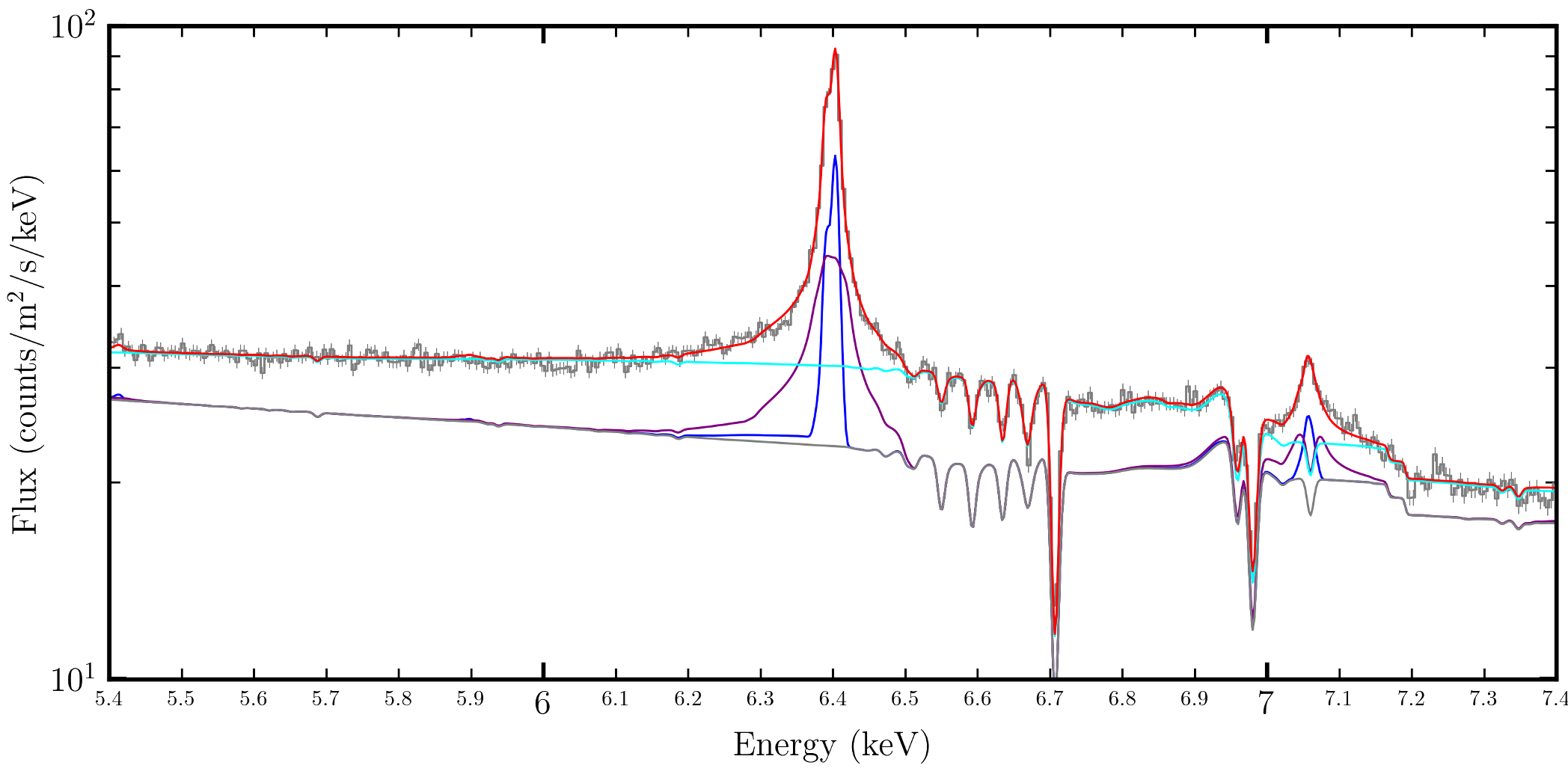 Figure: Decomposition of the Fe K emission complex showing contributions from the inner disk (cyan), BLR (purple), and torus (blue).
Furthermore, the data statistically prefers an emissivity index of q=2 over the standard q=3. This is a crucial physical insight: it suggests the reflecting material is not a flat pancake but has a significant vertical extent—effectively a "bowl" shape that intercepts more radiation from the central black hole.
Wind Ecology: Failed Winds and Galactic Feedback
The spectrum is "imprinted" with multiple layers of outflows:
- Ultra-Fast Outflows (UFOs): One component is moving at 50,300 km/s (0.17c). While significantly energetic, the authors calculate that with conservative volume filling factors, these winds might not always reach the threshold required to shut down star formation in the host galaxy—a key requirement in many cosmological models.
- Warm Absorbers (Failed Winds): The slow winds (v ≃ 200–800 km/s) are particularly interesting. The authors modeled these with both absorption and emission components (a P-Cygni profile).
- The Turnaround Point: By comparing the velocity seen in absorption vs. emission, the study suggests these "warm absorbers" are actually failed winds. They are launched but lack the speed to escape the black hole's gravity, eventually stalling at their "apocenter" (turnaround point) before falling back.
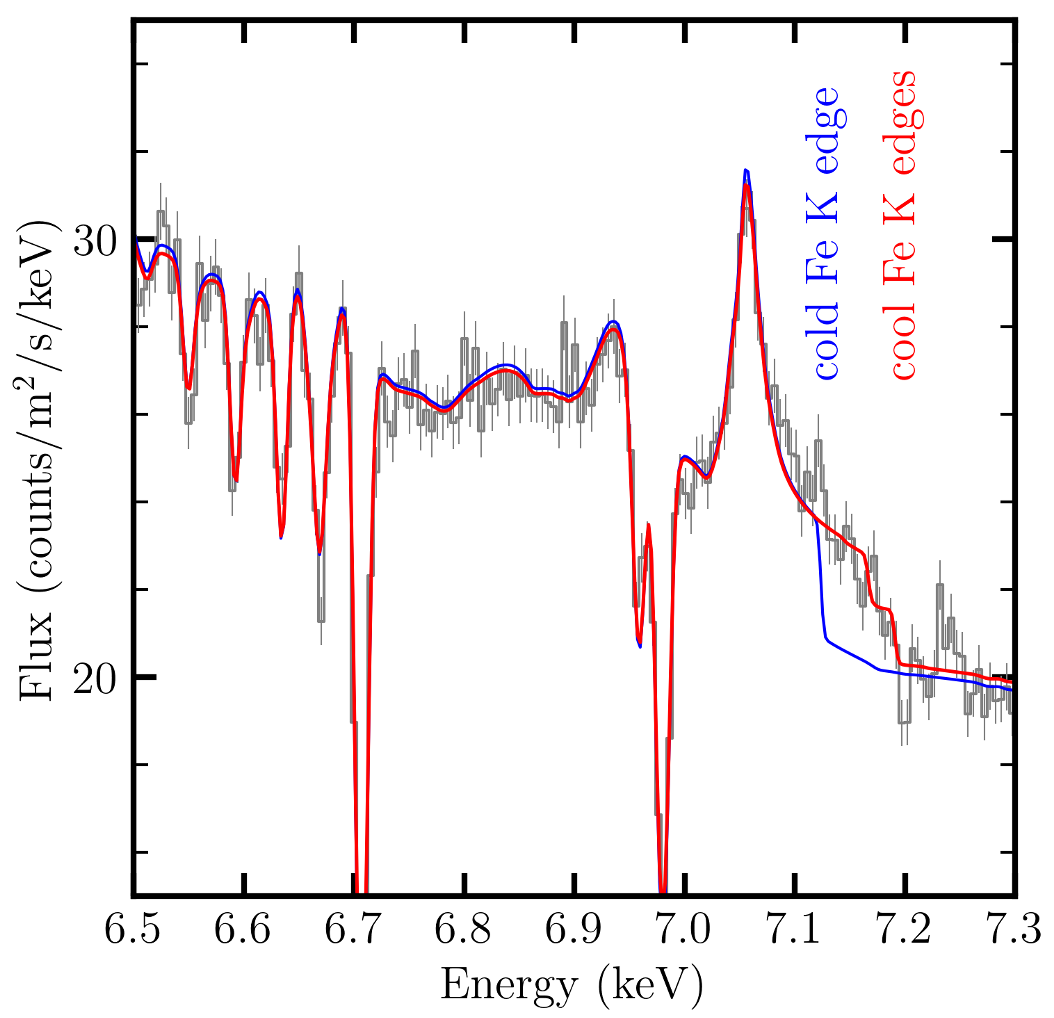 Figure: The impact of different wind components (VFOs, UFOs) on the spectral fit. Removing these components (blue lines) results in significant residuals compared to the best-fit model (red).
The Fe K Edge: It's Not Just "Neutral"
Perhaps the most "heretical" finding for traditional models is the Fe K absorption edge at 7.1 keV. For years, this was modeled as "cold, neutral gas." XRISM reveals this is incorrect. The edge is smooth and better matched by cool, collisional gas (kT ≃ 5.5 eV) consisting of multiple charge states. This suggests that the "partial covering" material is likely a disk atmosphere or a highly variable layer situated deep within the central engine.
Critical Insight & Future Outlook
This paper proves that high-resolution spectroscopy is no longer optional for AGN research. The ability to distinguish between dynamical broadening (motion) and atomic scattering (physics of the medium) changes our fundamental map of the AGN.
Limitations: The study uses a time-averaged spectrum, which might dilute highly variable features like UFOs. The authors acknowledge that while relativistic reflection is statistically supported, some of that "curvature" could potentially be modeled as scattered light in a complex wind environment.
The Takeaway: NGC 4151 is not a simple disk-wind system; it is a layered, multi-phase environment where dust plays a key role in lifting gas into the line of sight, and where much of the wind we see may never actually leave the galactic center.