
XRISM/Resolve Unveils the Gaseous Heart of NGC 7213: Probing Ionized Iron at Low Eddington Ratios
A XRISM Study of Highly Ionized Iron Emission Lines from the Low-Eddington-ratio AGN in NGC 7213
This study utilizes high-resolution X-ray spectroscopy from the XRISM mission and NuSTAR to analyze highly ionized iron emission lines in the low-Eddington-ratio AGN NGC 7213. Using the Resolve microcalorimeter, the authors performed detailed photoionization and collisional ionization modeling of Fe XXV and Fe XXVI lines, exploring the relationship between gas density and the Eddington ratio.
TL;DR
By utilizing the unprecedented 5 eV spectral resolution of XRISM's microcalorimeter, researchers have dissected the highly ionized iron "fingerprints" of the nearby galaxy NGC 7213. The study reveals that the density of the plasma surrounding this supermassive black hole is substantially higher than that of its lower-luminosity cousin, M 81*, providing vital evidence for how accretion environments physically thin out as black holes "starve."
Scientific Context: This work sits at the intersection of high-energy astrophysics and galaxy evolution, serving as a critical Performance Verification (PV) phase result for the XRISM mission.
The "Missing Link" in Accretion Physics
Active Galactic Nuclei (AGNs) are typically classified by their Eddington ratio (), a measure of how much "fuel" they are consuming relative to their theoretical maximum. While high-luminosity AGNs are dominated by thick, bright accretion disks, Low-Luminosity AGNs are thought to harbor Radiatively Inefficient Accretion Flows (RIAFs)—optically thin, hot, and geometrically thick structures.
The problem? Previous X-ray missions like Chandra or XMM-Newton could detect the presence of ionized iron (Fe XXV and Fe XXVI) but couldn't "see" the internal kinematics (line widths and shifts) clearly enough to distinguish between a hot wind, a stagnant plasma, or a rotating disk atmosphere.
Methodology: High-Resolution Forensics
The team combined XRISM/Resolve (capturing the 2-10 keV band with extreme precision) with NuSTAR (extending up to 60 keV to anchor the "hard" X-ray continuum).
Modeling the Iron Complex
To decode the signals, the authors tested two primary physical scenarios:
- Photoionization (pion): Gas ionized by the intense radiation field of the black hole.
- Collisional Ionization (bapec): Gas heated to extreme temperatures via shocks or internal friction within the flow.
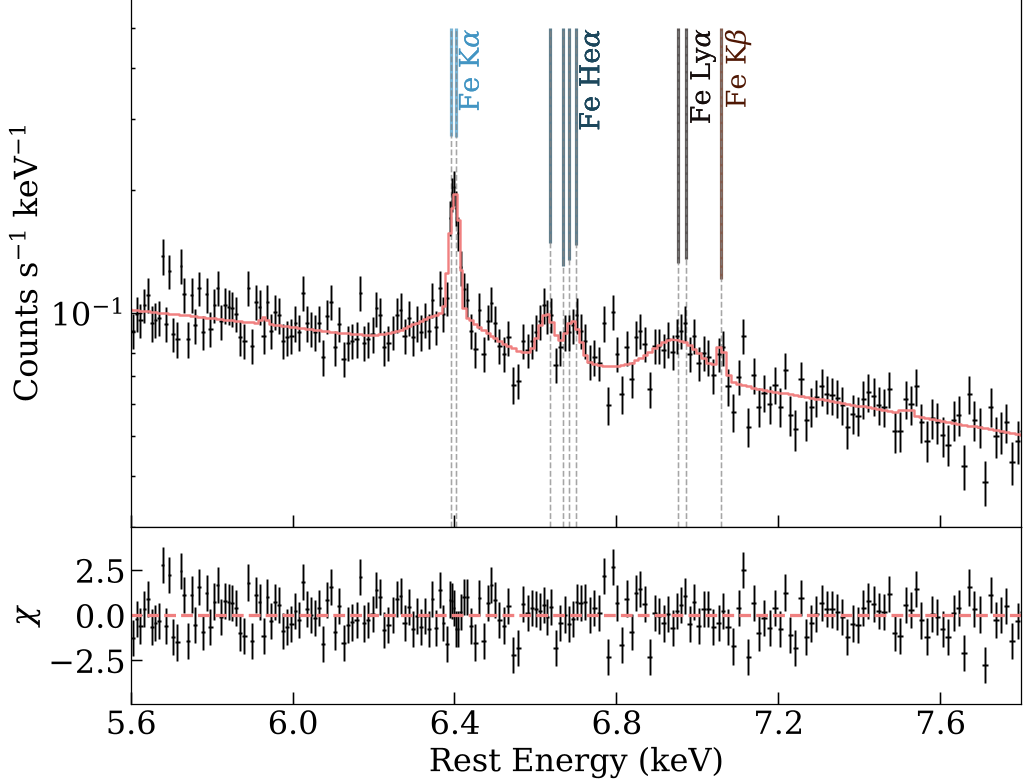 Figure 1: Comparison between "tied" velocity widths (left) and independent widths for Fe XXV/XXVI (right). The right panel hints that H-like iron (higher ionization) might be moving faster, suggesting it originates closer to the black hole.
Key Insights: Does Density Follow the Diet?
The most striking finding comes from the comparison with M 81*, a black hole of similar mass but with an Eddington ratio 100 times lower than NGC 7213.
- Density Scaling: In NGC 7213 , the ionized gas density is approximately .
- The Lower Limit: In M 81* , the density drops to .
This suggests a fundamental scaling law: as the accretion rate drops, the density of the highly ionized plasma in the nuclear region decreases. This supports the theoretical shifts from dense, radiation-driven winds in bright AGNs to tenuous, thermal/magnetic winds in LLAGNs.
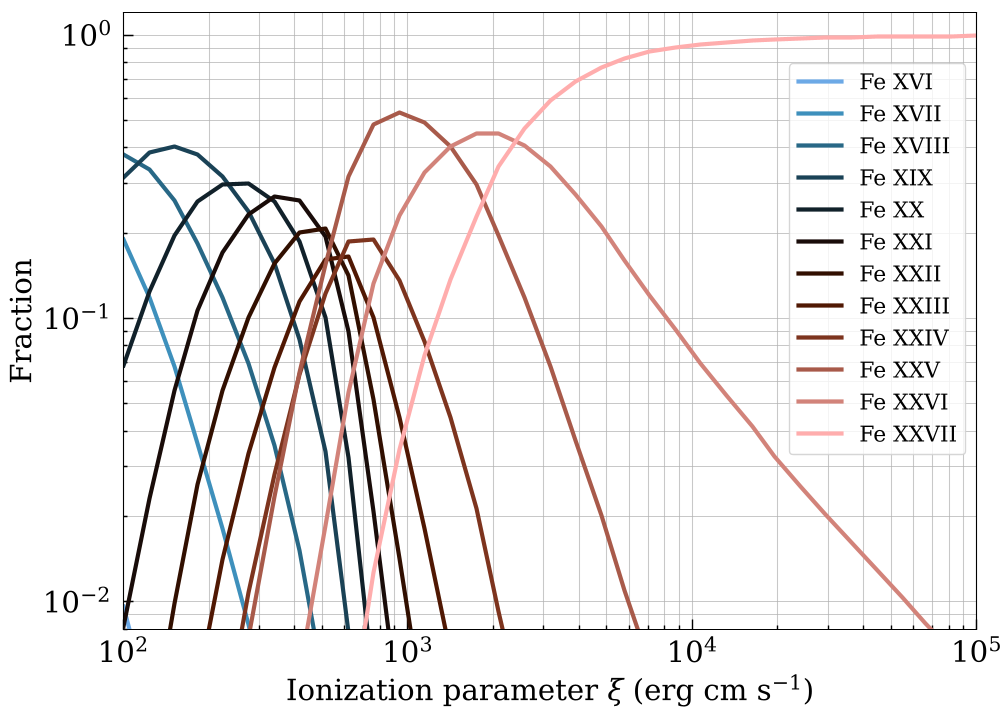 Figure 2: The ionization "balance" used to constrain the physical state of the gas. As increases, lower ionization states disappear in favor of Fe XXV (He-like) and Fe XXVI (H-like).
Conclusion and Future Outlook
While the current data from the PV phase cannot yet definitively "choose" between photoionization and collisional ionization (statistical improvement ), it establishes a clear methodology for future XRISM observations.
Takeaway: The density of coronal/wind gas is a direct tracer of the black hole's "feeding" habits. As the XRISM sample grows, we will finally be able to map the transition from the "roaring" bright AGNs to the "whispering" LLAGNs with chemical and kinematic precision.
Limitations
The suppression of intercombination lines in the Fe XXV complex remains a mystery. Standard models struggle to reproduce the exact line ratios suggested by the Gaussian fits, hinting that we may be missing subtle absorption effects or complex clumping in the gas.