
89Y+: The "Nuclear-Spin" Breakthrough for Large-Scale Trapped-Ion Computing
Yttrium ion as a platform for quantum information processing
The paper investigates singly-ionized yttrium (89Y+) as a new platform for quantum information processing. Utilizing its I=1/2 nuclear spin to form a field-insensitive ground-state qubit and leveraging high-resolution spectroscopy and hybrid CI+All-order calculations, the authors demonstrate 89Y+ as a versatile system achieving SOTA potential for low-crosstalk memory and operations.
TL;DR
Trapped-ion quantum computing has long been dominated by single-valence-electron ions (like Ba+ or Yb+). This paper introduces singly-ionized yttrium (89Y+) as a superior "all-in-one" candidate. By utilizing a spin-1/2 nucleus, it offers a ground-state qubit that is naturally shielded from magnetic noise and a rich internal structure that allows for "hidden" operations—effectively solving the crosstalk bottleneck for large processors.
The "Crosstalk" Crisis in Ion Traps
In a typical ion-trap array, pulses intended for Qubit A often "leak" to neighbors, causing decoherence. While the field has improved via the OMG (Optical, Metastable, Ground) architecture, most ions are still too sensitive to environmental magnetic fields.
The authors identify 89Y+ as a unique solution because:
- It has a 1/2 nuclear spin (ideal for a 2-state qubit).
- Its ground state has zero electronic angular momentum (1S0), meaning it only "sees" magnetic fields through its tiny nuclear moment.
- It possesses metastable levels where gates can be performed without disturbing the ground-state memory.
Methodology: Bridging Spectroscopy and Theory
Since 89Y+ data was historically sparse, the team combined cryogenic laser spectroscopy with high-precision CI+All-order (Configuration Interaction + Coupled-Cluster) calculations. This hybrid theoretical approach treats core-valence correlations with CC accuracy while handling the two valence electrons via CI.
The "OMG" Architecture in 89Y+
The secret to 89Y+'s efficiency lies in its complex level structure, which allows for different "modes" of operation:
- Storage: Ground-state nuclear spin (5s^2 1S0).
- Gating: Metastable manifold (4d5s 3D1).
- Readout: Narrow-line transition to 5s5p 3P0.
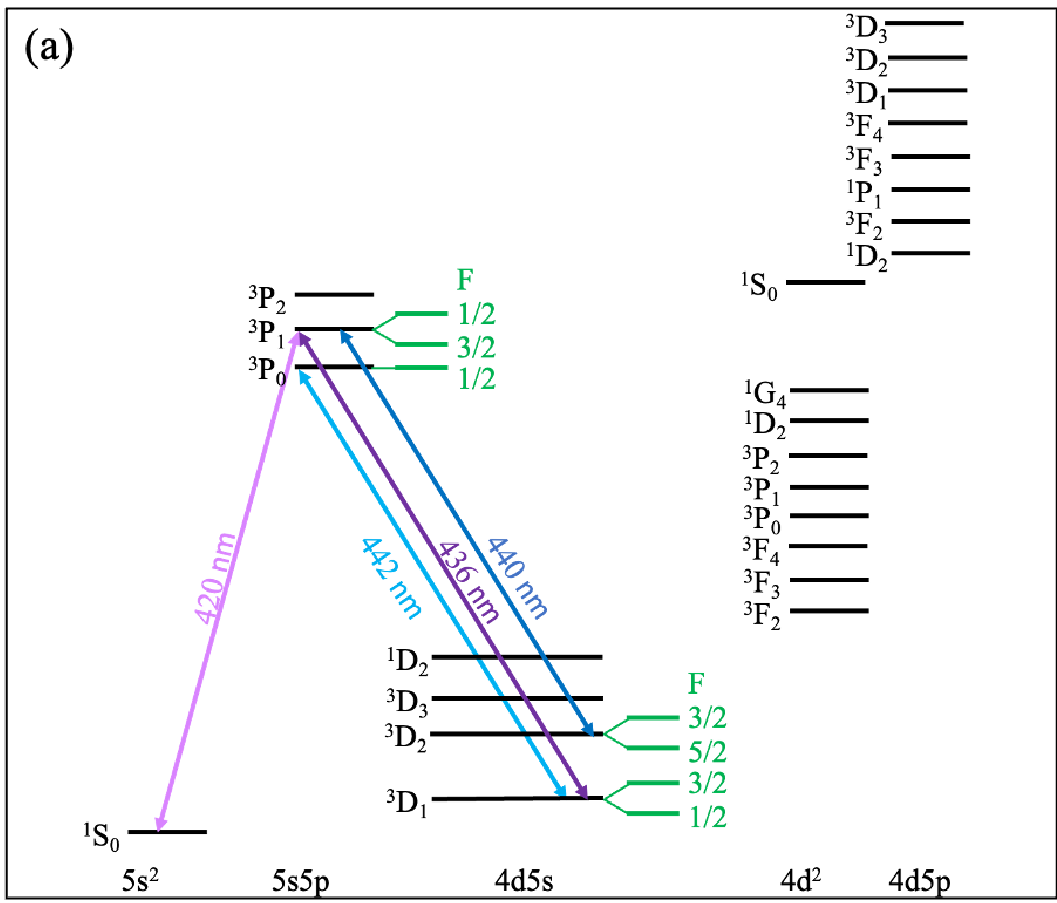 Fig 1. Energy levels of 89Y+. Note the separation between the ground state memory and the higher-energy operational manifolds.
Experimental & Numerical Results
The paper provides a masterclass in atomic characterization. Key findings include:
- Extreme Coherence: The 4d5s 3D1 state's lifetime is predicted at 45 billion seconds—effectively infinite for any quantum circuit.
- High-Fidelity Shelving: Moving information from the "shielded" ground state to the "active" gate states is critical. The authors simulated Raman shelving schemes (using 419nm and 445nm light) showing errors as low as ~10^-6, even with 1% laser polarization imperfections.
- Spectrally Isolated Measurement: By using the 442nm transition for readout, the branching fraction into the ground-state qubit is merely ~2 x 10^-9, meaning you can measure one ion without ever touching the data in the neighbor.
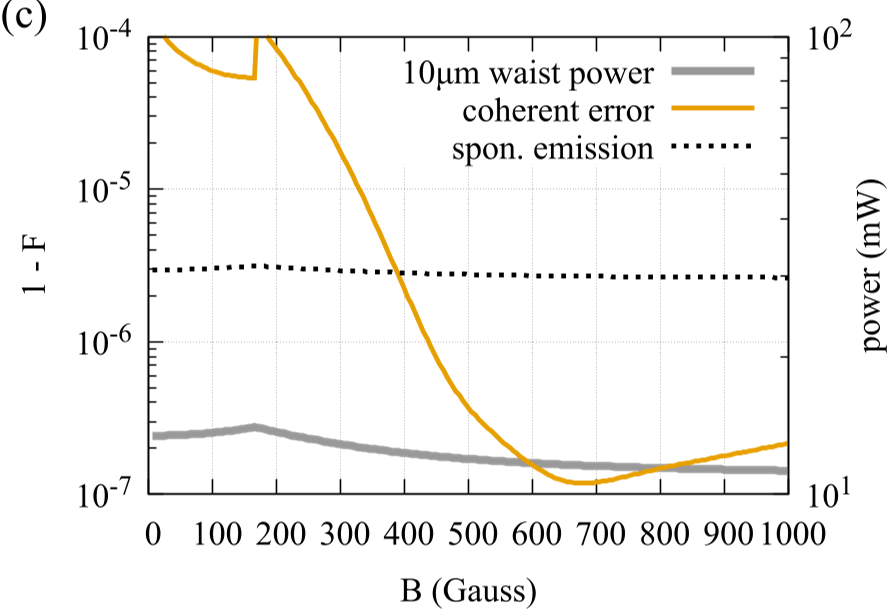 Fig 2. Shelving infidelity vs. magnetic field. The sharp drop highlights the "sweet spots" for robust coherent control.
Deep Insight: Why This Changes the Game
Most ion traps require two different species (e.g., one for cooling, one for math) to avoid crosstalk. 89Y+ can do both. Its nuclear spin is so insensitive that you can laser-cool a 89Y+ ion (acting as a coolant) right next to another 89Y+ ion (acting as a memory) without the cooling laser destroying the quantum data.
Limitations: The primary challenge is the need for more laser wavelengths (IR and UV) compared to "simpler" ions. However, as integrated photonics mature, this "resource usage" cost is outweighed by the massive gain in fidelity and scalability.
Conclusion
This work positions 89Y+ not just as another ion, but as a uniquely capable next-generation qubit. By marrying nuclear-spin memory with spectrally isolated metastable operations, it provides a blueprint for a monolithic, low-error quantum processor that could finally scale past the hundred-qubit barrier.