
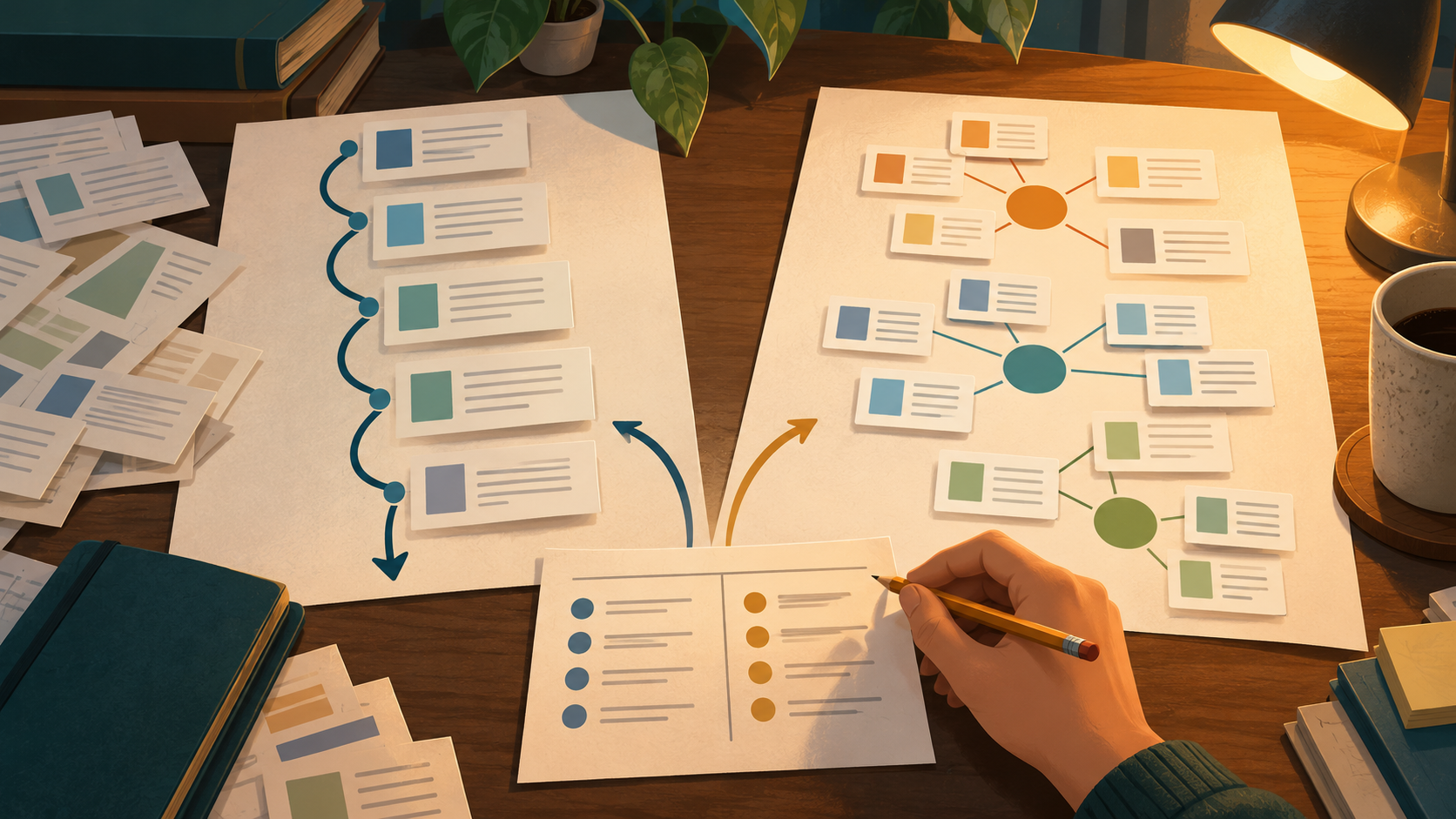
A literature review can be organized in two common ways. A chronological structure follows how a field developed over time. A thematic (argument-centered) structure groups studies by the ideas, debates, or mechanisms your question turns on. The right choice is not a matter of taste alone: it should follow from the question you are answering and the pattern of evidence you have collected.
This guide compares both structures on the same task, shows where each one fails, gives a decision table, and offers a combined workflow for a student or early-career researcher working to a deadline. It ends with a concrete submission decision.
The same task, two structures
Imagine a course paper due in three weeks. Your question is: How has research on [your topic] changed, and what does the current evidence say about [your specific claim]? Your rubric rewards a clear argument, critical synthesis, and correct citation. You have limited database access and one supervisor meeting before submission.
Under a chronological plan, you would:
- Identify the earliest foundational studies.
- Order later work by publication date.
- Describe how methods and findings shifted across periods.
- Close with the most recent studies.
Under a thematic plan, you would:
- Define two to four themes or debates that your question depends on.
- Assign each study to the theme it informs.
- Compare findings within and across themes.
- State what the balance of evidence supports and where gaps remain.
Both plans use the same sources. The difference is the organizing logic: time versus argument.
What each structure does well
Chronological strengths
A chronological review is strongest when the development itself is the question—for example, when you are tracing how a method, definition, or debate evolved. It makes change visible and helps a reader see which ideas are foundational and which are recent. It also gives you a natural narrative and an easy way to show that you have read broadly across a field's history.
Thematic strengths
A thematic review is strongest when your question asks what the evidence says about a claim, mechanism, or controversy. Grouping by theme lets you put studies that disagree side by side, compare their methods, and weigh their findings. This is the structure that most directly supports an argument, because each section answers a sub-question rather than reporting a date.
Where each structure fails
Chronological failure modes
- The timeline becomes the argument. You describe what happened without saying what it means for your question.
- Recency bias. The final section becomes a list of the newest papers, not an assessment of the strongest evidence.
- Buried comparison. Studies that disagree may sit years apart and never be compared directly.
- Weak fit with a claim-driven question. If your rubric asks for critical synthesis, a date-ordered list can read as description rather than analysis.
Thematic failure modes
- Themes that do not match the evidence. You impose categories the literature does not support, and studies fit awkwardly.
- Lost context. Without any historical framing, a reader may not understand why an older finding mattered or why a method changed.
- Repetition. The same study appears in several themes without adding new insight.
- Overlapping themes. If your categories blur together, the argument loses shape.
Decision table: which structure fits your task
| Criterion | Choose chronological | Choose thematic |
|---|---|---|
| Your question is about how a field, method, or debate evolved | Yes | Less suitable |
| Your question asks what the evidence says about a claim | Less suitable | Yes |
| Your rubric rewards critical synthesis and argument | Weak fit unless development is the argument | Strong fit |
| Your sources cluster by era with clear turning points | Yes | Possible but harder |
| Your sources cluster by debate, mechanism, or method | Harder | Yes |
| You have limited access and a short deadline | Workable if the timeline is simple | Workable if themes are few |
| You need to compare conflicting findings directly | Difficult | Yes |
A useful rule: if the word "how" in your question refers to change over time, go chronological; if it refers to what is supported or contested, go thematic.
A combined workflow when neither alone is enough
Many strong reviews use a hybrid: a short chronological opening that establishes the field's development, followed by thematic sections that carry the argument. This works when your reader needs historical context but your question is claim-driven.
A practical sequence for a deadline-bound project:
- State your question and sub-questions. Write them before you search, so your structure follows the question rather than the order in which you found papers.
- Plan the search from your eligibility criteria. Cochrane guidance recommends planning searches from eligibility criteria, using multiple sources, combining free-text terms with subject headings, and documenting the process. Use WisPaper search to find academic papers through its scholarly search interface, and keep a record of the terms and sources you used.
- Screen in stages and deduplicate. Cochrane also recommends deduplicating records, screening in stages, and linking multiple reports of one study. As you screen, note each paper's era and its theme so you can test both structures against your actual evidence.
- Save and organize the papers you keep. Use My Library to save or upload papers and organize them in the WisPaper library, so your chronological and thematic groupings draw on the same set.
- Test both outlines. Sketch a date-ordered outline and a theme-ordered outline from the same saved set. Whichever outline exposes more comparison and better answers your sub-questions is your structure.
- Ask questions across your saved papers. Use Library QA to ask questions based on papers uploaded to My Library or added from search results—for example, to check how different studies treat the same mechanism before you commit to a theme.
- Draft the synthesis, then check the citations. For longer research tasks that fit WisPaper's Scholar Agent area and its literature review, inspiration, or reproduction use cases, Scholar Agent can support the review workflow. Before submission, use TrueCite to screen your BibTeX against real academic databases and flag hallucinated references.
Applying rigor to either structure
NIH guidance treats careful assessment of prior knowledge, strengths, weaknesses, knowledge gaps, transparent methods, validation, and reproducibility as core parts of rigorous research practice. In a literature review, that translates into concrete habits regardless of structure:
- Assess prior knowledge explicitly. Say what is established, what is contested, and what is missing.
- Name strengths and weaknesses of studies. A chronological entry and a thematic entry should both note limitations.
- Make your method transparent. Describe how you searched, screened, and grouped studies.
- Identify knowledge gaps. End each section with what remains unresolved.
If your review is a systematic review rather than a course paper, PRISMA 2020 provides a reporting checklist, expanded explanations, an abstract checklist, and flow-diagram templates, including transparent reporting of search, selection, and synthesis methods. A chronological or thematic structure can sit inside that reporting framework; the framework tells you what to report, while the structure tells you how to organize the argument.
Worked example: the three-week deadline
Return to the course paper. After screening, you find that your sources fall into three clusters: an early period that established the basic definition, a middle period that debated measurement, and a recent period with conflicting findings on your specific claim.
- A purely chronological draft would describe the three periods in order. It would satisfy breadth but leave the conflicting recent findings as a final list.
- A purely thematic draft would group by definition, measurement, and current claim. It would compare the conflicting findings directly but might not explain why the measurement debate arose.
- A hybrid draft opens with two short paragraphs on the definition and measurement periods, then devotes most of the paper to the current claim, comparing studies by method and finding. The historical opening earns context; the thematic core carries the argument.
With limited access, the hybrid also helps you prioritize: the historical opening can rely on the foundational papers you already have, while your remaining search time goes to the current claim where the comparison matters most.
Using supervisor feedback to choose
Bring both outlines—one page each—to your supervisor meeting. Ask two questions: Does the rubric reward development or argument? and Which outline makes the conflicting evidence easiest to compare? Feedback that pushes you toward "more analysis" usually points to a thematic core; feedback that says "I don't understand how this field got here" points to a chronological opening. You do not have to choose one structure for the whole paper.
Final submission decision
Before you submit, make one explicit decision and write it into your methods paragraph:
- If your question is about change over time, submit a chronological structure, but add a comparison paragraph at each turning point so the timeline still argues.
- If your question is about what the evidence supports, submit a thematic structure, but add a short historical opening so the themes have context.
- If both are true, submit the hybrid: brief chronology, thematic core, explicit gap statement.
Then check that every factual claim traces to a source, that your search and screening process is described, and that your references are real. That final check is the difference between a structure that looks organized and a review that earns its argument.
FAQs
Keep Reading

Citation Verification: A Complete Pre-Submission Workflow
Citation verification is the practice of confirming, for every reference in a manuscript, that the work exists, that its metadata is correct, that you are citing the right version, that its correction status is known, th

Crossref vs. PubMed Metadata: Why the Same Paper Can Look Different
A single paper can appear under slightly different titles, author strings, dates, and subject terms depending on whether you meet it through a publisher deposit or through PubMed. For a clinician or researcher building a

Database Search vs. Natural-Language AI Search for Evidence Gaps
You have a deadline, a rubric that rewards a defensible literature base, and a nagging worry that you have missed a key paper. The question is not whether databases or natural-language AI search are "better" in the abstr