
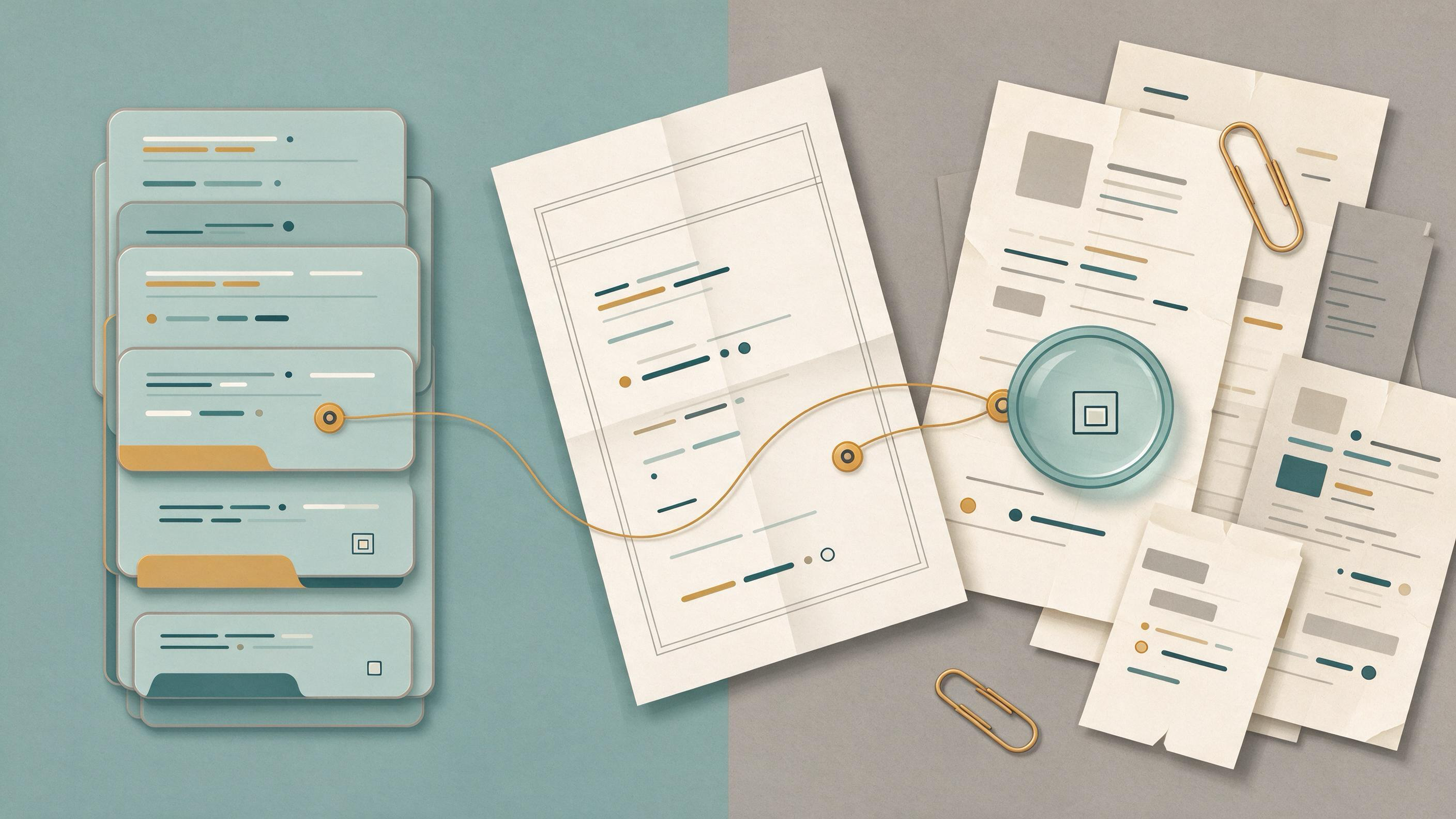
A reference manager and a shared folder usually drift apart for a mundane reason: they store different things. The reference manager holds bibliographic records and citation keys. The shared folder holds PDFs, drafts, notes, and whatever a coauthor renamed at midnight. When the two disagree, the manuscript is not necessarily wrong, but its evidence trail has become unauditable. This guide walks through a concrete repair for a manuscript heading into coauthor review, then shows how the same method transfers to a lab handoff or a reproducible search.
What the disagreement actually looks like
Picture a manuscript in its second revision. The reference manager lists 84 entries. The shared folder holds 91 PDFs. Three citations in the draft point to keys that no longer exist in the library. Two PDFs in the folder have filenames that match no library record. One entry has a title that differs slightly from the PDF sitting next to it.
None of these signals proves a citation is fabricated or that a claim is unsupported. They prove something narrower and still serious: you cannot currently trace each in-text citation to a specific record and a specific document. That traceability is the deliverable you are repairing.
Diagnose your starting state before you touch anything
Repair work goes wrong when it starts with editing. Start with a read-only inventory instead. You want to know which of three conditions you are in.
- Record-only drift. The library and folder mostly match, but a few keys were renamed or merged.
- Document-only drift. Extra PDFs sit in the folder with no library record, often downloaded during a literature sweep.
- Identity drift. A record and a document share a filename but may not describe the same work, or a record's metadata may not match the version you read.
Write the inventory down as a dated file in the shared folder. A short table with columns for citation key, in-text location, library record present, PDF present, and status is enough. This file becomes the audit log that later readers, including your future self, will rely on.
Decide what counts as the source of truth
Before reconciling, decide which artifact governs. There are two defensible choices, and they lead to different work.
Record-governed. The reference manager is authoritative; the folder is cleaned to match it. This suits projects where the library was curated carefully and the folder accumulated clutter.
Document-governed. The PDFs are authoritative; library records are corrected to match the documents actually read. This suits projects where coauthors added papers directly to the folder.
Most real manuscripts need a hybrid: records govern identity, documents govern what was actually read. State the rule in the audit log so coauthors apply it consistently. Without a stated rule, each coauthor reconciles differently and the disagreement returns.
Verify identity with identifiers, not filenames
Filenames are the least reliable field in any shared folder. A DOI is a better anchor. A DOI resolves through doi.org to the current destination registered for that identifier, which helps you locate a work. Resolution alone does not confirm that the bibliographic fields match or that the source supports your claim, so treat it as a locating step, not a verification step.
For each disputed entry, work in this order:
- Resolve the DOI and confirm it points to the work you intend.
- Compare title, authors, venue, and date against the record.
- Check whether the record reflects a post-publication update, since publisher-deposited metadata can include updates from trusted sources.
- Only then decide whether the record or the document needs correcting.
Crossref's REST API exposes publisher-deposited metadata including titles, authors, venues, dates, identifiers, licenses, funding, ORCID and ROR identifiers, and abstracts when deposited. That makes it a useful place to check whether a field in your library came from a deposit or was typed by hand.
Rebuild the citation-to-document chain
With identity settled, rebuild the chain from the manuscript outward. Open the draft and list every in-text citation with its location. For each one, record the citation key, the library record, and the PDF that supports the claim.
Where a citation has no matching record, you have three options: restore the record, replace the citation with a verified one, or remove the claim. Where a record has no PDF, decide whether the claim rests on an abstract, a preprint, or a version you no longer have. Mark that decision explicitly rather than leaving a blank cell.
This is also the point to screen the bibliography itself. If entries were assembled quickly or inherited from an earlier draft, run the BibTeX through TrueCite, which checks BibTeX against real academic databases to flag hallucinated references. Flagged entries go back into the identity check above; a flag is a prompt to verify, not a verdict.
Use search to close gaps, not to reopen them
Gap-filling is where repair work often creates new drift. A coauthor searches for a missing paper, downloads a PDF, and drops it in the folder without a record. To avoid repeating the original problem, search and record in the same pass.
When you need to locate a work by author or title, or find an alternative version, Google Scholar documents searching by author and title, date sorting and date limits, Cited by and Related articles, citation export, library access links, email alerts, and ways to locate alternative versions. Use those controls to narrow the search, then immediately create or correct the library record before moving on.
If you prefer to run the search inside a research workspace, WisPaper search provides a scholarly search interface where you can find papers and then carry them into your library rather than leaving them loose in a folder.
Consolidate the corrected library and folder
Once every citation has a record and a document, consolidate. Save or upload the reconciled papers into My Library so the curated set lives in one organized place rather than being reconstructed from folder contents each time.
Then clean the folder against the audit log. Rename PDFs to match citation keys, move unmatched files into a clearly labeled holding area, and leave the audit log at the top level. The goal is that a coauthor opening the folder can move from any filename to a library record without asking you.
Check the claims, not just the citations
A reconciled bibliography still leaves a separate question: does each cited source actually support the sentence it is attached to? Identity verification answers whether the paper is the right paper. Claim support is a different check.
Work through the manuscript section by section, reading the cited passage alongside the sentence. Where a claim rests on a paper in your curated library, you can query the uploaded set directly with Library QA, which lets you ask questions based on papers uploaded to My Library or added from search results. Use it to locate the relevant passage quickly, then confirm the wording against the source text yourself.
Produce the corrected deliverable
The repair is finished when you can hand over four artifacts together:
- the revised manuscript with citation keys that all resolve to library records;
- the reconciled library, with corrected metadata and no orphan keys;
- the cleaned folder, with filenames matching keys and unmatched files quarantined;
- the dated audit log recording the source-of-truth rule, the identity checks performed, and the disposition of every disputed entry.
That bundle is the corrected deliverable. It is also the evidence trail a coauthor, reviewer, or successor needs to retrace your decisions without reconstructing them from memory.
Know when the result is ready
Use a short readiness test rather than a feeling that the draft looks fine.
- Every in-text citation maps to exactly one library record and one document, or to an explicit, logged exception.
- Every disputed entry has a recorded resolution and a reason.
- No filename in the folder contradicts its library record.
- The audit log is dated and stored where coauthors can find it.
If any line fails, the disagreement has moved rather than closed. Fix the failing line before circulating the draft.
Transfer the method to a lab handoff or reproducible search
This repair generalizes because the underlying problem is always the same: two stores of evidence with no stated reconciliation rule. For a lab handoff, the audit log becomes the handoff note, and the source-of-truth rule tells the incoming researcher which store to trust. For a reproducible search, the log records the search controls used, the versions selected, and the reason each paper entered the set.
Longer projects benefit from keeping the reconciliation inside a structured workspace. Research Projects gives you a place to create and organize a project, so the library, the audit decisions, and the manuscript stay associated rather than scattered across drives. When a review needs a broader literature pass before reconciliation, Scholar Agent supports longer research tasks in the literature review, inspiration, and reproduction areas.
FAQs
Keep Reading
Your Supervisor Asks What Changed Since the Last Draft
A supervisor's question about what changed since the last draft is not a request for reassurance. It is a request for a defensible record: which claims moved, which evidence arrived, which sections were cut, and what you

Your Team Cannot Tell Which Sources Were Actually Checked
A shared folder full of PDFs feels like progress. But when a teammate opens the folder in January and asks "which of these did anyone actually read, and which ones support the claim in paragraph three?" the honest answer

Your Client Deck Uses a Number from an Unknown Version of a Report: A Provenance Repair Playbook
A figure is sitting in slide 14 of a client deck. It has a citation, but the citation points to a report title with no version, no date, and no page. Someone on the team pulled it months ago, and nobody can say whether i