
Chasing Offensive Conduct: The Physics of Reputation in Social Moderation
1003_Chasing Offensive Conduct in Social Networks A Reputation-Based Practical Approach for Frisber.
Summary
Problem
Method
Results
Takeaways
This paper introduces a reputation-based automatic moderation system for social networks, specifically implemented in the geolocalized platform "Frisber." It utilizes dynamic reputation scores to weigh user reports, effectively filtering offensive public content and abusive private interactions without human oversight.
## TL;DR
Moderating a social network is a race against scale. This paper presents a practical, automated solution deployed on the **Frisber** network. By treating every user report as a weighted reputation signal rather than a simple "flag," it eliminates the need for human administrators. Its innovation lies in **dynamic parameters** that adjust to user behavior in real-time, handling both public posts and private harassment.
## The Problem: The scalability Wall of Manual Review
Most social giants (Facebook, Twitter, LinkedIn) still rely on a "report-then-review" loop. This creates three critical failures:
1. **High Latency**: Content often stays up for hours or days while waiting for an admin.
2. **Binary Bias**: A single report from a malicious user is often treated with the same initial weight as one from a trusted community pillar.
3. **The Private Blindspot**: Most research focuses on public feeds, leaving private messaging—a hotbed for cyber-bullying—unmoderated.
## Methodology: Trust as a Dynamic Variable
The authors' core "Insight" is that trust shouldn't be static. They reworked the baseline model (Gómez Mármol et al. 2014) to be self-adaptive.
### 1. The Reporting Physics
When a user reports something, they "gamble" a portion of their reputation. If the report is eventually verified, their reputation is restored and rewarded. If they are wrong (or malicious), they suffer **Reputation Decay**.
The paper introduces two vital dynamic variables:
- **$\lambda$ (Time Window)**: How fast the reputation drops. Trusted users who report frequently get more "breathing room" (a longer $\lambda$) while their reports are processed.
- **$\delta$ (Decay Amount)**: How much reputation is lost. This is now dependent on how many others have seen the content—if you're the only one reporting a widely seen post, the system suspects your intentions and increases your potential penalty.
### 2. Private Abuser Detection
Unlike public posts, private messages have no "crowd" to verify claims. The authors solve this using the **Dynamic Trust Threshold (DTT)**.

*The DTT equation accounts for the distance between users and the time since their last interaction, ensuring that long-standing relationships require more evidence to break than a single interaction between strangers.*
## Experiments: Battle-Tested on Frisber
The system wasn't just a theory; it was deployed on Frisber, a geolocalized social network.
### Key Findings:
- **Accuracy**: In real-world trials, 100% of the content and users banned by the system were manually verified as truly offensive.
- **Robustness**: In large-scale simulations (U=200), the system maintained high accuracy (the "NN" and "OO" curves) until malicious users exceeded 40% of the population.
- **Performance**: While LinkedIn takes 100+ hours to respond to reports, Frisber’s automated system takes between **2 to 50 minutes**.
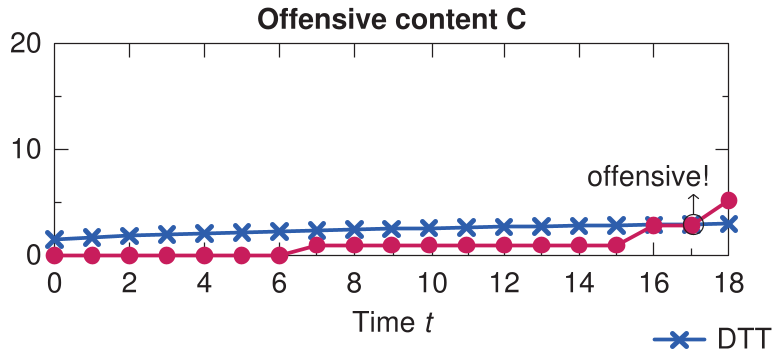
*Figure: Cumulative Likelihood (CL) climbing against the Threshold (DTT) for four offensive messages. Once the blue line crosses the red line, the content is vaporized.*
## Critical Analysis & Conclusion
The "Frisber approach" provides a blueprint for small-to-mid-sized platforms to police themselves without a massive legal or ops team.
**The Takeaway**: The move from static to dynamic reputation decay is the "secret sauce." It prevents the system from being "gamed" by malicious mobs while protecting the reputations of honest, active users.
**Limitations**: The system assumes "offensive" is a consensus, which may fail in highly polarized political environments where two groups might both have high reputations but fundamentally different definitions of "offensive." Future work integrating NLP to distinguish between "disagreement" and "abuse" would be a potent next step.
## Future Outlook
As social networks move toward decentralization (like Mastodon or BlueSky), centralized moderation is impossible. Reputation-based models like the one proposed here are likely the only way these "ownerless" networks will survive the inevitable influx of trolls.