
Beyond Ratings: Building Social Connections in Recommender Systems via Fuzzy Linguistic Hierarchies
11521_ks in Social Network-Based Recommender System.
The paper proposes a novel model to boost user connections in Social Network-Based Recommender Systems (SNRSs) by utilizing Fuzzy Linguistic Approaches and Extended Linguistic Hierarchies (ELH). It specifically focuses on matching users based on psychological theories of interpersonal attraction, such as attitude and personality similarity, to mitigate data sparsity and cold-start problems.
TL;DR
This research introduces a framework to enhance Social Network-Based Recommender Systems (SNRSs) by modeling interpersonal attraction. By using Extended Linguistic Hierarchies (ELH) and Fuzzy Linguistic Approaches, the system can process vague, qualitative data about user personalities and attitudes to suggest meaningful social connections, effectively addressing the "Cold-Start" problem through psychological profiling rather than just historical transaction data.
Problem & Motivation: The Vague Nature of Human Connection
Modern e-commerce faces a paradox: users want personalization, but new users provide no data—the classic Cold-Start problem. While social networks can bridge this gap, how do we encourage social links in a vacuum?
The authors argue that current systems are "digitally rigid." Human traits (likes, dislikes, temperament) are inherently imprecise and multigranular. One user might describe their personality as "High" (granularity of 3), while another uses a 9-point scale. Previous models struggled to unify these disparate qualitative inputs without losing precision or forcing users into unnatural scales.
Methodology: The Core of Extended Linguistic Hierarchies (ELH)
The heart of this paper is the Extended Linguistic Hierarchy (ELH). It moves beyond simple numerical mapping to a 2-tuple linguistic representation.
1. Unification through ELH
The system allows for various levels of linguistic term sets (). To compare a user who assesses their "Sociability" on a 3-term scale with one who uses a 7-term scale, the model uses a transformation function ():
This ensures that "High" on a small scale maps accurately to the corresponding value on a larger, more granular scale without losing the "informational fuzziness."

2. Similarity and Affinity Logic
The model calculates two primary vectors:
- Attitude Similarity (): Comparing stances on specific topics.
- Personality Similarity (): Comparing core psychological traits.
The final Affinity Degree () is a weighted aggregation of these similarities, allowing the system owner to prioritize, for example, attitude over personality.
Experimental Results & Practical Example
The paper illustrates the model through a scenario where a user seeks to connect with unknown users .
By applying the transformation logic and similarity functions, the system produces a ranked vector of candidates. In the provided example, the model calculated that and shared the highest affinity with user , despite the input data being expressed in heterogeneous linguistic sets.
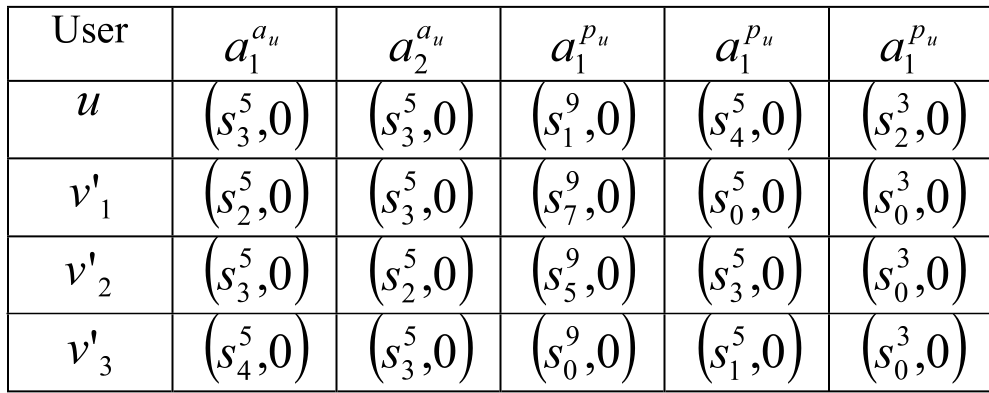
Table: Input linguistic assessments for user and potential candidates.
Critical Analysis & Conclusion
Takeaway
The power of this method lies in its flexibility. It respects the user's natural language and provides a mathematically sound way to handle "vague" data, which is far more human-centric than traditional binary or integer ratings.
Limitations & Future Work
While the theoretical framework is robust, the paper leaves the automated gathering of traits as an open question. Manually filling out personality or attitude surveys is a high-friction task. Future iterations will likely look toward Implicit Feedback Analysis—extracting these traits automatically from user comments or social media activity to fuel the fuzzy logic engine.
By bridging the gap between psychological theory (similarity-attraction effect) and fuzzy mathematics, this work paves the way for "smarter" social commerce where platforms don't just recommend products, but potential collaborators and friends.