
Beyond the Silo: Decoding Human Behavior in the Age of Multiplex Social Media
13151_Following People's Behavior Across Social Media.
The paper presents a multidimensional analysis of user behavior across multiple social platforms using a novel dataset from the aggregator Alternion. It investigates user membership, centrality (popularity), posting activity, and username consistency across different layers of the online social ecosystem.
TL;DR
Are you a "celebrity" on Twitter but a "nobody" on LinkedIn? This paper proves that your digital influence isn't a portable asset. By analyzing over 19,000 users across 150+ platforms via the aggregator Alternion, researchers found that while we tend to use the same usernames everywhere, our popularity (centrality) and activity levels vary wildly from one site to another.
The "Single Site" Blind Spot
For a decade, social media research has treated Facebook, Twitter, and LinkedIn as isolated islands. However, humans are inherently "multiplex." We use Instagram for visual storytelling, LinkedIn for professional networking, and Twitter for real-time news.
The authors argue that studying a user on just one platform provides a fractured, incomplete picture. The challenge has always been data: platforms don't like sharing, and users value privacy. By using Alternion—a service where users voluntarily aggregate their public profiles—the researchers bypassed these silos to see the "whole" digital human.
Methodology: Mapping the Multiplex
The study utilizes two primary datasets:
- D1 (19,680 profiles): Focused on posting activity and network "degree" (number of friends/followers).
- D2 (15,000 profiles): Focused on username strings to check for cross-site consistency.
The core of the analysis relies on Kendall’s rank correlation. Instead of asking "Does a user have more friends?", it asks "If a user is in the top 10% of popular accounts on Facebook, are they also in the top 10% on Twitter?"
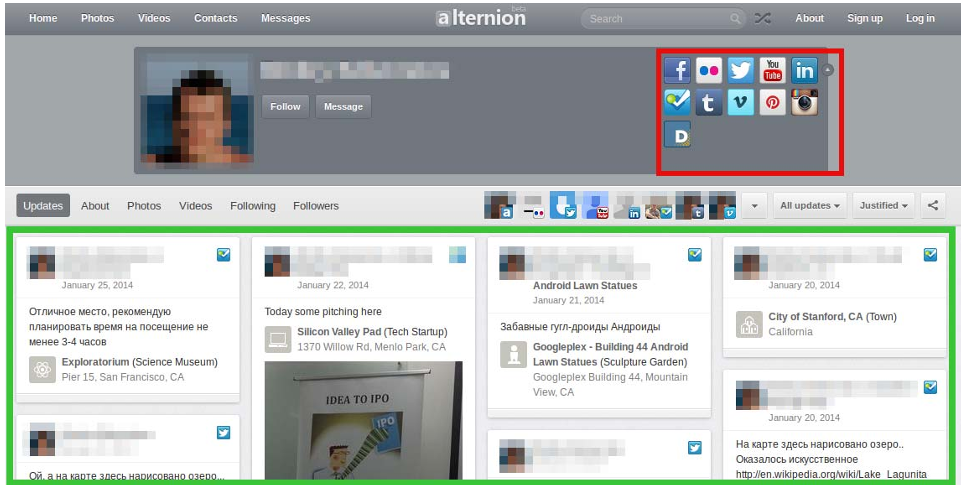 Fig 1: The Alternion interface allowed researchers to link disparate identities back to a single human user.
Key Insight 1: Popularity is Context-Dependent
One of the most striking findings is the lack of degree correlation. The rank correlation matrix (Fig 5e) shows coefficients as low as 0.1 to 0.23.
- The Hub Paradox: A "hub" (highly central user) on LinkedIn might be a peripheral observer on YouTube.
- Platform Specificity: Because different platforms serve different psychological and professional needs, "social capital" does not transfer automatically. Your 5,000 Facebook friends don't necessarily follow you to your professional circle.
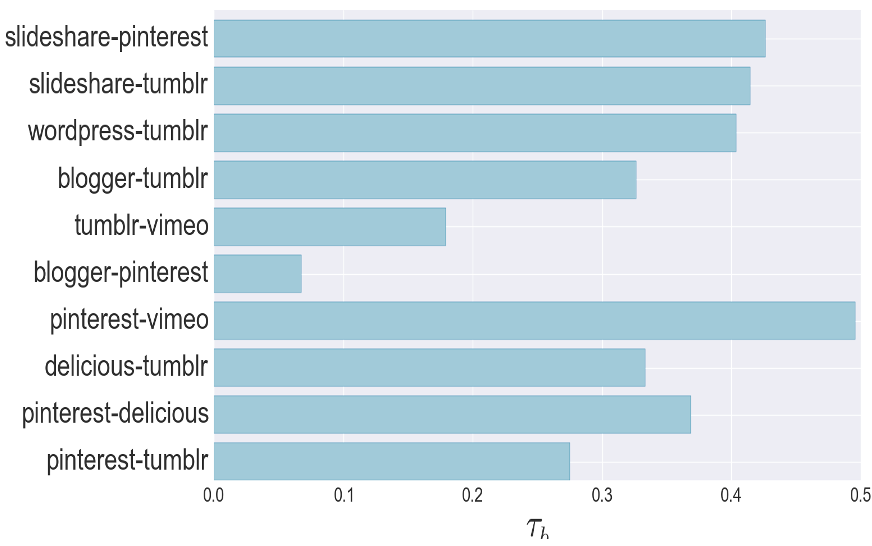 Fig 2: The Rank Correlation Matrix (e) reveals very weak links between a user's popularity across different platforms.
Key Insight 2: The "Identity Thread" (Usernames)
Despite our varying popularity, we strive to remain recognizable. The researchers used Edit Distance and Jaccard Index to compare usernames across sites.
- High Consistency: There is a significant peak at 0 for dissimilarity measures, meaning many users keep their exact username.
- Intentional Branding: This suggests that users want to be identifiable, even if their level of engagement fluctuates between platforms.
Experiments & Results: The Rise of the Multi-Platformer
The data confirms a massive shift in usage:
- Multi-Platform Usage: 56% of users are on at least three platforms.
- Active Users: 73% of users who actually post content do so on at least two networks.
- Production Leader: Twitter remains the king of content volume, while Facebook is the "home base" for social ties.
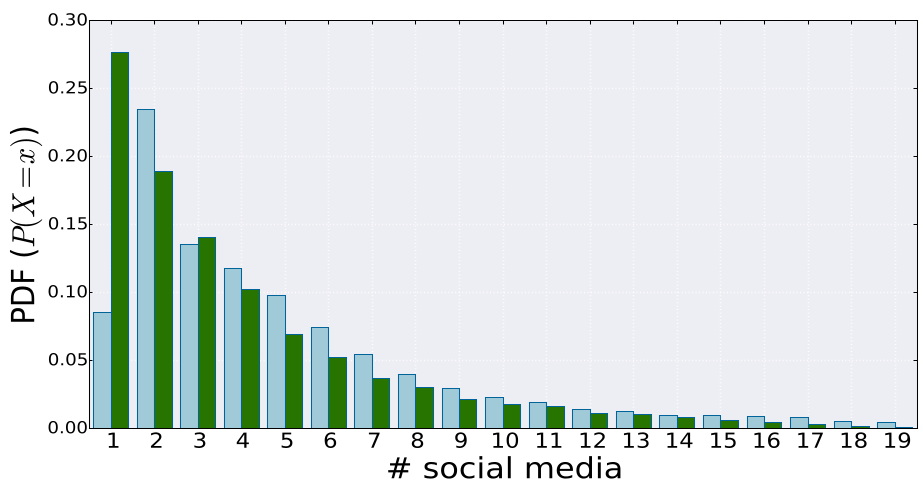 Fig 3: Distribution of posts per user (CCDF), showing a heavy-tail distribution where a few "super-users" produce the vast majority of digital content.
Critical Analysis & Conclusion
This work is a vital check on the "influence" industry. It suggests that "Total Reach" (summing followers across all platforms) is a flawed metric because it ignores the fact that the nature of a user's influence changes per medium.
Limitations: The study focuses on public data. Private interactions (DMs, private groups) remain the "dark matter" of social media that this multiplex analysis cannot yet reach. Additionally, the dataset is restricted to users who use aggregators, who might be more "tech-savvy" than the average person.
Future Outlook: The next frontier is Content Multiplexing. Do we talk about the same topics on Twitter and LinkedIn? By applying NLP to these longitudinal time series, we can finally understand how human discourse adapts to the digital environment it inhabits.