
i-MAC: Pioneering Priority-Aware Scheduling for In-Body Healthcare IoT
13583_i-MAC In-Body Sensor MAC in Wireless Body Area Networks for Healthcare IoT.
This paper introduces i-MAC, an energy-efficient Medium Access Control protocol specifically designed for in-body (implant) sensors within Wireless Body Area Networks (WBANs). By implementing a modified superframe structure and a Ranking and Priority Assignment (RAP) algorithm, it achieves lower latency and reduced energy consumption compared to the IEEE 802.15.6 standard.
TL;DR
The i-MAC protocol revolutionizes how implantable sensors (like pacemakers or insulin pumps) talk to external hubs. Unlike existing standards that rely on "crash-prone" arbitrary transmissions during emergencies, i-MAC introduces a Scheduled Access mechanism. By ranking nodes based on the urgency of their biological data, it ensures that critical alerts get through first while maximizing the battery life of devices buried deep within human tissue.
Background: The Hidden Challenges of In-Body Networks
Wireless Body Area Networks (WBANs) are the backbone of modern remote patient monitoring. However, "In-body" sensors (implantable) face a much harsher environment than "On-body" (wearable) sensors. Signal attenuation is not just about distance; it's about the depth of muscle and fat.
The current IEEE 802.15.6 standard has a major flaw: when an emergency occurs, sensors just "scream" data onto the channel without sensing it. This leads to a "collision disaster" where multiple sensors trying to report emergencies actually block each other out.
Methodology: The i-MAC Architecture
The core innovation of i-MAC lies in its Modified Superframe Structure and the Ranking and Priority Assignment (RAP) algorithm.
1. The Superframe Redesign
The hub divides time into superframes with specialized slots:
- i-Scheduled Uplink: Every node sends a digest of its sensing history.
- i-Unscheduled Bilink: The hub polls the most "critical" nodes first for detailed data.
- Regular Phases: For standard, non-emergency monitoring.
2. The RAP Algorithm: Smart Medical Prioritization
How does the hub know who is in the most danger? It calculates an Emergency Event Index (EEI).
- Phase I: Counts total critical events (How many times did the heart rate spike?).
- Phase II: Analyzes the "Recency" (Did the spike happen just now, or 5 minutes ago?).
- Phase III: Combines these into a final Rank. Recent emergencies are given the highest priority.
 Figure 1: The logic flow of the Ranking and Priority Assignment (RAP) algorithm.
Experiments & Performance Analysis
The authors compared i-MAC against the standard IEEE 802.15.6 and newer "Emergency Access Phase" (EAP) schemes using MATLAB simulations.
Latency Win
As shown in the results, because i-MAC eliminates the "back-and-forth" of collisions seen in CSMA/CA, the delay remains controlled even as the number of nodes increases.
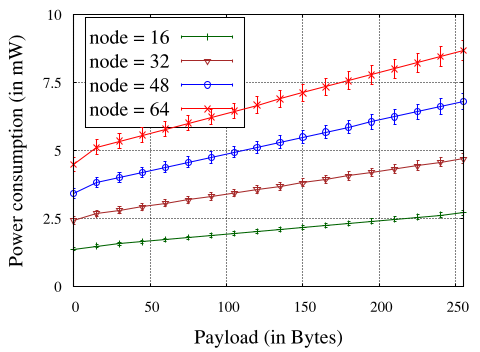 Figure 2: Benchmark Comparison showing i-MAC's superior performance in latency (a) and power consumption (b).
Power Efficiency
Power consumption in implantable devices is critical—replacing a battery often means surgery. i-MAC's scheduled polling prevents nodes from wasting energy on failed transmissions and idle listening, significantly extending device longevity.
Critical Insight & Conclusion
While most MAC protocols focus on "high throughput," i-MAC focuses on "meaningful reliability." By moving the "intelligence" of the emergency detection to the Hub, it keeps the implantable sensors simple and low-power.
Limitations: The current model assumes a one-hop star topology. In reality, very deep implants might need a multi-hop (two-hop) relay through on-body sensors, which the authors suggest for future work.
Takeaway: i-MAC proves that for Healthcare IoT, Deterministic Scheduling is safer and more efficient than Competitive Access. It sets a new benchmark for how we design life-saving communication systems.