
Hardwiring Optimization: A 1600-MIPS Parallel Processor for Job-Shop Scheduling
13615_A 1600-MIPS parallel processor IC for job-shop scheduling.
This paper presents a 1600-MIPS SIMD parallel processor IC specifically designed to accelerate Job-Shop Scheduling using the Lagrangian Relaxation Neural Network (LRNN) algorithm. Fabricated in 0.35-μm CMOS, the chip implements a tailored instruction set to resolve complex manufacturing optimization problems with high efficiency.
TL;DR
Researchers have developed a specialized SIMD parallel processor IC that turns the complex Lagrangian Relaxation Neural Network (LRNN) algorithm into high-speed hardware logic. By utilizing 16 processing elements and a custom instruction set, this chip achieves up to 30x speedup over traditional PC-based software for job-shop scheduling, making real-time manufacturing adjustments a reality.
Background: The Cost of a Bad Schedule
In a high-variety manufacturing environment (a "job shop"), scheduling is the difference between profit and bankruptcy. The goal is simple: which machine processes which part at what time to minimize tardiness? However, the math is brutal. Traditional software-based heuristics often take too long to respond to real-world changes like machine failures or urgent new orders.
The LRNN algorithm is a powerful mathematical framework that decomposes the massive global scheduling problem into smaller, independent subproblems using Lagrange multipliers. While theoretically parallel, running this on a standard CPU or even a DSP still encounters sequential bottlenecks, particularly during the "forward sweep" and "dynamic programming" phases.
The Architecture: Fine-Grained SIMD Power
The authors recognized that the LRNN algorithm is inherently structured around "states" (time units) and "stages" (operations). They built a Single-Instruction Multiple-Data (SIMD) architecture where each Processing Element (PE) is responsible for a single time state.
Key Design Innovations:
- Local Multiplier Storage: Unlike traditional architectures that fetch data from global memory, each PE stores its own Lagrange multipliers locally. This significantly reduces bus contention.
- Specialized Instruction Set: The IC features 1-cycle instructions like
CMPAS(Compare, Store, and Shift) andADDDS, which combine three standard operations into one. - Search Bypass Circuitry: The "Forward Sweep" (finding the optimal path) is usually a serial bottleneck. The authors implemented a "carry-bypass" inspired logic that allows the search signal to skip entire blocks of non-optimal states, drastically cutting down latency.
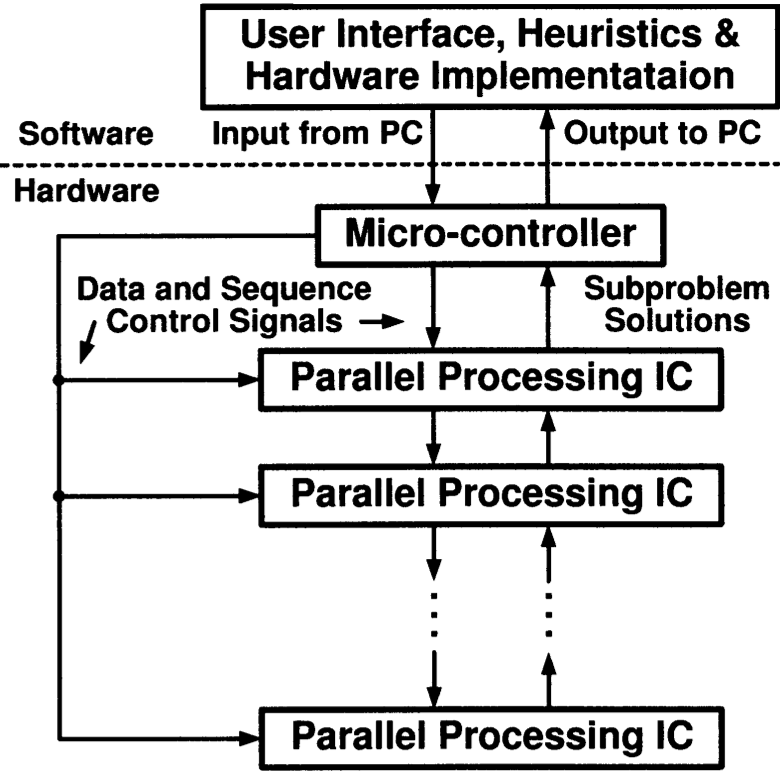 Figure 1: The overall system architecture connecting the host PC, microcontroller, and the parallel processor ICs.
Methodology: Solving Subproblems in Silicon
The core of the methodology lies in Neuron-Based Dynamic Programming (NBDP). The chip iterates through the following steps:
- Backward Pass: PEs calculate the "cost-to-go" stage-by-stage.
- Forward Sweep: The search bypass circuit identifies the optimal beginning times.
- Multiplier Update: The chip adjusts the "penalties" (Lagrange multipliers) locally within each PE based on machine capacity violations.
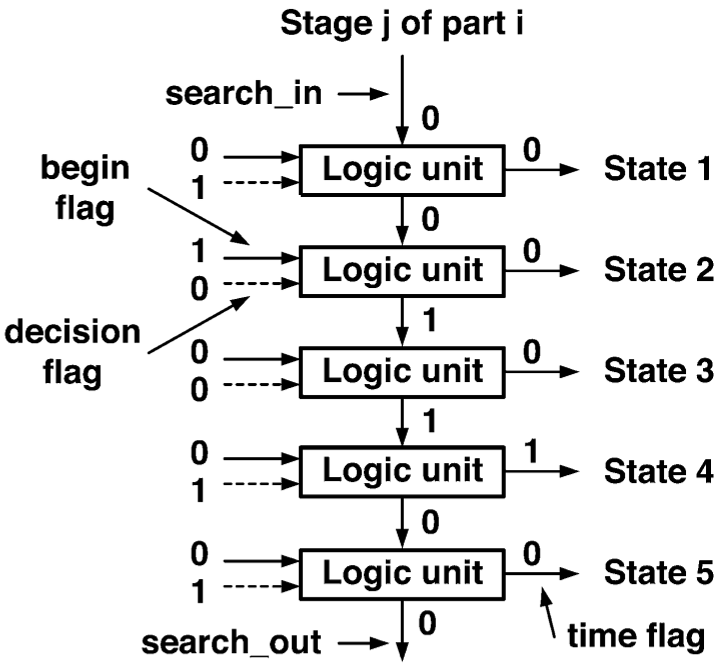 Figure 2: The detailed architecture of the Processing Element (PE), featuring local memory and a specialized ALU.
Experimental Results: Performance Benchmark
The IC was tested against several industry standards, including the TI TMS-320C6201 DSP and a 600-MHz PC.
- Speedup: For a complex 20-part problem (Problem B), the parallel processor took only 6.54 ms, whereas a 600-MHz PC took 180 ms (a ~27.5x improvement).
- Efficiency: Despite having 16 PEs and running at 100 MHz, the chip consumes only 742 mW, making it suitable for embedded industrial controllers.
- Scalability: The design is "cascadable." For problems with longer time horizons, multiple chips can be linked together without significant performance degradation, as inter-chip communication is limited to adjacent PEs.
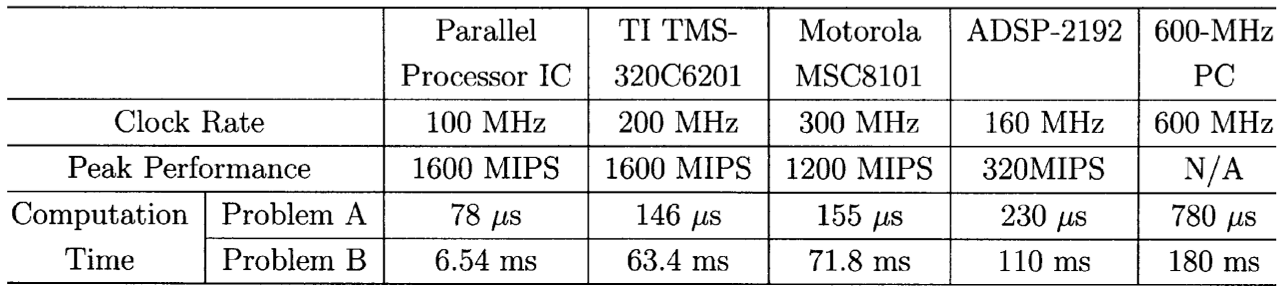 Table 1: The chip outperforms commercial DSPs by over 10x in large-scale scheduling tasks.
Critical Insight & Conclusion
This paper is a masterclass in Algorithm-Hardware Co-design. Instead of trying to force a general-purpose processor to run a specific algorithm faster, the authors modified the algorithm (Search Range Limitation) and built the hardware to match its intrinsic logic.
While the 0.35-μm process is dated by today's standards, the architectural principles—SIMD state processing and carry-bypass search—remain highly relevant for modern AI and optimization accelerators. As we move toward Industry 4.0, specialized silicon like this will be essential for managing the sheer complexity of automated semiconductor fabrication plants.