
CL-SNA: Leveraging Lisp for Deep Social Network Insights
14290_CL-SNA social network analysis with Lisp.
This paper introduces CL-SNA, a comprehensive open-source toolkit for Social Network Analysis (SNA) implemented in Common Lisp. It integrates graph-theoretic metrics, metadata-driven data management, and external visualization compatibility (e.g., Graphviz) to handle both small-scale sociological data and large-scale technical dependency networks.
TL;DR
CL-SNA is an open-source Lisp-based framework designed to modernize Social Network Analysis (SNA). It moves beyond mere visualization by providing a programmable environment where graph theory meets metadata. By representing networks as S-Expressions, it offers a highly extensible playground for researchers to compute complex metrics like Betweenness and LS sets on datasets ranging from Renaissance families to modern Linux distributions.
Background & Motivation: The Gap in SNA Tools
Social Network Analysis has evolved from early 1930s "sociometrics" into a rigorous quantitative field. However, in 2007, the software landscape was fragmented. Researchers were often stuck between expensive commercial software like UCINET or specialized tools like Pajek that were difficult to programmatically extend.
The authors identified three critical needs:
- Flexibility: The ability to add new metrics without rewriting the core engine.
- Metadata Integration: Treating node/edge attributes as first-class citizens.
- Scalability: Handling large graphs (20k+ nodes) while maintaining human-readable data formats.
Methodology: Why Common Lisp?
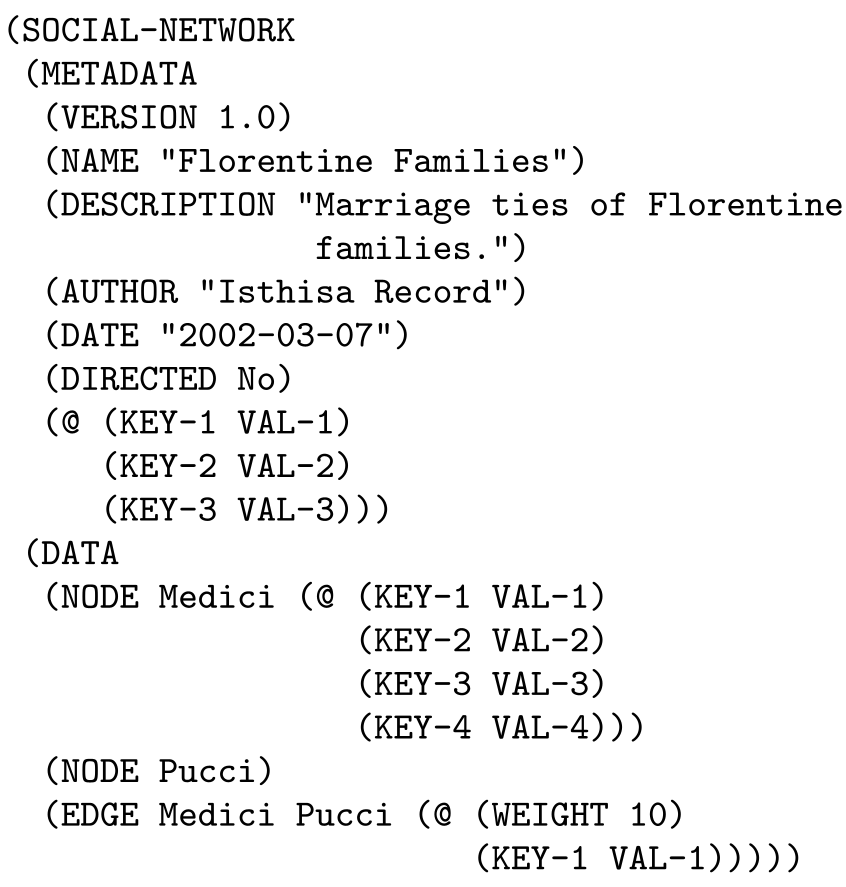
The choice of Common Lisp is not incidental; it is strategic. The "Code is Data" philosophy allows CL-SNA to utilize S-Expressions for both the internal representation of the graph and the external data format.
1. Data Representation
The framework adopts a markup based on S-Expressions that follows XML tagging conventions. This allows for seamless inclusion of metadata (e.g., family wealth, package maintainer) directly within the graph structure.
2. Algorithmic Flexibility
CL-SNA balances two worlds:
- Graph Search Methods: Efficient for sparse, large-scale networks.
- Matrix Methods: Convenient for dense, smaller networks, though often suffering from complexity.
By using Lisp, the authors implement complex Subgroup Identification algorithms (like LS sets) that test relative connectivity. Since testing all candidate subsets for LS sets is an -hard problem (), the paper highlights the use of heuristics and pruning—such as grouping adjacent nodes—to maintain tractability.
Experiments: From Medici Marriages to Debian Dependencies
The paper validates the engine using two contrasting datasets:
Case Study 1: The Florentine Families
An analysis of 16th-century marriage ties. Using degree-centrality-of-all-nodes, the tool identifies the Medici family as the most central node (degree of 6), explaining their historical dominance.
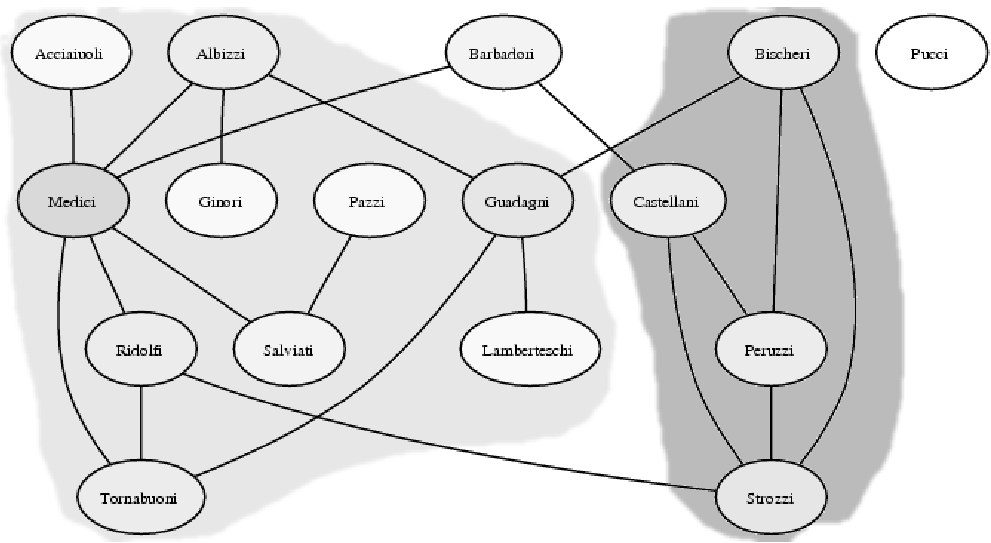 Figure: Advanced visualization emphasizing sub-groups through LS set analysis.
Case Study 2: Debian GNU/Linux (Scale Test)
The authors pushed CL-SNA to its limits with 20,610 nodes representing software packages.
- Performance: Calculating degree centrality for 92,534 edges took ~7 minutes on a P4 desktop.
- Insight: The most central packages were foundational libraries like
LIBC6andPYTHON, reflecting their structural importance to the OS ecosystem.
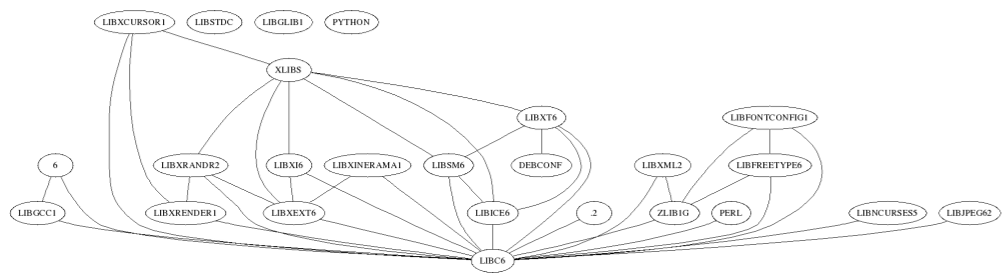 Figure: A filtered view of the Debian network showing only high-centrality (degree > 500) nodes.
Critical Insight: The Value of Context Management
A standout feature described in Section 6 is intograph and exitgraph. This stack-based context management allows researchers to "zoom in" on a subgraph (e.g., nodes with more than 500 connections), perform isolated analysis, and then "pop" back out to the global graph. This reflects a deep understanding of the iterative workflow inherent in exploratory data science.
Conclusion & Future Work
CL-SNA proves that functional programming provides a robust backbone for SNA. While it lacks internal support for network dynamics (longitudinal analysis showing how a network evolves over time), its modular API paves the way for future extensions in parallel processing and 3D visualization.
Key Takeaway: For researchers who need more than just a "GUI to draw circles," CL-SNA provides a programmable bridge between raw graph theory and meaningful social interpretation.