
Leveraging Collective Intelligence: A Social Network Analysis Approach to OER Discovery
17922_OER Recommendation for Entrepreneurship Using a Framework Based on Social Network Analysis.
This paper proposes a recommendation framework that extracts Open Educational Resources (OER) from Twitter for the StartUp entrepreneurship project. By integrating Social Network Analysis (SNA) and Linked Data, the system identifies influential users and relevant hashtags to filter high-quality URLs, achieving a selection of 16.68% of unique, high-value resources from a massive stream of raw data.
TL;DR
The explosion of Open Educational Resources (OER) has made discovery a "needle in a haystack" problem. This paper introduces a framework for the StartUp project that mines Twitter to extract entrepreneurship-focused OERs. By combining Social Network Analysis (SNA) with Linked Data, the system identifies influential experts and trending hashtags to recommend high-quality URLs, bypassing the limitations of traditional recommendation systems that require explicit user profiles.
Problem & Motivation: The Discovery Bottleneck
OERs are typically confined to institutional repositories or indexed by general search engines like Google. However, these methods often miss the dynamic, real-time sharing of professional resources occurring on social media.
The challenge is twofold:
- Data Noise: Millions of links are shared on Twitter, but many are marketing-driven or low quality.
- Cold Start: Traditional recommendation systems need user history (profiles) or resource ratings, neither of which are readily available for ephemeral social media posts.
The authors' insight is profound: Expertise leaves a trace in the network structure. If we can identify who the "influencers" are in a specific niche (like Project Management), the links they share or are mentioned in are likely to be high-quality educational assets.
Methodology: From Raw Tweets to Expert Insights
The discovery pipeline consists of several sophisticated stages:
1. Semantic Query Expansion
To avoid missing resources due to strict keyword matching, the system uses SPARQL queries against DBpedia. For example, a search for "Business" automatically expands to include "Marketing," "Finance," and "Business Intelligence," ensuring a broader harvesting of relevant URLs.
2. The SNA Core
The paper utilizes Betweenness Centrality to analyze three distinct networks:
- Hashtag Network: Based on co-occurrence, identifying "bridge" topics.
- Retweet Network: Identifying authors whose content is deemed worthy of redistribution by others.
- Mention Network: Identifying users who are recognized as authorities by their peers.
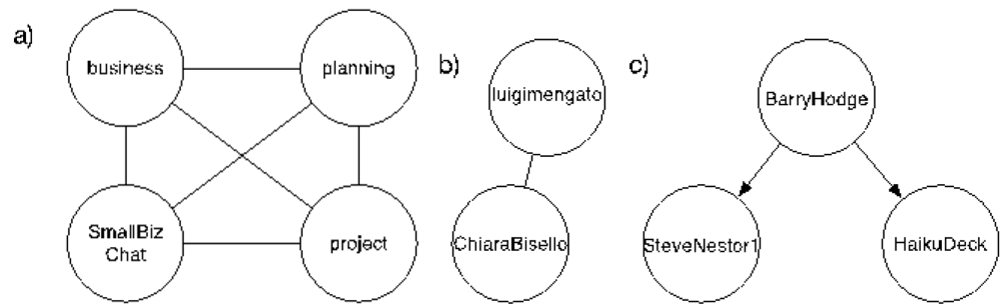 The figure illustrates how networks of mentions and retweets help map the influence of participants.
3. URL Normalization and Ranking
Shortened URLs (bit.ly, t.co) are expanded to their original form to remove duplicates and verify their HTTP status. A ranking algorithm then prioritizes OERs based on metadata extracted from HTML tags and the social weight of the sharing network.
Experiments: Project Management Case Study
To validate the framework, the authors applied it to the Project Management domain over 30 days.
| Metric | Count/Value |
|---|---|
| Total Tweets Collected | 3,666 |
| Valid URLs Identified | 1,235 |
| Final Recommended OERs | 206 (16.68%) |
| Influential Users Found | 112 |
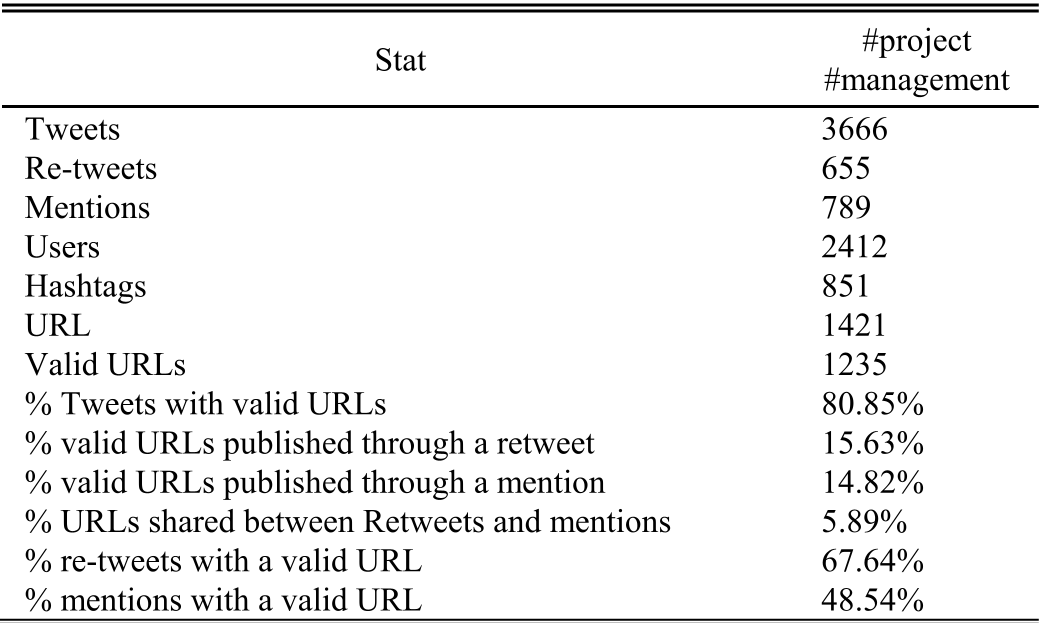 Statistical breakdown of the data collection and filtering process.
The results showed that by focusing only on the "top of the crop" (users with high betweenness centrality), the system filtered out over 80% of the noise, leaving a curated set of resources that experts later validated as high-quality educational material.
Critical Analysis & Conclusion
Takeaway
The study demonstrates that Social Network Analysis is an effective proxy for human curation. In the absence of a structured rating system (like 5-star reviews), the "retweet" and "mention" behave as implicit quality endorsements.
Limitations & Future Work
While successful, the system currently relies on manual selection of initial query expressions. Furthermore, the ranking algorithm is heavily weighted toward HTML pages, potentially overlooking valuable resources in other formats (like PDF or Video) that lack meta-tags. Future research could integrate Natural Language Processing (NLP) to automatically assess the pedagogical value of the content beyond its social popularity.
In conclusion, this work provides a scalable blueprint for building "Living OER Repositories" that evolve alongside the professional communities they serve.