
Celebrating 75 Years of AI: From Gödel's Logic to the Self-Improving Singularity
2006: Celebrating 75 Years of AI - History and Outlook: The Next 25 Years
Jürgen Schmidhuber provides a comprehensive historical and forward-looking analysis of Artificial Intelligence, tracing its formal roots back to Kurt Gödel's 1931 work. The paper marks the transition of AI from a heuristic-dominated field to a formal science through the emergence of universal, mathematically optimal frameworks like AIXI and Gödel Machines.
TL;DR
In this seminal reflection, Jürgen Schmidhuber argues that AI didn't start in 1956, but in 1931 with Kurt Gödel’s work on universal languages. He charts the field's evolution from brittle heuristics to a "Full-Fledged Formal Science," introducing the Gödel Machine—the theoretical peak of self-improving software. Schmidhuber predicts that exponentially accelerating history will lead us to a technological "Omega Point" around 2040.
Backtracking the Roots: Why 1931 Matters
While many point to the Dartmouth Workshop (1956) as the birth of AI, Schmidhuber asserts that the logic foundations laid by Kurt Gödel in 1931 are the true starting point. Gödel constructed formal systems that could talk about themselves—a prerequisite for any machine that seeks to understand its own logic or improve its own code.
The path since then has been a battle between two philosophies:
- Heuristics: Trial-and-error "tricks" that solve specific problems (e.g., early Expert Systems).
- Formalism: Mathematical theorems of optimality that are true "for eternity."
The Core Methodology: The Gödel Machine
The paper’s most provocative contribution is the concept of a Gödel Machine. Unlike traditional software that remains static unless updated by a human, a Gödel Machine possesses:
- A description of its own hardware and software (Self-referential).
- A utility function (A goal).
- A proof searcher.
The machine systematically searches for a "proof" that changing its own code will make it more efficient at reaching its goal. If it finds such a proof, it rewrites itself. This ensures that every self-modification is provably optimal, preventing the "runaway" bugs usually associated with self-modifying code.
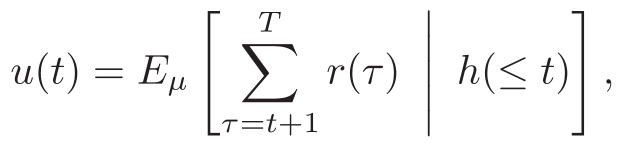 Figure 1: The mathematical definition of intelligence as the maximization of future reward (u) given a known history (h) and unknown environment (μ).
From Theory to Practice: The Rise of LSTM
Schmidhuber doesn't just dwell in theory. He highlights Long Short-Term Memory (LSTM) as the practical bridge for AI to handle sequential, "time-aware" data. By using a gated architecture to store memories over long periods, LSTM solved the fundamental flaw of early Recurrent Neural Networks (RNNs) that "forgot" information too quickly. This architecture has since become the backbone of modern speech recognition and translation.
Experimental Insight: The Speed Prior
The paper discusses the Speed Prior, a computable alternative to Solomonoff's universal induction. Instead of assuming all programs are equally likely, it biases the search toward fast programs.
- Finding: This approach yields near-optimal predictions while remaining computationally feasible.
- Context: It provides a mathematical "yardstick" to measure how far away our current heuristic models are from "perfect" intelligence.
Future Outlook: The 2040 Singularity
Schmidhuber uses a "binary logarithmic scale" to analyze human history. He notes that the time between major revolutions (Agriculture -> Industrial -> Information) is shrinking by half each time.
Note: In the original text, Schmidhuber lists 14 milestones showing history accelerating toward a convergence point (Ω).
By his estimation:
- 2020: Computers reach raw brain power levels.
- 2031: 100 years post-Gödel, we see practical Gödel Machines.
- 2040: The "Omega Point"—a point where technological progress becomes so rapid that it surpasses all human imagination.
Critical Analysis
Schmidhuber’s view is unapologetically logic-driven. While critics argue that human intelligence is built on biological "messiness" that logic cannot replicate, Schmidhuber counters that "Life is Problem Solving." If intelligence is defined as achieving goals in complex environments, then the formal approach is not just a branch of AI—it is AI.
The primary limitation remains the computational overhead of formal proofs. While a Gödel Machine is optimal, the initial search for the first "self-improvement proof" could take longer than the age of the universe on current hardware. However, as hardware continues to follow Moore's Law (and beyond),These "large additive constants" in the complexity equations will eventually become negligible.
Conclusion
This paper is a call to move away from "Astrology-like" AI heuristics toward the rigorous logic of Gödel and Kolmogorov. Whether or not history "converges" in 2040, the transition of AI into a formal science is an undeniable shift that is already defining the current era of Deep Learning.