
Same-As Object Management: Aligning Social Media Privacy with Human Intuition
2013 IEEE/ACM International Conference on Advances in Social Networks Analysis and Mining 541
The paper introduces "Same-As Object Management," a novel access control paradigm for Online Social Networks (OSNs) that focuses on simplifying the protection of large content volumes. By leveraging user perception and mental models, it allows users to set permissions for a representative "example object" and propagate those settings to similar items, achieving superior usability and security compared to traditional grouping methods.
TL;DR
Managing privacy on social networks is a nightmare of "who can see what." While most research focuses on grouping friends, this paper tackles the explosion of content (objects). By introducing Same-As Object Management, the authors allow users to set a policy for one representative photo and apply it to "similar" ones. The result? A 24% faster setup process and significantly more secure (conservative) privacy settings.
The "Object" Crisis in Privacy
In the early days of access control, we focused on Role-Based Access Control (RBAC) to manage users. But in the modern era of Online Social Networks (OSNs), a single user may have hundreds of friends and thousands of photos. The math is brutal: to manage friends and objects, you potentially face decisions.
The authors argue that traditional grouping (putting photos into folders) is disjointed from how we actually think. Our mental model doesn't see "Folder A"; it sees "that sensitive photo from last Friday night" and implicitly knows other photos like it should be protected the same way.
Methodology: Policy-by-Example
The core innovation is shifting the focus from subject-grouping to object-centered management.
1. The Same-As Paradigm
Instead of building a complex matrix, the user follows a simple workflow:
- Select an Example: Pick a photo that represents a specific "type" of sensitivity (e.g., a "work-appropriate" photo or a "highly sensitive" party photo).
- Set Permissions: Define which friend groups (Family, Work, High School) can see this one photo.
- Propagate: Simply click other similar photos to link them to this example.
2. Visual Policy Editor
The authors implemented a Facebook prototype using Adobe Flex to minimize "task switching." Unlike traditional systems where you group, then permit, then review, this interface allows for a "live" perception of the policy's reach.
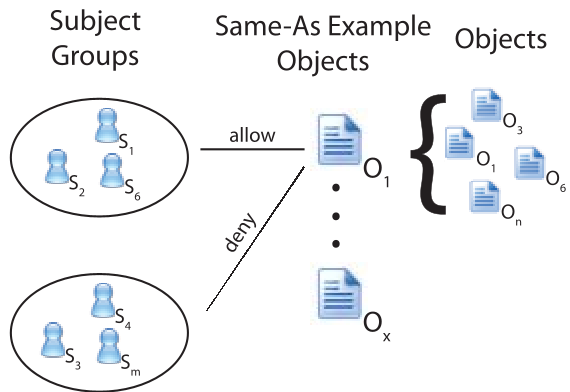 Fig 1: The Same-As Object Management workflow showing the transition from example selection to group permissioning.
Experimental Battle: Grouping vs. Same-As
The authors conducted a study with 99 Amazon Mechanical Turk workers, comparing traditional Grouping-Based (GB) models against Same-As Subject (SaS) and Same-As Object (SaO) management.
Key Metrics:
- Expressiveness: Users created 25% more policy templates in the SaO model, indicating they felt more empowered to create nuanced, fine-grained rules.
- Efficiency: SaO reduced the time spent in the interface by 24% compared to traditional folders.
- Security (Policy Openness): This is the most crucial finding. In traditional folders, users tended to be "lazy" and leave things more public. In the SaO model, policies were 11% more conservative, adhering closer to the principle of "least privilege."
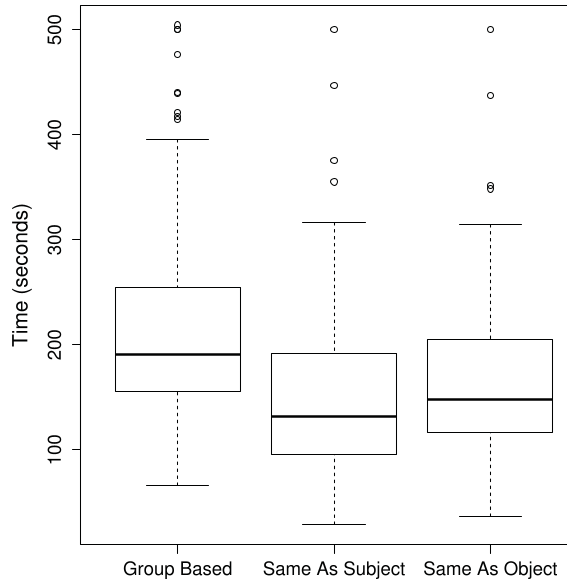 Fig 2: Comparison of (a) Number of templates, (b) Authoring time, and (c) Ease of Use across the three models.
Deep Insight: Why Why Perception-Based Management Wins
The success of this method isn't just about a better UI—it's about Relational Memory.
Humans find it easier to remember a specific object (a photo of a drink) than an abstract concept (Sensitivity Level 3). By providing a "Same-As" anchor, the system reduces the cognitive load required to categorize content. This is why "Readability" and "Flexibility" scores were significantly higher for this method:
"The framework’s capabilities should align, as much as possible, to the user’s mental model... the more alignment, the less likely for policy errors."
Conclusion & Future Look
The paper proves that usability is a security feature. When tools are easy to use, users naturally default to more secure behaviors.
Limitations: The study relied on a fixed set of 15-30 items. Scaling this to 10,000 photos might require integrating AI-driven "Same-As" suggestions (e.g., "We noticed these 50 photos also look like your 'Highly Sensitive' example; link them?").
As OSNs move toward the Metaverse and more complex object types, the "Same-As" philosophy offers a scalable, human-centric path out of the privacy management jungle.