
Hawkes Processes: Detecting Social Trends through the Lens of Stochastic Control
2015 IEEE/ACM International Conference on Advances in Social Networks Analysis and Mining
The paper proposes a novel trend detection algorithm for social networks using self-exciting Hawkes processes. It introduces a "trend index" derived through stochastic control and limit theorems, allowing for the identification of topics that exhibit rapid intensity bursts relative to their expected behavior.
TL;DR
Volume is not trendiness. This paper presents a sophisticated framework that uses Hawkes processes and stochastic control to identify "trendy" topics in social networks. By focusing on intensity peaks rather than raw counts, the algorithm can spot emerging memes even if their total volume is low, effectively filtering noise from genuine social momentum.
Background & Motivation: Beyond the Follower Count
In the world of social media, a "trending" topic is typically defined by a rapid, self-reinforcing surge in activity. However, most standard algorithms use simple thresholds or frequency counts. These "What is Popular" metrics fail because:
- Social Influence is Non-Linear: A tweet from a high-influence user (e.g., Barack Obama) carries more weight than one from an anonymous account.
- Temporal Decay: Old spikes shouldn't define current trends.
- Baseline Activity: High-volume topics (e.g., "Good morning") are always active but rarely "trending."
The authors argue that a true trend is a peak in broadcasting intensity that deviates from the expected stationary behavior.
Methodology: The Math of Social Viralit
The research leverages the Hawkes Process, a self-exciting point process where past events increase the probability of future events.
1. Scaling to the "Nearly Unstable" Regime
The core insight is to treat trending topics as processes operating near the edge of instability. In a stable regime, activity is linear; in an unstable one, it's exponential. By rescaling the intensity toward this boundary, the authors transform discrete social events into a continuous Cox-Ingersoll-Ross (CIR) diffusion process.
2. Factoring in Network Topology
To account for social influence, the authors weight the intensity by the eigenvector centrality () of the users. This ensures that the "trendiness" is boosted if influential nodes are participating.

3. Finding the Peak via Optimal Stopping
Once the social activity is converted into a CIR process, the problem becomes: When has this process reached its maximum potential? The paper uses stochastic control to define an optimal barrier (). If the intensity touches or crosses this barrier, it signals a "peak," contributing to a high Trend Index ().
Experimental Proof: MemeTracker Analysis
The researchers tested their model against the MemeTracker dataset. The results (Table II) reveal a striking contrast between volume and trendiness.
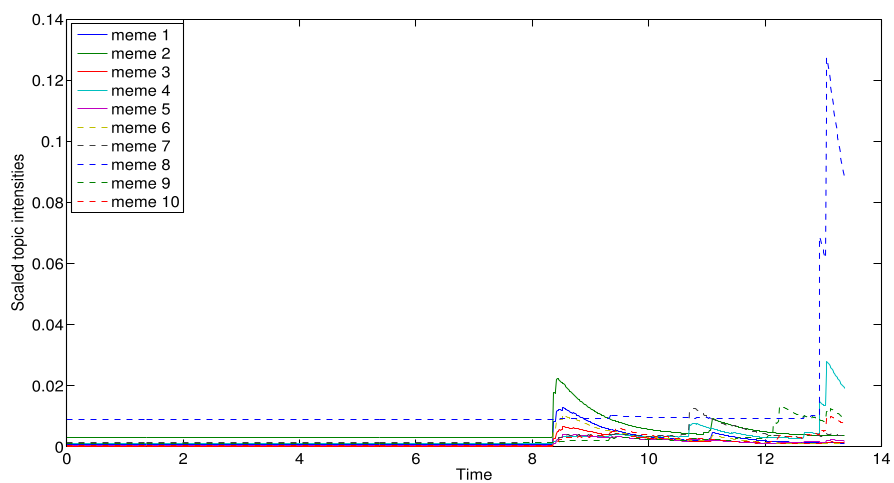
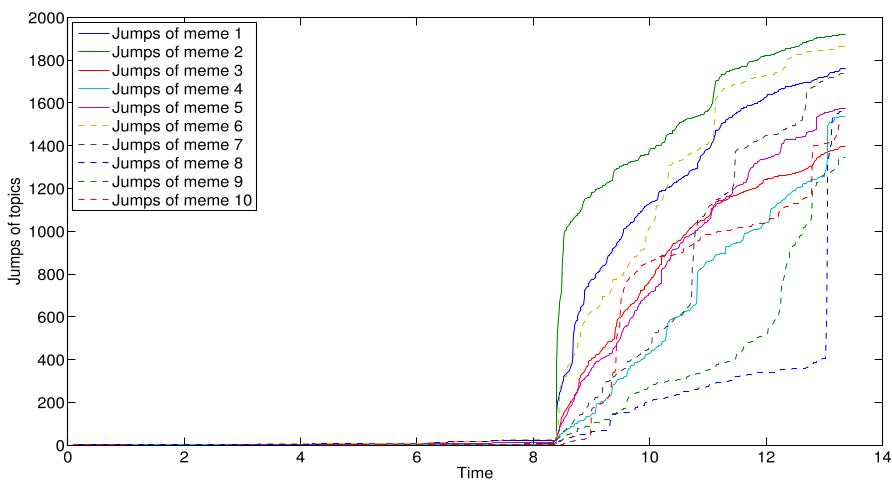
- Meme 9 ("The Girl with the Dragon Tattoo"): Had the lowest number of posts but the highest trend index. This is because its activity was characterized by sharp, recent peaks in intensity.
- Meme 2 ("Two and a Half Men"): Had the highest volume of posts but the lowest trend index. Why? Most of its activity happened early in the timeline, meaning its intensity had already decayed by the time of prediction.
Deep Insight & Conclusion
This paper provides a bridge between point processes and stochastic differential equations. By aggregating high-dimensional social data into a one-dimensional CIR process, the authors managed to create an algorithm that is both mathematically rigorous and computationally efficient ( complexity).
Takeaway: Effective trend detection must distinguish between sustained volume and dynamic acceleration. By measuring how far a topic's intensity sits from its "expected maximum," we can catch the next viral wave before it reaches its peak.
Limitations: The model assumes predefined topics (e.g., via labeling). Future extensions could integrate real-time NLP to discover topics dynamically while maintaining the Hawkes framework.