
Hybrid Security Architecture: Balancing Speed and Privacy in Cloud-Based Social Networks
2668_A new framework for secure sharing data on cloud-based social networks.
The paper proposes a hybrid secure framework for data sharing in cloud-based social networks, combining the speed of the Advanced Encryption Standard (AES) with the security of Proxy Re-Encryption. The method integrates a dynamic one-time symmetric key approach with Modified RSA (MRAA) and Advanced ElGamal (AEG) to ensure data confidentiality and integrity.
TL;DR
As social networks migrate to the cloud, the tradeoff between data privacy and processing speed has become a critical bottleneck. This paper introduces a novel framework that bridges this gap by combining the raw efficiency of AES with the flexible security of Proxy Re-Encryption. By using dynamic one-time keys and a tiered encryption approach (MRAA + AEG), the authors provide a system where data remains secure even if the cloud provider is untrusted.
Context & Motivation: The Cloud Privacy Paradox
We live in an era where Facebook, LinkedIn, and Instagram are the backbones of social interaction. However, these platforms increasingly rely on Cloud Service Providers (CSPs) for data storage. The "Paradox" lies in the fact that while we want the ubiquity of the cloud, we lack control over data confidentiality.
Prior works often struggled with a "binary" choice:
- Symmetric Encryption (e.g., AES): Fast, but sharing keys between millions of users is a logistical and security nightmare.
- Asymmetric Encryption (e.g., RSA, ElGamal): Great for sharing, but computationally "heavy"—especially for large media files like photos and videos.
The authors' insight is to decouple the data encryption from the key management using a "Semi-Trusted Proxy."
Methodology: The Three-Tiered Defense
The framework is built on three core entities: the Cloud Service Provider (CSP), the Proxy Server, and the End Users.
1. The Data Upload Workflow
When a user uploads a file, the system doesn't just apply one lock. It follows a sequential process:
- Step A (AES-256): The actual data is encrypted with a Dynamic One-Time Symmetric Key. This ensures the bulk processing is lightning-fast.
- Step B (MRAA): The symmetric key itself is then encrypted using Modified RSA (MRAA), which is based on the factoring problem and decisional composite residuosity.
- Step C (The Proxy Handshake): The Proxy Server receives this "double-encrypted" package. It performs Proxy Re-Encryption using the Advanced ElGamal (AEG) algorithm. This allows the proxy to transform the ciphertext so that a different authorized user can decrypt it later, without the proxy ever seeing the original data.
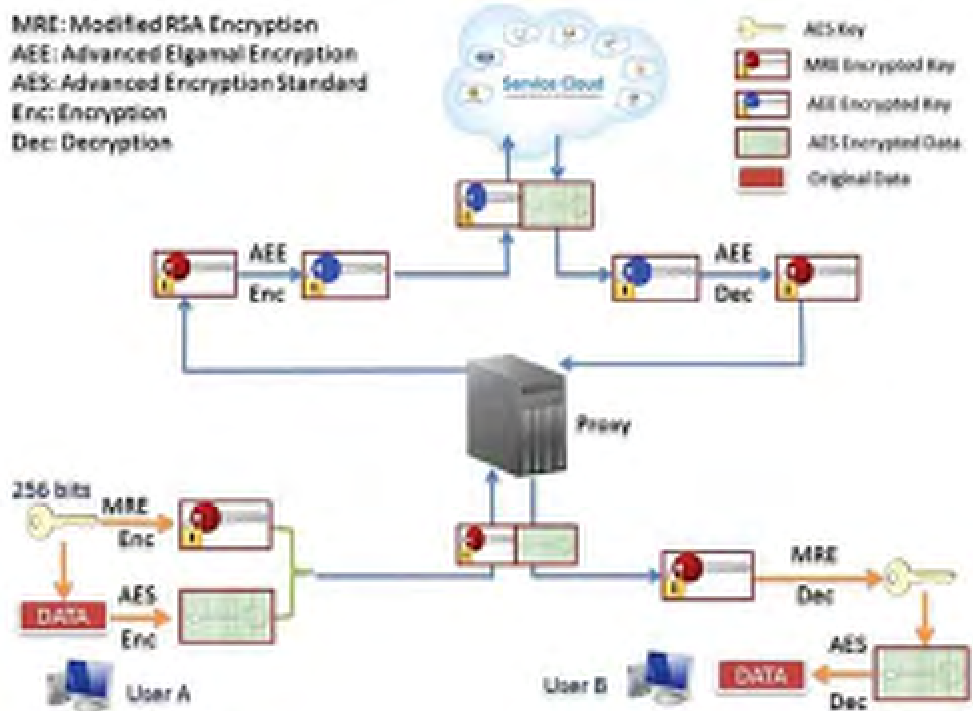
2. The Data Access Workflow
When another user wants to view the shared data:
- The Proxy performs a partial decryption (pre-decryption) to convert the AEG-protected key into an MRAA-compatible format for the recipient.
- The End-User uses their private key to retrieve the dynamic AES key.
- The AES key finally unlocks the original content.
Why This Works: Beyond Standard SOTA
The core advantage over prior SOTA (like Tran et al., 2011) is the introduction of Dynamic Key Generation. In standard Proxy Re-Encryption, if a key is compromised, the historical data is often at risk. By using a "One-Time" dynamic approach, the "blast radius" of a potential leak is restricted to a single session or file.
Furthermore, by utilizing Modified RSA (MRAA), the framework adds an extra layer of protection against the typical vulnerabilities of standard RSA, such as side-channel attacks or specific mathematical shortcuts.
Experiments & Critical Analysis
The paper highlights that by using AES for the data layer, the framework is suitable for Big Data applications, not just small text snippets.
Key Takeaways from Comparison:
- Latency: Significant improvement over pure ElGamal-based data encryption systems because the "heavy lifting" is only done on the tiny keys, not the large files.
- Security: Multi-factor security (Discrete Logarithm + Factoring Problem) means an attacker must break two distinct mathematical problems to compromise the system.
Conclusion & Future Outlook
This research provides a robust blueprint for the next generation of privacy-preserving social media. However, an objective look suggests that the Proxy Server is still a potential point of failure; if the Proxy and the Cloud Provider collude, security could be threatened.
The authors suggest that future work will focus on Probabilistic Attack Analysis to quantify exactly how much effort an adversary would need to expend to breach this multi-layered defense. For now, this hybrid approach represents a significant step toward practical, secure, and fast cloud sharing.