
3-HBP: Decoding the Latent Drivers of Social Connection via Hidden Bayesian Models
3-HBP: A Three-Level Hidden Bayesian Link Prediction Model in Social Networks
The paper introduces 3-HBP, a Three-level Hidden Bayesian Link Prediction model that integrates user behavioral data and structural relationships in social networks. By combining a Gaussian-weighted Latent Dirichlet Allocation (LDA) for modeling internal interests and a Hidden Naive Bayes algorithm for external common neighbor dependencies, it achieves state-of-the-art performance in predicting missing links on Twitter datasets.
TL;DR
Predicting who will connect next in a social network is more than just counting common friends. This paper presents 3-HBP, a hybrid Bayesian model that mines "Latent Interests" from user behaviors (retweets, mentions) using an optimized LDA and models structural dependencies through Hidden Naive Bayes. The result? A significant jump in link prediction accuracy by actually understanding why people interact.
Problem & Motivation: Beyond Structural Similarity
Most link prediction algorithms assume a "birds of a feather flock together" logic—if we share enough friends, we might become friends. However, this ignores the internal drive: our specific interests.
Current SOTA methods often struggle with:
- Latent Interests: How do you turn a stream of retweets and follows into a coherent interest profile?
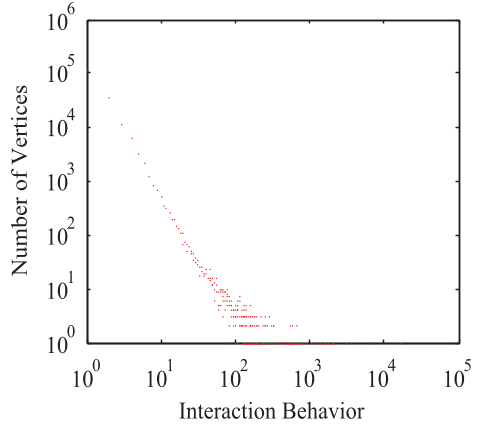
- Power-Law Noise: In social networks, a few "super-users" generate massive amounts of data, which can drown out the specific interests of average users in standard LDA models.
- Neighbor Dependency: Common neighbors aren't independent nodes; they influence each other in complex ways that standard Naive Bayes fails to capture.
Methodology: The Three Levels of 3-HBP
The authors solve these challenges by building a bridge between text-mining techniques and graph theory.
1. Internal Driving Mechanism: Optimized LDA
The model treats a user as a "document" and their behavior (following, retweeting) as "vocabulary." By applying Latent Dirichlet Allocation (LDA), the model extracts a probability distribution of interests (e.g., Tech, Sports, Politics).
- The "Gaussian" Fix: To prevent high-frequency users from skewing the results, the authors introduce Gaussian Weighting to the LDA's sampling process, effectively normalizing the influence of "hyper-active" accounts.
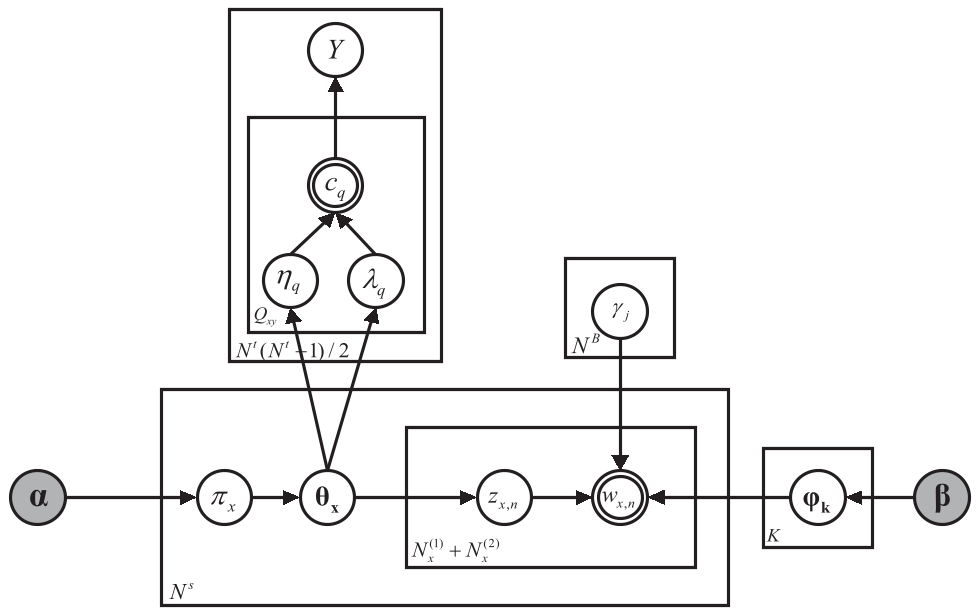
2. External Driving Mechanism: Hidden Naive Bayes
Standard link prediction looks at common neighbors. 3-HBP goes further by using Hidden Naive Bayesian (HNB) algorithms. It introduces an "implicit factor" for each attribute, quantifying the joint dependence between groups of friends, rather than treating them as isolated points.
3. The Fusion: 3-HBP Learning Algorithm
The model iterates through a training process (mining interests) and a testing process (predicting links using a probability ratio ). If exceeds a threshold, a link is predicted.
Experiments & Results: Probing the Twitter Graph
The authors tested 3-HBP on Twitter datasets focused on the discovery of the Higgs Boson—a high-interaction environment.
Performance Gains
3-HBP consistently outperformed classical models (SVM, Logistic Regression) and specialized topic models (Topic-link LDA).
- Accuracy Boost: Up to 7.9% improvement over baselines.
- Recall Improvement: Up to 9.7%, showing the model is much better at finding "unseen" future links.
 Individual users show distinct, concentrated latent interests (seen in graphs a-f), which the model successfully utilizes to match potential future friends.
Sensitivity Analysis
The study found that the number of interests () is optimal around 10 to 15. Too many topics lead to overfitting on noise; too few lead to a lack of descriptive power.
Critical Insight: Why This Works
The brilliance of 3-HBP lies in its treatment of social interaction as a language. By translating graph topology into a "topic space," the authors circumvent the sparsity issues of social graphs. The addition of Hidden Naive Bayes provides the structural "glue," ensuring that while interests drive the connection, the existing social structure validates it.
Conclusion & Future Work
The 3-HBP model proves that link prediction is optimized when we combine what users do (Internal) with who users know (External). The authors suggest this could revolutionize targeted advertising and recommendation engines by allowing for "novelty" in suggestions—recommending people who share your latent interests even if you don't have 50 friends in common yet.
Takeaway: To predict the future of a network, look at the hidden Bayesian dependencies between behavior and structure.