
Beyond Degrees: Decoding Social Networks with Generalized Markov Graphs
3293_A Generalized Markov Graph Model Application to Social Network Analysis.
This paper proposes a Generalized Markov Graph (GMG) model for social network analysis, moving beyond traditional degree-based characterizations. It introduces "crowding coefficient distribution" as a novel fundamental feature and demonstrates SOTA performance in network classification and synthesis tasks.
TL;DR
While most researchers believe that a social network's identity is defined by its degree distribution (the "Power Law"), this paper proves that's only part of the story. By introducing a Generalized Markov Graph (GMG) model, the authors show that higher-order relationships—specifically clustering and a new crowding coefficient—are the real keys to classifying and synthesizing realistic social structures, reducing classification errors from 34% to a staggering 1.28%.
The "Degree" Delusion: Why Prior Models Fail
For decades, the Barabási-Albert model and standard Markov Graphs have dominated social network analysis. They operate on a simple intuition: nodes with more connections are more likely to get new ones (preferential attachment).
However, as the authors demonstrate, these features are "lossy." If you try to distinguish a p2p transmission network from a physics collaboration network using purely degree-based statistics, you hit a performance ceiling. Standard Markov models assume conditional independence between relationships that don't share a node, a simplification that ignores how human groups actually form—through complex, overlapping triplets.
Methodology: The Geometry of Tightly-Knit Groups
The core innovation of the GMG model is the inclusion of Triplet-Node-Vertices. Instead of just looking at edges (pairs), the model looks at the dependencies between triangles (triplets).
The Structural Trinity
The paper identifies three fundamental sub-networks that constitute the probability mass function of any social graph:
- k-Stars: Traditional degree-based clusters (who is the "hub"?).
- Cluster-Stars: Structures that reveal the Clustering Coefficient (how many of my friends are also friends with each other?).
- Tri-Stars: The birthplace of the Crowding Coefficient (how dense is the environment surrounding a specific triangle of individuals?).
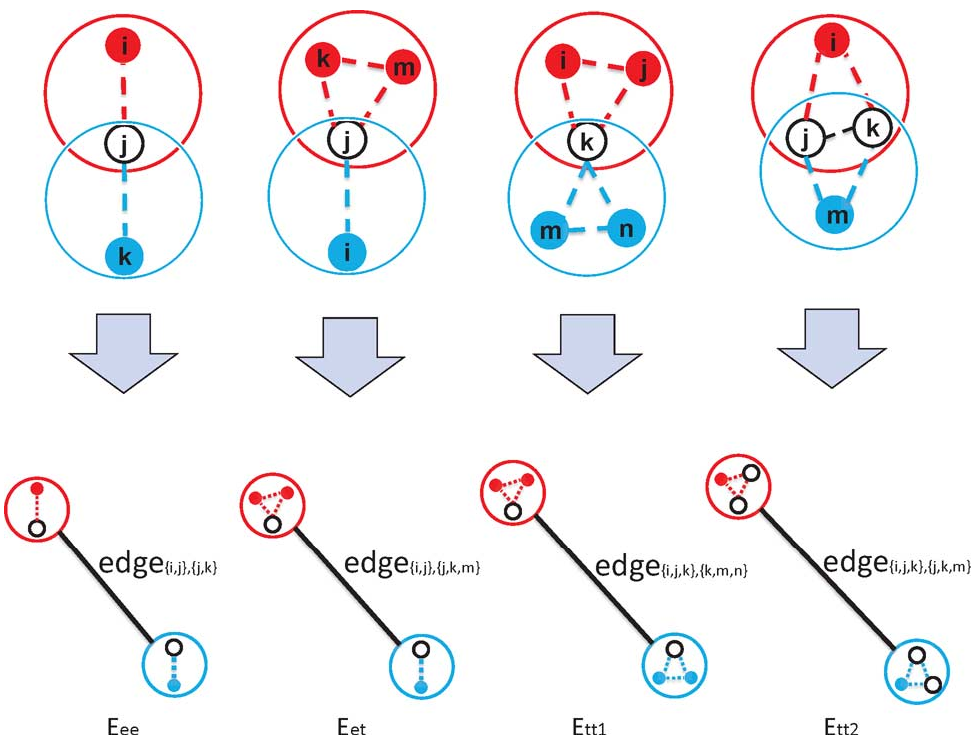 Figure: The evolution from simple stars to complex tri-stars in the GMG framework.
The physical intuition here is powerful: a relationship isn't just a link between A and B. It is influenced by the "crowding" of the social space. If A, B, and C form a triad, their likelihood of staying connected depends on how many other triads they belong to simultaneously.
Experiments: Accuracy and Stability
1. Classification Breakthrough
The authors tested their features against the Stanford Large Network Dataset. Using only degree and triads (Standard Markov), the error rate was ~34%. By adding the Clustering Coefficient and the Crowding Coefficient, the error plummeted.
| Features Used | Classification Error (Euclidean) |
|---|---|
| Degree + Triads (Standard) | 34.44% |
| Degree + Clustering | 3.32% |
| Degree + Clustering + Crowding | 1.28% |
2. Superior Network Synthesis
Traditional synthesis (Barabási-Albert) creates networks that follow the power law but are often "stochastically unstable" in their local structure. The GMG-based synthesis algorithm generates networks where the clustering behavior stabilizes much faster and remains consistent across realizations.
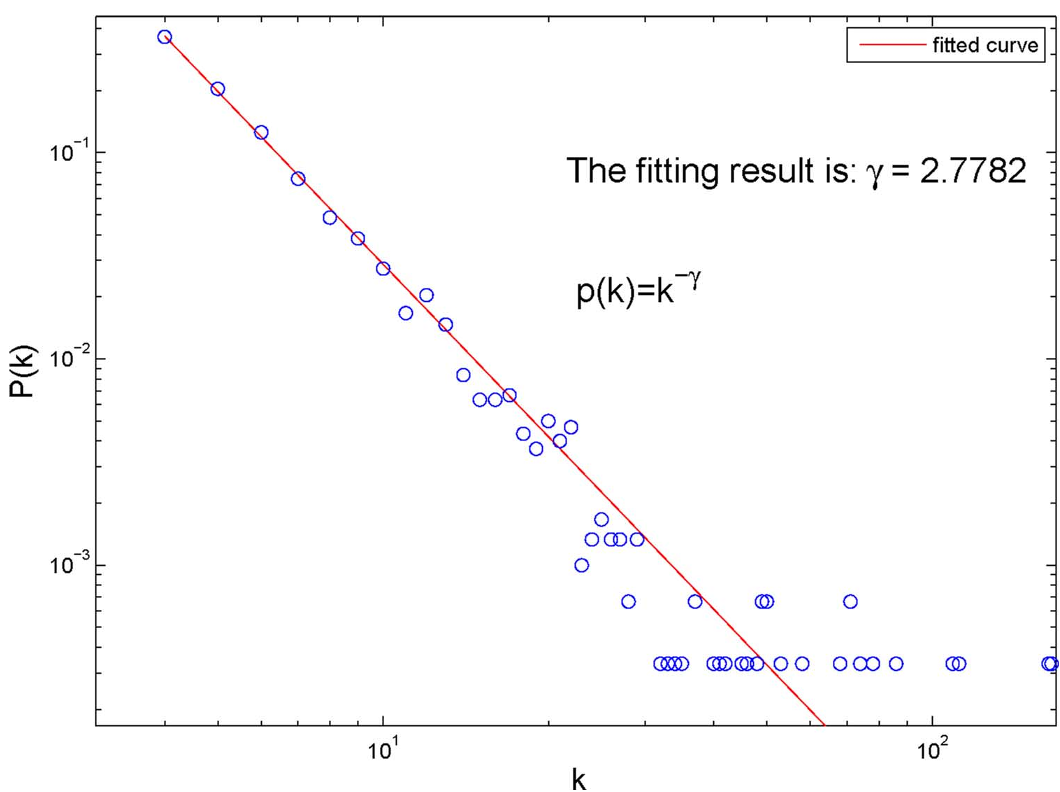 Figure: The synthesized network maintains the power-law degree distribution while fixing the local "DNA" of the graph.
Critical Insights & Future Outlook
The "Crowding Coefficient" is perhaps the most significant theoretical takeaway. It provides a mathematical proxy for "social pressure" or "structural redundancy." In practical terms, this could be used to:
- Identify Leaders: Detecting high-crowding hubs in terrorist or criminal networks.
- Predict Churn: In online social networks, users in low-crowding triads might be more likely to leave.
Limitations: The computational complexity is due to the need to calculate crowding coefficients across all triads. While manageable for networks of a few thousand nodes, applying this to the multi-billion node "Global Social Graph" would require significant approximation or sampling optimizations.
Conclusion
This work is a rigorous reminder that social networks are not just collections of points and lines, but intricate tapestries of overlapping motifs. By mathematically formalizing "Crowding," Wang et al., have provided a more granular lens through which we can view the architecture of human connection.