
The Social Link: Enhancing D2D Communications with Belief-Based Game Theory
3416_Enhance device-to-device communication with social awareness a belief-based stable marriage game framework.
This paper introduces a "Belief-Based Stable Marriage Game" framework to enhance Device-to-Device (D2D) communications by integrating social awareness. It maps social relationships into preference functions to optimize spectrum sharing between D2D links and cellular users, achieving more efficient resource allocation than traditional physical-only methods.
TL;DR
Researchers have moved beyond simple signal strength to optimize Device-to-Device (D2D) networks. By treating D2D resource allocation as a "Stable Marriage Problem" enhanced with "Social Beliefs," this paper demonstrates how latent social relationships—like shared interests in a viral video—can be used to drastically improve spectrum efficiency and offload cellular traffic.
Problem & Motivation: The Physical-Social Gap
In current 5G/6G visions, D2D communication is essential for capacity. However, existing protocols are "socially blind." They focus on physical proximity (is User A close to User B?) but ignore the data context (do they both want the same file?).
The challenge is twofold:
- Complex Mapping: How do you turn a "Facebook Friend" status into a "Frequency Resource Block"?
- Uncertainty: UEs rarely have perfect knowledge of the global social network. Information is often private or outdated.
Methodology: The Belief-Based Stable Marriage
The authors introduce a framework where the matching of D2D units to spectrum resources is modeled as a Stable Marriage Game. In a traditional game, every man has a strict preference for every woman. Here, the "men" are D2D links, and the "women" are Cellular Subscribers (CSs) or their sub-bands.
1. The Innovation: Socially Aware Preference
The core of the method is the integration of physical SINR (Signal-to-Interference-plus-Noise Ratio) with social content similarity. If a D2D link and a CS are interested in the same content, the D2D link can serve as a local cache/relay, turning potential interference into a useful signal.
2. The Mechanics: Belief Functions
Since UEs don't know everything, they maintain a Belief Function , which is a probability distribution over the content similarity .
- Physical Preference: Based on distance to avoid interference.
- Social Preference: Based on the expected transmission rate, weighted by the belief of shared content.
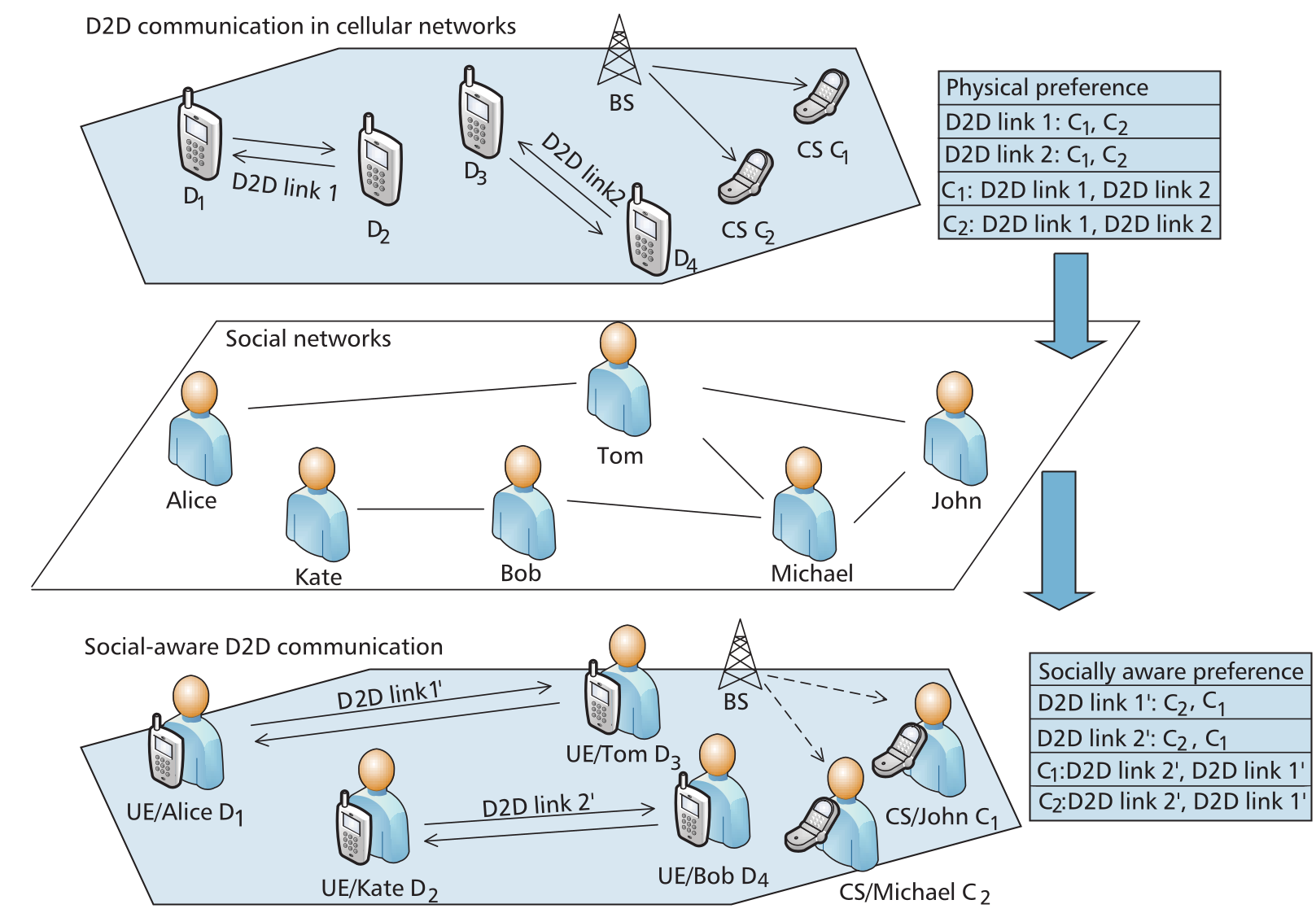
3. Solving the Matching
Once preferences are established, the system uses the Gale-Shapley Algorithm (Deferred Acceptance). This ensures that the resulting network state is Stable: no D2D link and CS would both prefer to break their current pairing to match with each other.
Experiments & Results
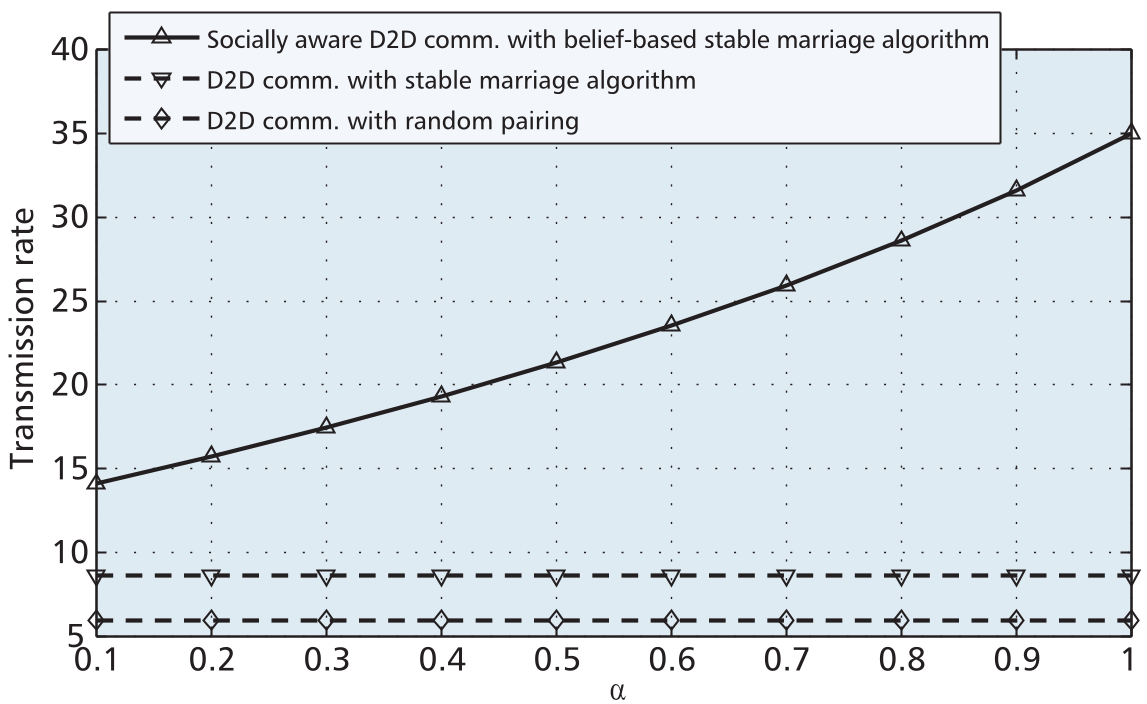
The authors tested the framework with 20 CSs and 20 D2D links.
Key Findings:
- Spectrum Sharing Pairs: The proposed framework significantly increases the number of active D2D links without causing unacceptable interference to the primary cellular network.
- Robustness: Using Bayesian updates, the UEs can "learn" and correct their social beliefs over time, even if the initial data from the social network was inaccurate.
Critical Insight & Conclusion
The true value of this work lies in its Inductive Bias: it assumes that human social structures are a strong predictor for network traffic patterns.
Takeaways for the Industry:
- Privacy-Preserving Optimization: Because the game is "belief-based" and distributed, UEs don't need to share their entire social profile with a central base station, preserving user privacy.
- Future-Proofing: The framework is extensible to "Stable Roommates" (many-to-many) and "College Admissions" (many-to-one) problems, making it suitable for complex 6G hetero-networks.
Limitations: The computational overhead of maintaining Bayesian belief functions on low-power IoT devices remains a concern, and the convergence speed in high-mobility scenarios (like V2X) requires further validation.