
Privacy Flag: Crowdsourcing the Shield Against Digital Risks
3536_Privacy Flag A crowdsourcing platform for reporting and managing privacy and security risks.
The paper introduces "Privacy Flag," a distributed crowdsourcing platform designed to monitor and manage privacy and security risks. It leverages a mobile application, a browser add-on, and a centralized "Observatory" to provide real-time alerts and visualizations based on collective intelligence and professional risk analysis.
TL;DR
The Privacy Flag project introduces a decentralized, user-driven ecosystem that turns ordinary citizens into data sentinels. By combining a browser add-on, a smartphone app, and a centralized "Observatory," the platform uses collective intelligence to identify privacy breaches and security threats in real-time, effectively replacing expensive, static, and slower centralized security models.
Positioning: This work is a pioneering architectural proposal in the domain of Social Cybersecurity, shifting the burden of protection from specialized firms to a collaborative, crowdsourced framework.
Problem & Motivation
Why is our current approach to privacy failing? The authors argue that traditional security models are essentially "top-down." Users rely on specialized companies that are often:
- Expensive: High-quality protection is often behind a paywall.
- Outdated: Centralized databases cannot keep up with the millions of new apps and sites launched daily.
- Opaque: Users often don't trust the security companies themselves with their data.
The research intuition here is that the "Wisdom of the Crowd" can solve the scale problem. By aggregating thousands of small, real-time observations, the system can identify "outliers"—those apps or sites that deviate from standard privacy behavior—much faster than a central authority could.
Methodology: The Privacy Flag Architecture
The architecture is built on three pillars: the end-user tools, the central database, and the analytical observatory.
1. Distributed Agents (DAs)
The system deploys DAs via an Android app and a browser add-on. These agents monitor local connections and compare them against a "Top Threat Matrix"—a set of expert-coded rules.
2. The Feedback Loop
When a DA detects a potential breach (e.g., an app accessing contacts without reason), it notifies the central database. The database then sends back an Early Warning System (EWS) alert to other users in the network, creating a real-time defense shield.
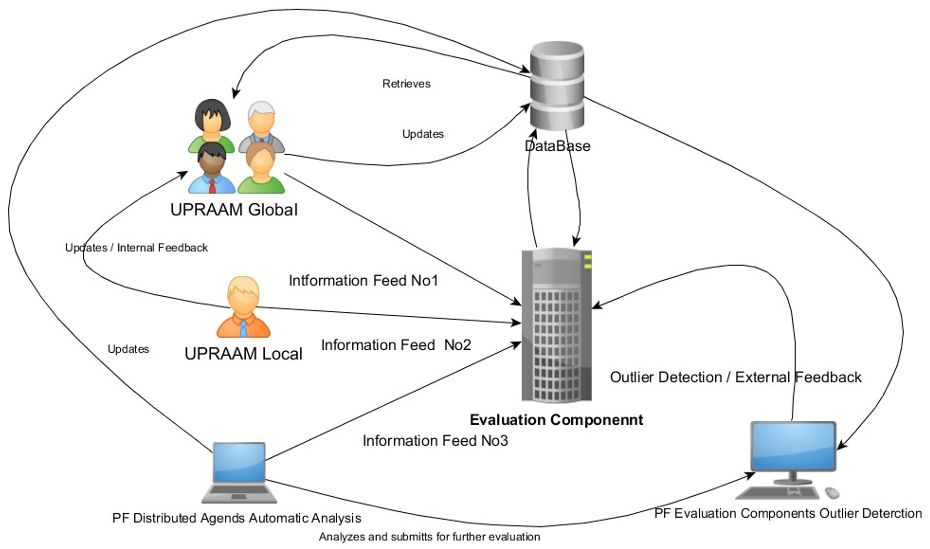
3. The Observatory
This is the "brain" of the project. It post-processes crowdsourced data to visualize trends in:
- Confidentiality: Analyzing the robustness of encryption algorithms used by sites.
- Security: Monitoring the use of obsolete or dangerous web technologies.
- Privacy: Tracking intrusive user-monitoring mechanisms.
Experiments & Results
The researchers validated the platform through two distinct focus groups: Regular Users and Academic Experts.
- Regular Users: Reported an "eye-opening" experience. Many were unaware of the persistent tracking they were subjected to until they saw the visualized charts in the Observatory.
- Experts: Praised the platform's ability to aggregate "concentrated information," noting that the data produced is highly valuable for secondary research in Data Mining and threat propagation.
The platform's strength lies in the Law of Large Numbers. As more users join, the margin for error in identifying malicious "outliers" decreases, making the system's statistical "Hypothesis Testing" increasingly accurate.
Critical Analysis & Conclusion
Takeaway
Privacy Flag proves that security is no longer just a technical problem; it is a social coordination problem. By providing "Privacy Enablers" to the public, the researchers have turned passive victims into active participants in the security lifecycle.
Limitations
- Incentive Structure: The paper does not deeply explore how to keep volunteers motivated in the long term without "participation fatigue."
- Adversarial Crowdsourcing: There is a potential risk of malicious actors joining the crowd to "poison" the data (reporting safe sites as dangerous), a common challenge in collective intelligence systems.
Future Work
The authors plan to integrate the platform with open-source threat databases like CVE (Common Vulnerabilities and Exposures) and implement more advanced statistical hypothesis testing to determine how risks propagate across different geographical regions.