
Steemit Unleashed: Does Cryptocurrency Truly Democratize Social Media?
3573_A Graph-Based Socioeconomic Analysis of Steemit.
Summary
Problem
Method
Results
Takeaways
Abstract
This paper presents a comprehensive graph-based socioeconomic analysis of Steemit, the most prominent Blockchain Online Social Medium (BOSM). By restructuring the follower-following network into a directed graph of 1.2M nodes, the authors evaluate how economic incentives influence social topology and user behavior.
## TL;DR
While Blockchain Online Social Medias (BOSMs) promise to return value to creators, this deep-dive into Steemit reveals a startling paradox: the platform's "Whales" (richest users) are often its least social. By analyzing a graph of 1.2 million users, researchers found that the rewarding system effectively creates a "pay-to-play" arena where influence is frequently bought on external exchanges rather than earned through community engagement.
## The Decentralized Dream vs. Economic Reality
The move from Facebook to decentralized platforms was driven by a desire for data ownership and fair revenue sharing. Platforms like Steemit introduced a revolutionary concept: **Reward-based Social Media**. In theory, if you write a great post, the community upvotes you, and you earn cryptocurrency.
But the researchers identified a critical tension. Steemit isn't just a social network; it's a complex multi-token economy. With three distinct currencies—**STEEM** (liquid), **VEST** (power/commitment), and **SBD** (stablecoin)—the platform attempts to balance liquidity with long-term investment. The "power-up" mechanism (converting STEEM to VEST) is designed to increase a user's voting weight, effectively turning wealth into social gravity.
## Methodology: Mapping the Socioeconomic Graph
The authors treated the Steem blockchain as a living ledger, extracting 98 million "follow" relationships.
### 1. The Multi-Token Ecosystem
The study emphasizes that the 13-week "power-down" period for VEST is intended to prevent market manipulation, yet it creates a rigid hierarchy.
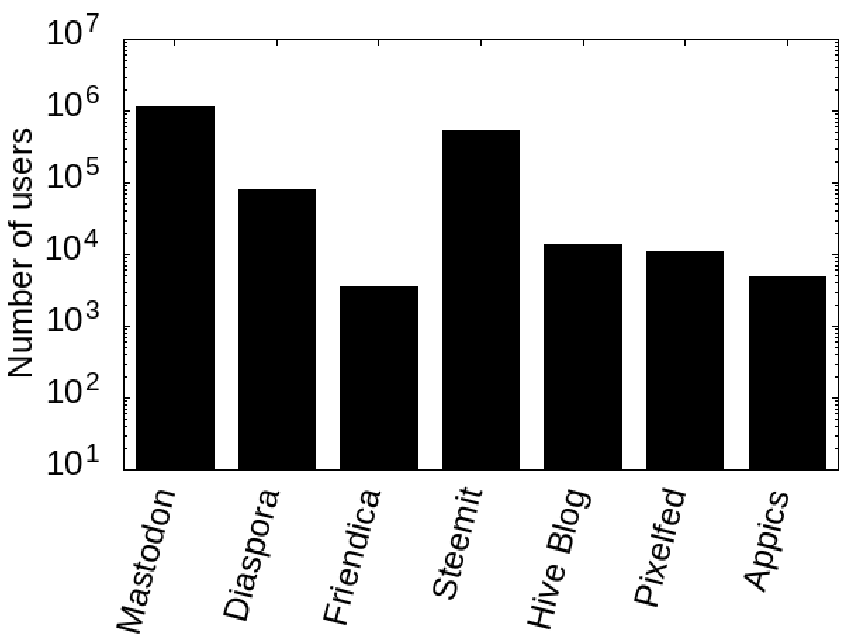
*Figure: The interaction and conversion paths between STEEM, SBD, and VEST.*
### 2. User Hierarchy: From Redfish to Whales
Users are stratified into levels based on their VEST holdings. A "Whale" holds 10x more power than an "Orca," who holds 10x more than a "Dolphin," and so on. This logarithmic scale creates immense power concentration.
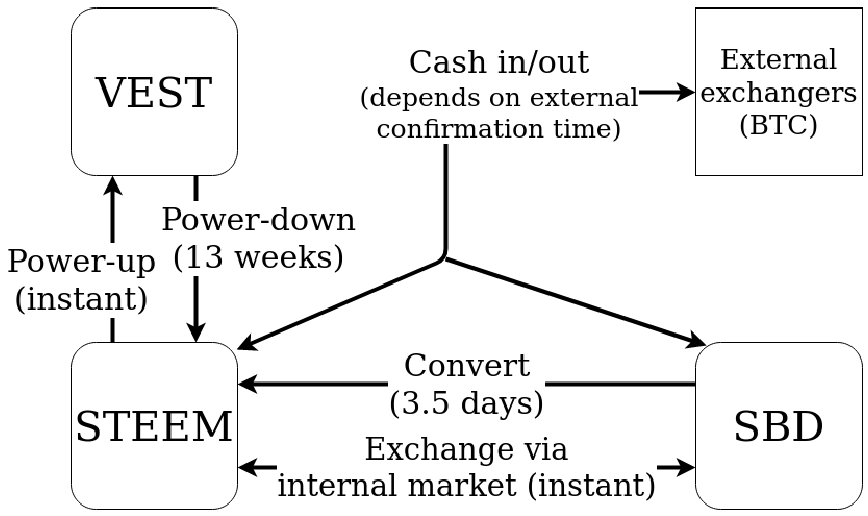
*Figure: The Steemit user hierarchy based on VEST holdings.*
## Core Findings: The "Wealth vs. Sociality" Paradox
The most striking result of the graph analysis is the **Inverse Correlation of Wealth and Activity**.
* **Scale-Free Properties**: The follower-following graph exhibits scale-free behavior typical of "ultra-small world" networks, similar to early-stage Facebook.
* **The Rich are "Quiet"**: When examining the top 1% of STEEM and VEST holders, their social activity (posts and votes) was actually *lower* than the platform average.
* **External On-ramps**: Because users can buy STEEM on external exchanges and "Power Up," the most influential users are often investors rather than contributors. This allows "Whales" to dominate content rewards without necessarily providing value to the ecosystem.
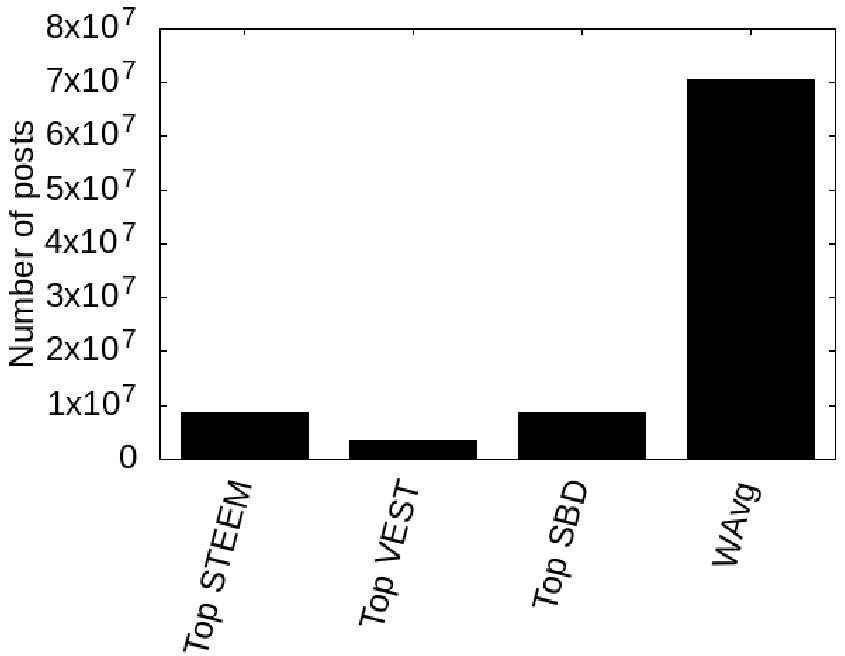
*Figure: Comparison of content creation across different holder categories, showing the platform average significantly outperforming the "rich" categories.*
## Comparison with Traditional Media
How does Steemit stack up against giants like Twitter or Facebook?
The researchers found that Steemit’s average degree (80.17) and average shortest path (3.7) suggest a very tightly knit community. However, the reciprocity of "follows" is quite low (17%), suggesting that users follow others more for visibility or reward-tracking than for mutual social bonding.
## Critical Analysis: The Future of BOSMs
The study concludes with a cautionary note. While Steemit represents a bold evolution of the social web, its economic layer is a double-edged sword:
1. **Censorship Resistance**: By storing interactions on-chain, it achieves true decentralization.
2. **The "Bot" Problem**: The rewarding system incentivizes the use of "bid-bots"—services where users pay for upvotes. This decoupling of "reward" from "quality" is the platform's greatest threat.
In the author's view, Steemit behaves like a social network in its early growth phase but faces a unique "plutocratic" pressure that traditional platforms do not.
**Final Takeaway**: For decentralized social media to succeed, they must find ways to ensure that *Reputation* (which cannot be bought) carries more weight than *Tokens* (which can). Otherwise, the new web will look remarkably like the old one: dominated by the few.