
WorldTV: Navigating the Global Social Pulse via a 3D Globe Interface
A 3D Globe-Based Interface for Social Video Discovery
WorldTV is a 3D globe-based interface designed for discovering and streaming geotagged, user-generated video content on televisions. It utilizes a dual-screen approach where a smartphone serves as an interactive remote to navigate a 3D Earth model populated with social and event-based video "pins."
TL;DR
WorldTV redefines the "leaning back" television experience by transforming the screen into a window to the world. By plotting geotagged, user-generated videos onto a 3D 3D model of the Earth, it creates an intuitive discovery platform where social connections and global events are just a "flick" of a smartphone away.
Background Positioning
Developed by MIT researchers in 2011, WorldTV sits at the intersection of Social TV and Geospatial Visualization. While modern platforms like TikTok use algorithmic feeds, WorldTV explores an alternative: the geography of human experience. It treats the globe as the primary UI, turning viewers into digital explorers.
Problem & Motivation: The Discovery Paradox
As user-generated content (UGC) exploded, two major hurdles emerged:
- Context Loss: A video of a protest or a family gathering loses its impact when stripped of its physical location.
- The "Cold Start" Filter: Traditional recommendation systems (like Amazon's or YouTube's item-to-item filtering) require historical viewing data. This doesn't work for live video that is happening right now.
The authors hypothesized that location is the most accessible and meaningful tag for live media. If we know where it is, we can provide context even if we don't yet know what it is.
Methodology: The 3D Globe UI
The core innovation is the use of a 3D globe—specifically leveraging the Google Earth API—to serve as the navigation interface.
1. The Visual Metaphor
- Blue Pins: Represent videos from your social circle (Facebook/Twitter friends).
- Red Pins: Represent "Event" videos (news, sports, or global happenings).
- Pin Scaling: The size of the pin is determined by real-time popularity, regional relevance, or uploader reputation.
2. The Dual-Screen Architecture
Instead of a clunky TV remote, WorldTV uses a smartphone. Utilizing the mobile's accelerometer, a user can "flick" the globe to spin it, providing a tactile sense of control.
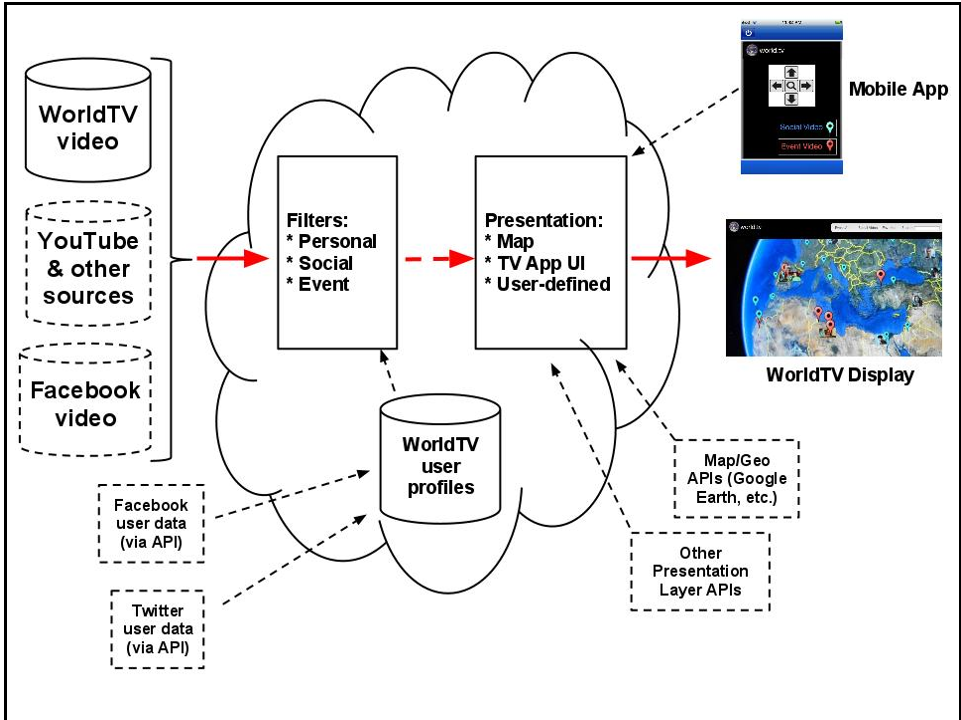 Figure 1: The WorldTV system architecture shows content flowing through social filters before appearing on the 3D presentation layer.
Experiments & User Insights
The team conducted a survey to gauge interest in amateur video on the "big screen." The results were overwhelmingly positive for social and news content:
| Content Type | Interested | Not Interested |
|---|---|---|
| Video from family | 90% | 10% |
| Video from friends | 87.5% | 12.5% |
| International News | 86.5% | 13.5% |
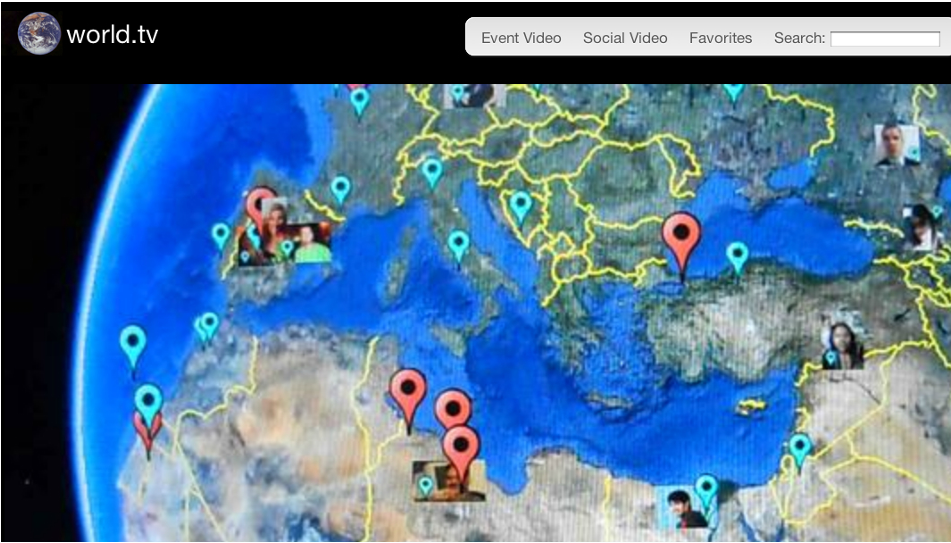 Figure 2: Mockup of the WorldTV interface showing the 3D globe visualization.
Filtering Beyond the Algorithm
Since item-to-item filtering fails for live streams, the authors proposed "User-to-User" filtering. By syncing your WorldTV profile with Facebook and Twitter, the app prioritizes content watched by people within your social graph, assuming shared interests.
Critical Analysis & Conclusion
Takeaway: WorldTV was ahead of its time in predicting that geotagging would become a standard feature of mobile video. It correctly identified that the TV is no longer just for professional broadcasts but for personal and social connection.
Limitations:
- Platform Fragmentation: In 2011, the lack of a universal "TV App Store" was a major hurdle.
- Privacy: The paper focuses on discovery but skips over the growing concerns regarding the public broadcast of geotagged personal locations.
Future Outlook: Today, we see elements of WorldTV in Snapchat's "Snap Map" or Periscope (RIP). However, the vision of a dedicated, high-fidelity 3D globe on the living room TV—controlled by spatial mobile gestures—remains a compelling and under-realized "Star Trek-esque" vision of the future.