
Elevating SIoT Security: A 3D Leap Over the Complexity of 2D Modelling
13286_A 3-D Security Modeling Platform for Social IoT En
This paper introduces a novel 3D security modelling platform for Social IoT (SIoT) environments by extending the Business Process Model and Notation (BPMN). Utilizing Unity 3D game technology, the system maps security requirements to a third dimension (Z-axis) to manage complexity while maintaining the original business process logic on the X/Y plane.
TL;DR
As Social IoT (SIoT) blends human interaction with billions of smart devices, the security landscape has become too dense for traditional 2D flowcharts. This paper presents a 3D Security Modelling Platform built on Unity, extending BPMN into the third dimension. By separating security requirements onto a vertical axis and using game-engine modularity, the researchers achieved a 169% accuracy boost in identifying security flaws compared to conventional 2D methods.
The "Sticker" Problem: Why 2D BPMN Fails
In the world of Business Process Model and Notation (BPMN), adding security has traditionally been an exercise in "stamping." If a task needs encryption, access control, and privacy logging, authors simply pile three icons onto one box.
The Pain Point: As SIoT environments scale, these diagrams become a cluttered "alphabet soup." Previous extensions suffered from:
- Construct Deficit: Missing 80% of necessary security concepts (e.g., non-repudiation or binding of duty).
- Cognitive Overload: The human brain struggles to differentiate 10+ overlapping icons on a single 2D plane.
- Poor Semantic Transparency: Using a simple "padlock" for every security concept makes it impossible to distinguish Authentication from Integrity at a glance.
Methodology: The Geometry of Security
The authors' core insight is to treat security not as a flat attribute, but as a perpendicular dimension.
1. The 3D Architecture
By using the Unity engine, the SIoT scenario (the business logic) stays on the horizontal "ground" plane (X/Z axes). Security requirements are "holders" that grow vertically (Y-axis).
 Fig 1: The standard 2D view vs. the proposed 3D spatial separation.
2. The Physics of Notations
Following Daniel Moody’s "Physics of Notations," the team designed a shield-based visual vocabulary:
- Perceptual Discriminability: Security is always a shield; IoT tasks are rectangles. They never look alike.
- Visual Expressiveness: They utilized 7 out of 8 visual variables, including Brightness (higher hierarchy symbols are brighter), Color (coding for 6 core areas like Privacy vs. Integrity), and Vertical Position.
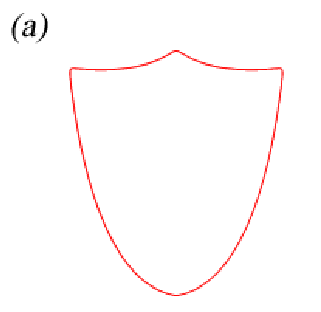 Fig 2: Example of visual variables applied to shield notations.
3. Modularization & Game Logic
To prevent a "forest of shields," the platform uses game-like interaction logic. If a user clicks on the "Access Control" shield, only its children (Authentication, Authorization) appear, while others collapse. This ensures the user only sees 6 constructs at a time, staying well within the limits of human working memory.
Experimental Results: Complexity is 3D's Best Friend
The researchers tested their platform against standard 2D models. The results were telling:
- Simple Diagrams: For low-complexity tasks, users preferred 2D for its familiarity.
- Complex SIoT Scenarios: When the diagram included 36 security constructs, the 3D platform crushed the competition.
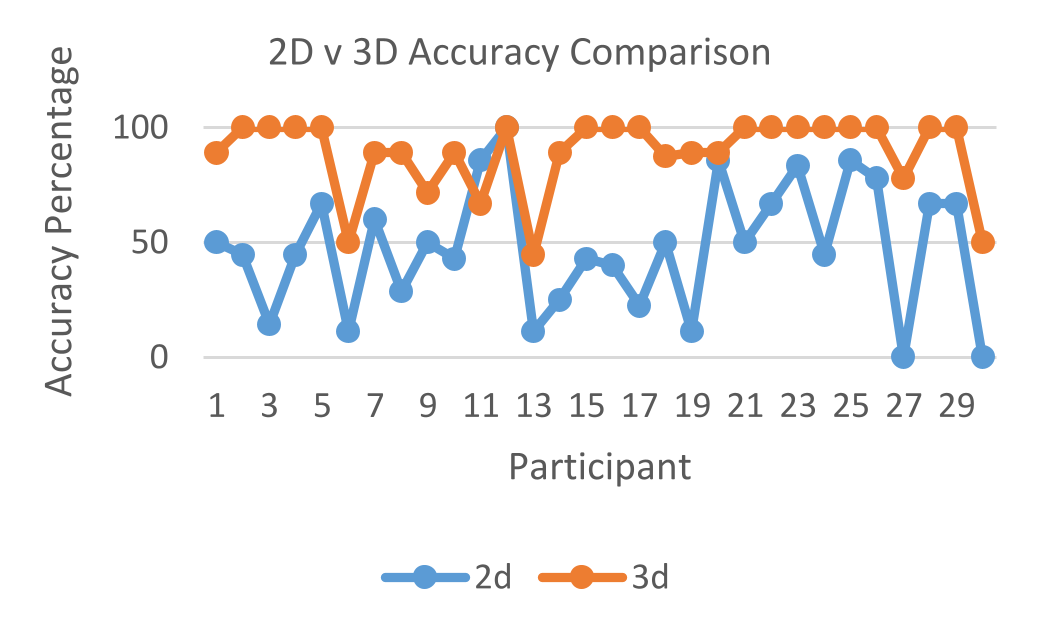 Fig 3: Accuracy and completion rates showing the massive efficiency gain in 3D (red) vs 2D (blue).
Key Stat: Users completed 21% more tasks with double the accuracy just by switching the view from flat to depth.
Critical Insight & Conclusion
The genius of this work isn't just "putting things in 3D"; it's the ontological mapping behind the graphics. By creating an ontology of 79 cyber-security requirements first, and then mapping them to a hierarchical 3D interface, the authors solved the "construct deficit" that plagued BPMN for a decade.
Limitations:
- Navigation Curve: Managing a 3D camera (WSAD keys) may be difficult for non-gamers.
- Asset Production: Creating 3D textures for every security nuance is more labor-intensive than 2D icons.
The Takeaway: As IoT environments evolve into "Social" entities involving human-device interaction, our modelling tools must evolve too. This paper proves that spatial depth is not just a gimmick—it's a fundamental tool for managing the exploding complexity of modern cyber-physical security.