
Sensing the Soul through the Screen: Unobtrusive Emotion Recognition on Smartphones
4315_Towards unobtrusive emotion recognition for affective social communication.
The paper proposes an "unobtrusive" emotion recognition system for smartphones that identifies seven emotional states by analyzing user-generated sensor data without specialized hardware. By implementing an Android application ("AT Client"), the authors use a Bayesian Network classifier to process behavioral and contextual patterns, achieving an average accuracy of 67.52%.
TL;DR
Researchers from Samsung’s Intelligent Computing Laboratory have developed a method to detect human emotions—ranging from happiness to fear—simply by observing how you type and where you are. By ditching intrusive heart-rate monitors in favor of a Bayesian Network that analyzes typing speed, device shaking, and location, they achieved a solid 67.52% accuracy in real-world scenarios.
The "Intrusion" Problem in Affective Computing
For decades, Affective Computing has faced a trade-off: Accuracy vs. Convenience. To know how a user truly feels, systems typically required:
- Wearables: Sensors for skin conductance or heart rate.
- Visuals: Constant camera access for facial expression mapping.
- Audio: Microphones "listening" for vocal tremors.
In the context of a social media user sending a quick tweet, these are blockers. Who wants to wear an ECG glove just to post a status update? The authors argue that the "unobtrusive" path is the only way to reach mass-market adoption.
Methodology: The "Invisible" Sensor Suite
The core insight of this paper is that our emotions leak into our micro-behaviors. When you are angry, you might type faster or shake the phone more; when you are hesitant (sad or fearful), your cadence changes.
The Architecture
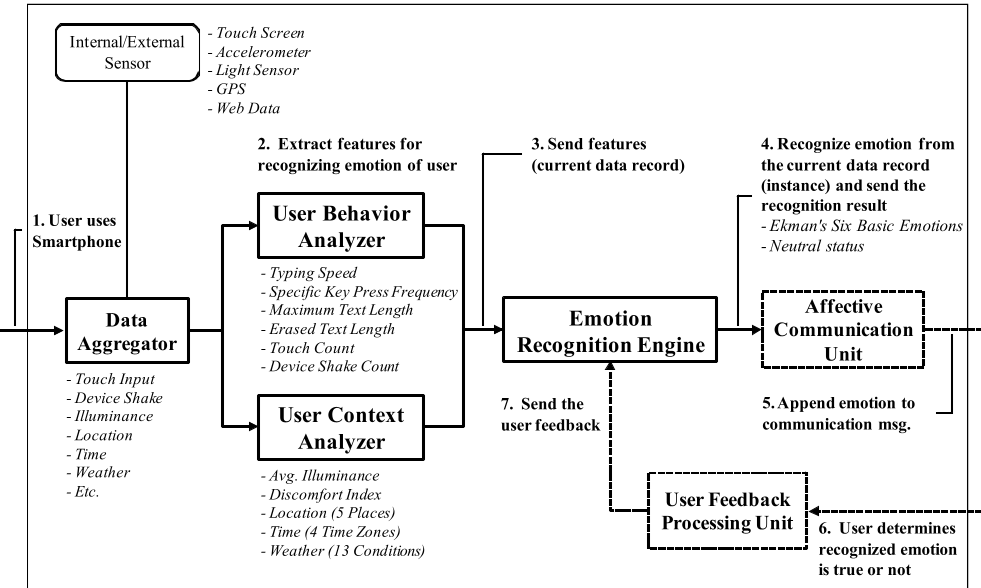
The researchers built the AT Client (Affective Twitter Client), which acts as a data aggregator. It splits inputs into two pipelines:
- Behavioral Analyzer: Tracks typing speed, backspace frequency, and accelerometer data (device shaking).
- Contextual Analyzer: Pulls environmental data like location (GPS), time of day, and weather.
Feature Selection
Using Information Gain, the authors identified that Typing Speed is the "crown jewel" of behavioral features. Interestingly, they discarded "Ambient Light" and "Discomfort Index" because the test subject spent most time in climate-controlled indoor environments, rendering those sensors "noise" rather than "signal."
Results: Can Machines Truly "Feel" Us?
The results from the 314 real-world data points show that the Bayesian Network is remarkably good at identifying Happiness and Neutral states.
- Happiness Accuracy: High precision, as happy users tend to have consistent, rhythmic typing patterns.
- The "Neutral" Anchor: Neutral remains the most frequent state (105 correct classifications), acting as the baseline for the system.
- The Pain Points: Sadness and Fear showed lower accuracy. The authors hypothesize this is due to a lack of "negative samples"—people in his study simply didn't feel fearful or profoundly sad very often during the two-week pilot.
Critical Insight: The Value of Negative Space
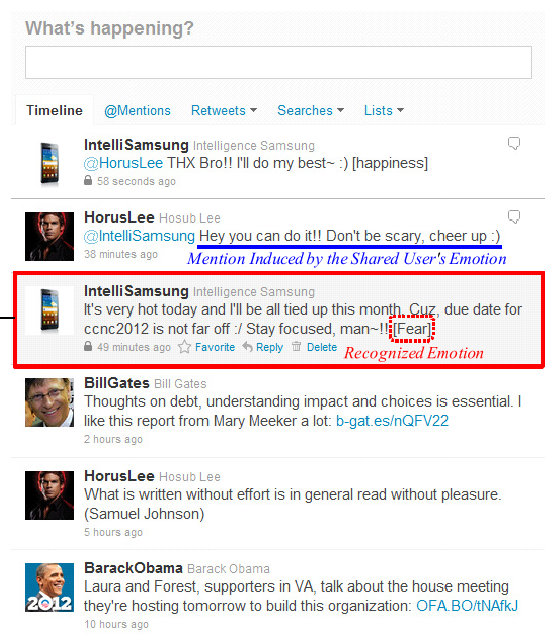
What makes this work stand out is the "Social Communication" loop. The researchers aren't just recognizing emotion for the sake of data; they intend to use it to enrich social interaction. Imagine a Twitter feed where a "Sadness" tag is automatically suggested, prompting friends to offer support to someone who might be too shy to ask.
Conclusion & Limitations
While the 67% accuracy is a breakthrough for a completely passive system, the study's reliance on a single participant (a male in his 30s) is a clear limitation. Emotion is deeply subjective and culturally tied; a "fast typer" in one culture might be an "angry typer" in another.
However, the "Samsung approach" proves that the sensors already in our pockets are powerful enough to decode our internal world—no gloves, no cameras, and no discomfort required.