
TAF: Overcoming the Velocity Barrier in Real-Time Healthcare Analytics
4316_TAF Temporal Analysis Framework for Handling Data velocity in Healthcare Analytics.
The paper introduces TAF (Temporal Analysis Framework), a targeted solution for managing data velocity in healthcare analytics. By utilizing a self-adaptable real-time data analysis mechanism, it optimizes data aggregation and reduces redundancy while maintaining high clinical data quality.
TL;DR
As healthcare transitions into the era of Electronic Health Records (EHR) and ubiquitous sensors, "Data Velocity"—the speed of incoming information—has become a bottleneck for traditional Big Data systems. This paper introduces the Temporal Analysis Framework (TAF), a self-adaptive system that throttles data ingestion based on the volatility of the clinical signals. By moving away from static batch processing, TAF reduces processing time by over 80% and memory usage by 60% without losing critical medical accuracy.
The Problem: When Batch Processing Fails Patients
In healthcare, "Variety" and "Veracity" are often prioritized to ensure diagnostic accuracy. However, "Velocity" creates a hidden crisis:
- Inaccuracy in Sampling: Standard systems struggle to process millions of rows per second, leading to over-sampling of redundant data or under-sampling of critical events.
- Data Volatility: Static monitoring systems (like traditional OLTP) cannot adjust to the dynamic nature of patient vitals, leading to high operational costs and "noisy" data.
- Infrastructure Limits: Open-source frameworks like Hadoop are designed for volume but fail in real-time "online" scenarios required for live patient monitoring.
Methodology: The Logic of Adaptive Monitoring
The core innovation of TAF lies in its ability to self-tune. Instead of taking a reading every seconds (static), it assesses the Data Instability Factor ().
1. Attribute Scrutinization
The system extracts clinical attributes and performs linear interpolation to fill gaps. It measures the "Mean Error" () between real readings and interpolated values. If the error is low, the data is stable.
2. Dynamic Temporal Intervals
TAF treats the time between readings () as a function of data instability.
- High Instability: decreases to capture more granular detail.
- Low Instability: increases to save memory and processing power.
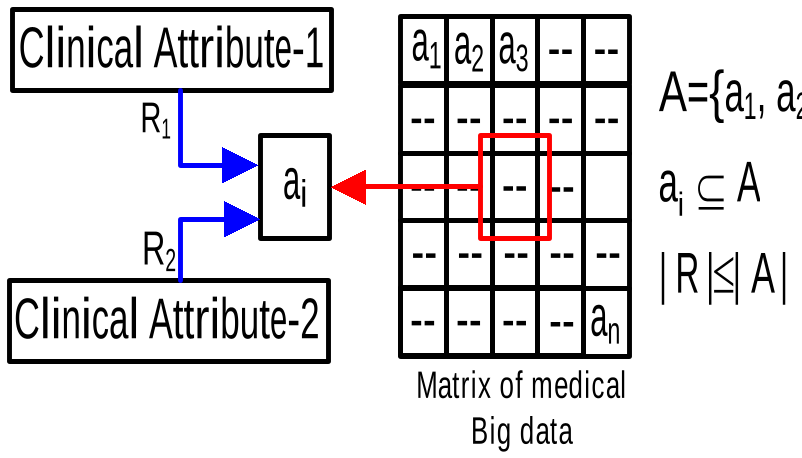 Figure 1: The framework's approach to identifying clinical significance within massive data matrices.
3. Memory Constraints
The algorithm incorporates a memory constraint () that acts as a buffer gatekeeper. It ensures the system doesn't commit resources to redundant data points, effectively creating a "virtual pipeline" that heals itself based on network throughput.
Experimental Results: Efficiency and Scalability
The authors tested TAF against a standard baseline using a synthetic medical database. The results highlight a massive leap in efficiency as data size grows.
- Processing Speed: TAF maintains near-constant efficiency. At higher data loads (4.5 GB), TAF was nearly 6 times faster than the baseline.
- Memory Utilization: Because TAF ignores redundant stable data, its memory footprint is significantly lighter.
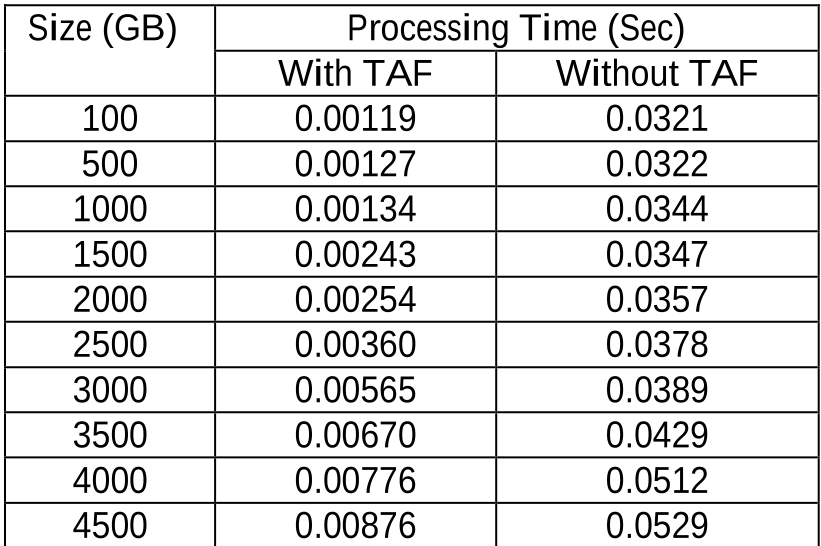 Table 1: Comparison of processing time (With TAF vs. Without TAF) showing significant gains in high-load scenarios.
Critical Insight: Why This Matters
The "Takeaway" for healthcare tech leaders is clear: Static is Expensive. By focusing on temporal analysis—understanding when a data point matters based on its variance from the norm—we can build systems that are significantly more scalable.
However, the paper acknowledges a trade-off: in healthcare, error minimization is paramount. TAF strikes this balance by ensuring that while it slows down monitoring, it only does so when the "instability factor" is within safe thresholds.
Conclusion & Future Outlook
TAF successfully addresses the "Velocity" challenge by making data ingestion dynamic. The next step for this research is the development of predictive decision models—using this high-quality, non-redundant data stream to not just monitor, but predict patient outcomes in real-time.
Keywords: Healthcare Analytics, Big Data Velocity, Real-Time Analysis, Temporal Analysis Framework.