
Image4Act: Revolutionizing Disaster Response through Real-Time Social Media Image Intelligence
4394_Image4Act Online Social Media Image Processing for Disaster Response.
The paper introduces Image4Act, an end-to-end online social media image processing system designed for real-time disaster response. Utilizing a combination of VGG-16 CNNs and Perceptual Hashing (pHash), the system achieves state-of-the-art performance in filtering irrelevant imagery and assessing infrastructure damage during mass emergencies.
TL;DR
Image4Act is an end-to-end processing pipeline that filters the "noise" of social media during crises. By combining Perceptual Hashing for de-duplication and Deep CNNs for relevancy and damage assessment, it turns chaotic Twitter streams into actionable intelligence for humanitarian organizations.
Contextual Background
In the immediate aftermath of a disaster, speed is everything. While text-based sentiment analysis has been the "bread and butter" of social media mining, visual data (images) often provides more visceral, ground-truth evidence of infrastructure damage and human need. However, for every 1 image of a collapsed bridge, there are 100 images of memes, celebrity news, or advertisements. Image4Act bridges this gap by providing a machine-learning-driven filter that empowers human responders.
The Core Problem: The Signal-to-Noise Challenge
Humanitarian organizations face two major constraints: Time and Crowdsourcing Budget.
- Duplicates: Users often retweet or repost the same viral images, leading to redundant work for analysts.
- Irrelevancy: Social media is inherently noisy. A hashtag like #CycloneDebbie will contain many non-situational images (banners, logos, or posters). Prior tools often lacked a robust, automated way to "clean" this data before it reached human eyes, leading to cognitive fatigue among volunteer responders.
Methodology: The Hybrid Intelligence Pipeline
Image4Act employs a sophisticated architecture that balances speed with accuracy.
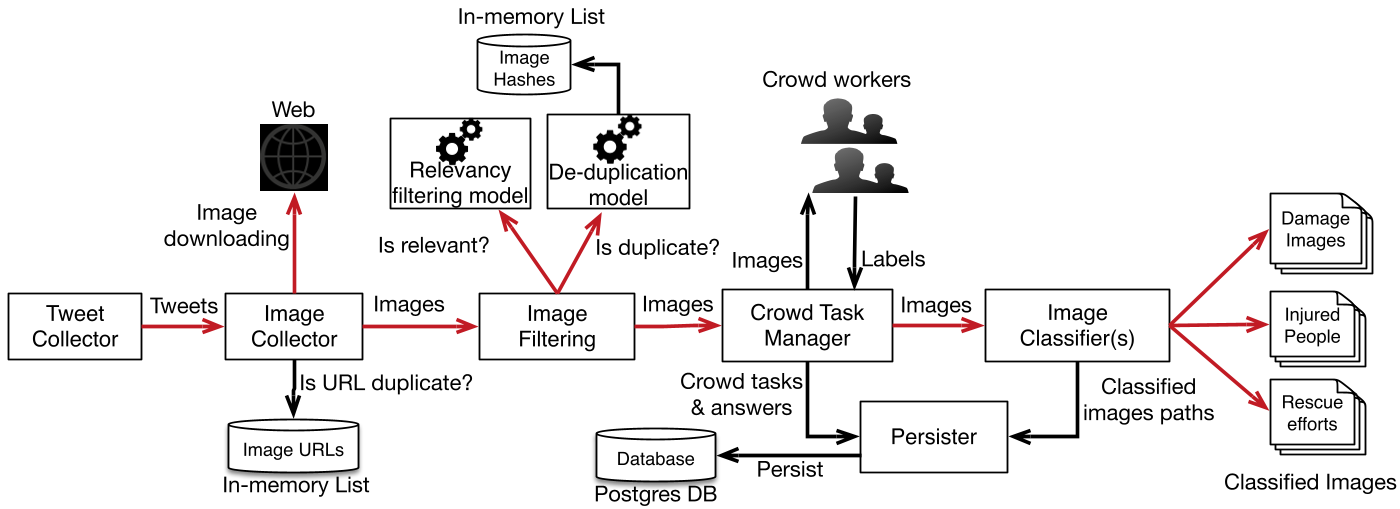
1. Architectural Overview
The system uses a modular approach powered by Redis channels for real-time data flow, allowing for high-concurrency processing.
2. Denoising Mechanics
- De-duplication: The system uses Perceptual Hashing (pHash). Unlike standard cryptographic hashes (MD5/SHA), pHash generates a fingerprint where similar images have similar hashes. By calculating the Hamming Distance, the system can identify "near-duplicates" (e.g., the same photo with a different crop or compression).
- Relevancy Filtering: Utilizing Transfer Learning, the authors took a VGG-16 model (pre-trained on 1.2 million ImageNet images) and fine-tuned it on disaster-specific datasets. This allows the model to "understand" what a crisis looks like (rubble, floods, injured people) versus what it doesn't (cartoons, lab coats, menus).
Experimental Results & Real-World Impact
The system's performance was validated both on historical datasets and during a live deployment.
- Offline Accuracy: The relevancy filter achieved a near-perfect AUC of 0.98. Even the complex task of damage severity assessment (Severe vs. Mild vs. None) reached a respectable AUC of 0.72, which is highly useful when processing data at scale.
- Deployment (Cyclone Debbie): During the 2017 Queensland cyclone, the system successfully filtered 7,000 images in real-time.
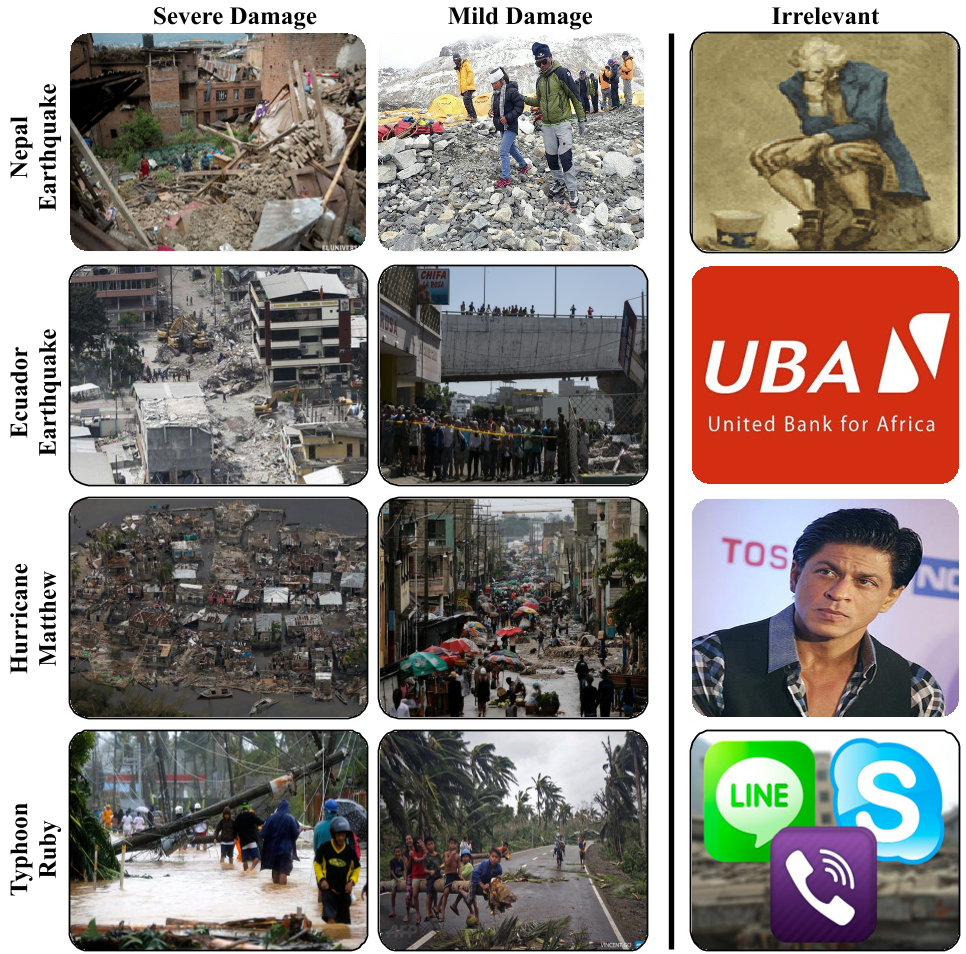 Fig: The system effectively separates actionable imagery (left) from noise (right).
Critical Insight: Why Human-in-the-Loop Matters
A key takeaway from this work is that AI should not replace the responder but curate the responder's experience. By using the Crowd Task Manager, Image4Act ensures that the Stand-By-Task-Force (SBTF) volunteers only spend their limited time on high-value, relevant images. This collaboration creates a "flywheel" effect: humans provide high-quality labels for machine learning, and the machine learning filters out the noise to make human time more efficient.
Limitations & Future Outlook
While the VGG-16 architecture was state-of-the-art at the time of publication, modern Vision Transformers (ViT) or State Space Models (SSM) could potentially offer even higher efficiency. Furthermore, the 0.72 AUC for damage assessment suggests that fine-grained classification remains a challenge due to the semantic ambiguity of crisis imagery.
Future directions for this work could involve Multimodal Fusion—analyzing the text of the tweet simultaneously with the image to resolve ambiguities that a purely visual model might miss.
Conclusion
Image4Act is more than a research project; it is a functional integration into the AIDR platform, proving that deep learning is mature enough to support critical humanitarian missions. By solving the "garbage-in/garbage-out" problem of social media data, it paves the way for faster, more intelligent crisis response.