
Trust2Privacy: Transforming Fuzzy Trust into Dynamic Privacy in Mobile Social Networks
4415_Trust2Privacy A Novel Fuzzy Trust-to-Privacy Mechanism for Mobile Social Networks.
This paper introduces Trust2Privacy, a novel trust-based access control mechanism for Mobile Social Networks (MSNs) that bridges the gap between trust evaluation and privacy preservation. It utilizes a fuzzy comprehensive evaluation algorithm and multi-dimensional features, including online interactions and offline location semantics, to provide personalized privacy protection.
TL;DR
Mobile Social Networks (MSNs) often struggle with a "post and pray" privacy model—where control vanishes after clicking 'Share'. Trust2Privacy shifts the paradigm by proposing a mechanism that dynamically converts multidimensional trust (calculated from both digital interactions and physical location semantics) into hierarchical privacy permissions. By leveraging fuzzy set theory and O2O (Online-to-Offline) evidence, it ensures that your data is only visible to those who truly belong in your "social circle."
The "Recommendation" Paradox
In MSNs like Twitter or Facebook, recommendation algorithms are a double-edged sword. While they help you find like-minded friends, they often inadvertently expose your private updates to malicious actors or incompatible strangers.
Current SOTA methods suffer from three fatal flaws:
- Symmetry Assumption: They treat trust as mutual, ignoring that User A following User B doesn't mean User B trusts User A.
- Binary Rigidity: Privacy is treated as an "on/off" switch, failing to account for the grey area of "acquaintances."
- Context Ignorance: They ignore the rich data provided by offline mobility (where you go and what those places mean).
Methodology: The Trust-to-Privacy Pipeline
The authors' core "Insight" is that trust is not a single number but a Fuzzy Vector. They decompose trust into a hierarchical "Feature Tree."
1. Multi-Dimensional Feature Extraction
Trust is calculated through three lenses:
- Similarity: Basic attributes (age, occupation).
- Correlation: Shared networks and social circles.
- Interaction: Recency and frequency of likes, comments, and shares.
2. The O2O (Online-to-Offline) Edge
Unlike previous models, Trust2Privacy uses Location Semantics. It isn't just about "how far" two users are, but the meaning of where they go. Using NLP techniques like Skip-gram, the system maps locations (e.g., "Gym," "Library") into vector spaces to find users with similar lifestyles, even if they aren't physically close.
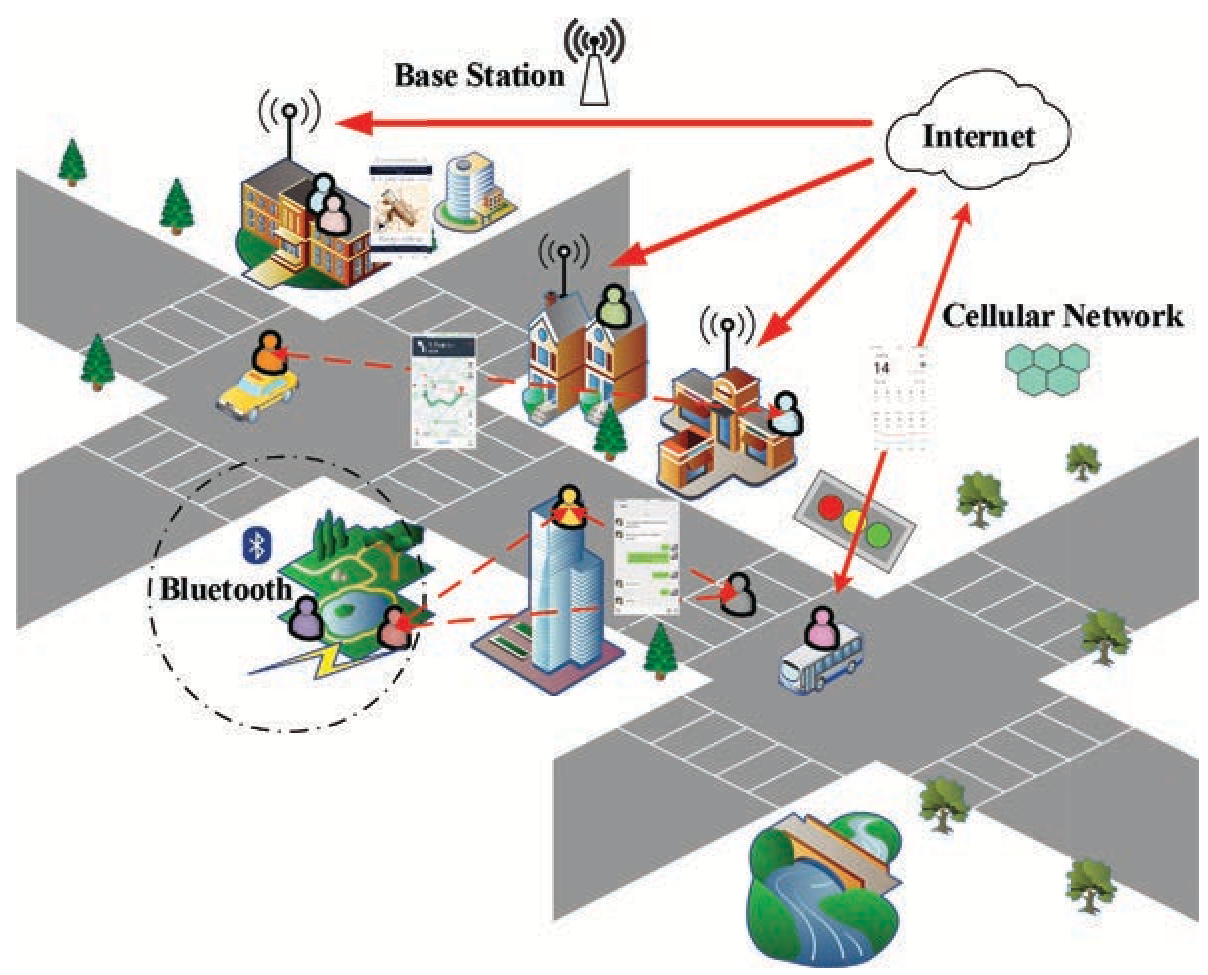 Figure 1: The overarching Trust2Privacy framework, illustrating the flow from user features to fuzzy trust evaluation and final access control.
3. Fuzzy Comprehensive Evaluation
Because a similarity of "0.7" doesn't inherently mean "High Trust," the paper uses fuzzy membership functions. This maps complex feature inputs into a level set: {Highest, Higher, Middle, Low, Lower, Lowest}.
Experimental Validation: Beyond Distance
Using the Weeplaces dataset (15,000+ users), the researchers proved that adding semantics to location data fundamentally changes trust accuracy.
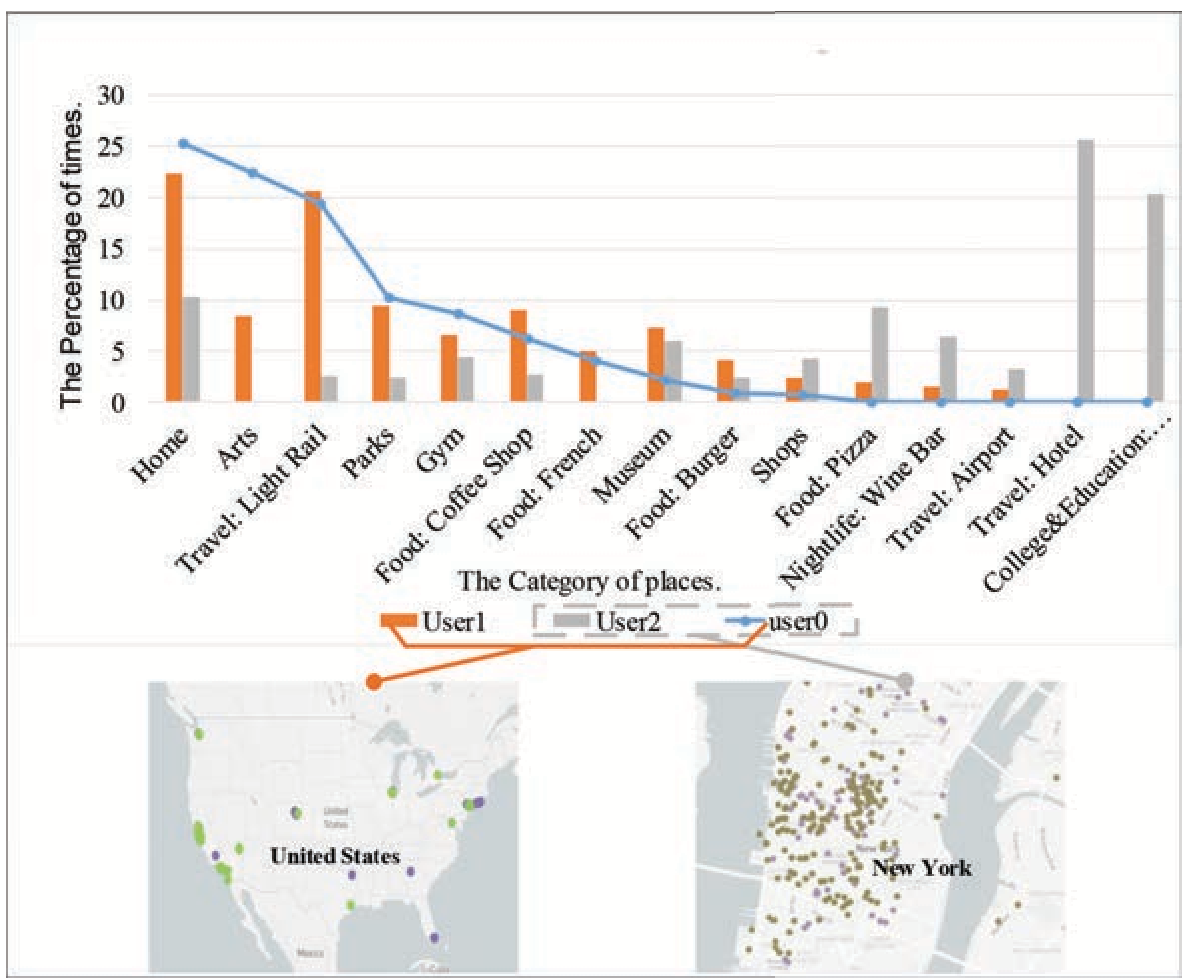 Figure 2: Analysis of user locations. Note how semantic similarity outweighs pure geographical proximity in defining true social relationships.
The study highlighted a critical observation: User 0 and User 1 might be far apart, but their frequent visits to "Sashimi Restaurants" and "Japanese Culture Centers" create a semantic link that traditional distance-based algorithms would miss.
Comparative Advantage
As shown in the table below, Trust2Privacy is the first to check all the boxes for modern MSNs:
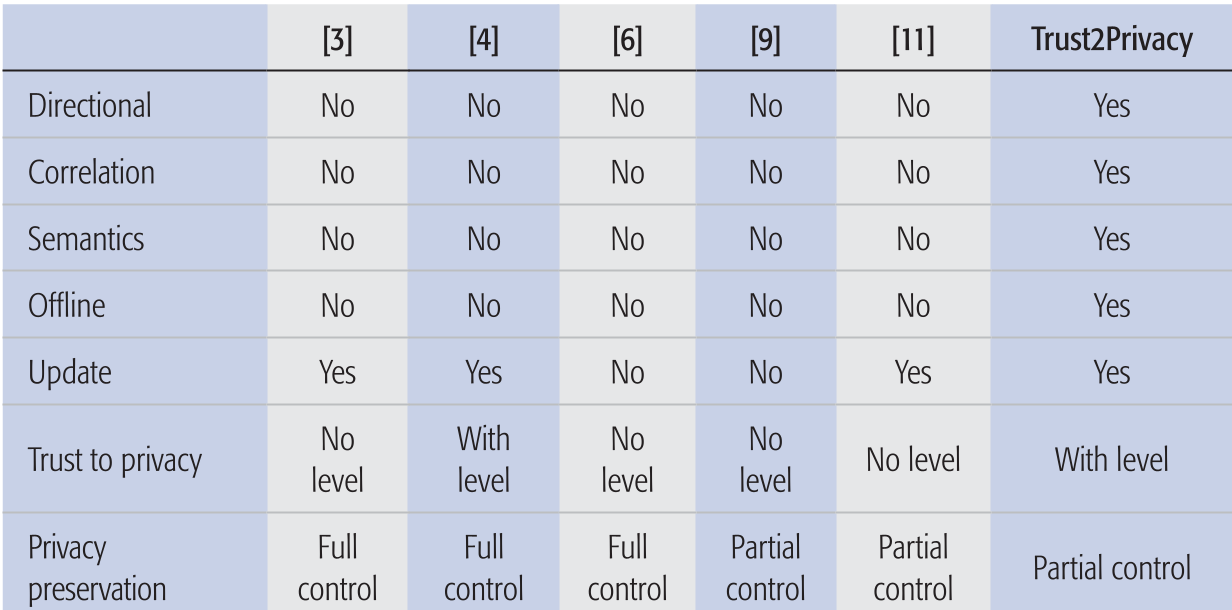
- Asymmetry: It respects the "Direction of Trust."
- Privacy Hierarchies: It uses cryptographic keys to ensure that a "Level 2" trusted user can see photos, but only a "Level 0" can see location data.
Critical Insight & Future Outlook
The brilliance of Trust2Privacy lies in its acknowledgment of human subjectivity. By allowing users to set thresholds based on "Sensitivity," it provides a personalized shield.
Limitations: The reliance on a "Trusted Service Provider" (TSP) for encryption management remains a centralized bottleneck. Future iterations might benefit from Decentralized Identifiers (DIDs) or Zero-Knowledge Proofs (ZKP) to remove the need for a central middleman.
Conclusion
Trust2Privacy successfully demonstrates that privacy in the 5G/6G era must be as mobile and dynamic as the users themselves. By bridging the gap between "where we are" (offline) and "who we talk to" (online) via fuzzy logic, this research sets a new benchmark for secure and usable social networking.