
Who are Your "Real" Friends? Distinguishing Offline Relationships from Social Multimedia
4454_Who Are Your Real Friends Analyzing and Distinguishing Between Offline and Online Friendships From Social Multimedia Data.
This paper introduces a large-scale data mining framework to distinguish "onsite offline friends" (those who have face-to-face contact) from general online social connections using social multimedia data. By leveraging Instagram's "tag people" feature as a proxy for physical presence, the authors develop a classification system based on behavioral and topological features to identify real-world friendships.
TL;DR
In the digital age, our friend lists on Instagram and Facebook often reach into the thousands, far exceeding the social capacity of the human brain (Dunbar's Number). This paper explores a fascinating technical question: Can we use your online "digital exhaust"—photos, tags, and likes—to figure out who your actual real-world, face-to-face friends are? By shifting from subjective surveys to large-scale data mining on Instagram and utilizing PU (Positive-Unlabeled) Learning, researchers have found that "Reciprocity" and "Geo-proximity" are the ultimate signatures of a physical-world friendship.
Problem: The Subjectivity Trap in Social Science
Historically, understanding the difference between online-only acquaintances and offline friends was the domain of social scientists with clipboards. They relied on surveys where participants judged their own friendships—a method prone to bias, faulty memories, and tiny sample sizes (usually dozens of people).
The authors of this paper argue that we need an objective, large-scale approach. The core difficulty? We don't have "negative" data. No one tags a person and explicitly labels them as "not a real-world friend." We only have positive signals (tags) and a massive sea of unlabeled data.
Methodology: High-Dimensional Social Sensors
The researchers analyzed a massive dataset of nearly 3 million users and 100 million "friendship" edges. Their strategy involves a three-pronged analysis:
1. The Ground Truth Proxy
The ingenious move here is using the "Tag People" feature on Instagram. If you tag a person in a photo, and a face is detected at that spot, it is a high-confidence signal of a "face-to-face" or onsite offline encounter.
2. Feature Engineering
The study compares offline and online friends across several vectors:
- Interest Similarity: Topically analyzed using multi-modal topic models.
- Social Attraction: The frequency of "Likes" and "Comments," specifically examining the backward direction (how much the friend interacts with the user).
- Geographical Proximity: How often both users post from the same city.
- Network Topology: Factors like Reciprocity (does the friend follow you back?) and Structural Equivalence (do you have the same circle of friends?).
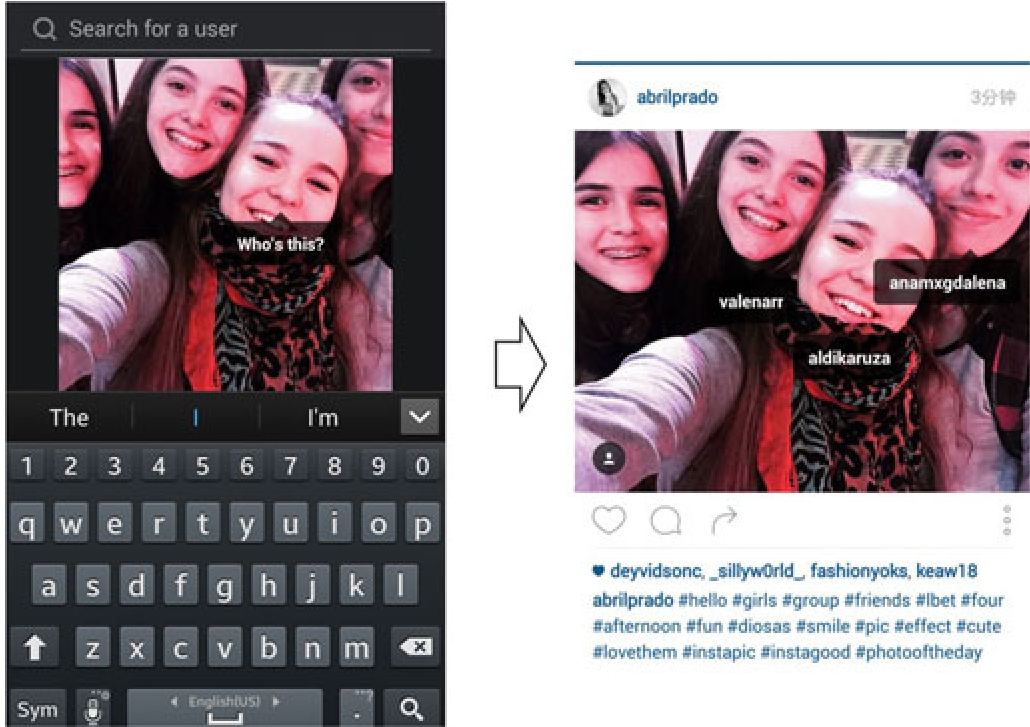 Figure 1: Illustration of user-tagging behavior on Instagram providing the physical ground truth.
3. Solving the Data Gap with PU Learning
To handle the "unlabeled" nature of the data, the authors didn't just use standard SVMs. They used Biased SVM and Spy+SVM. These algorithms are designed to treat the unlabeled set as a mix of hidden positives and negatives, allowing the model to learn even when half the data is "missing" labels.
Experiments & Results: What Makes a Friend?
The results shattered some common assumptions while confirming others:
- Reciprocity is King: The strongest predictor of an offline friend is whether your social structure shows high levels of reciprocal linking and shared paths.
- Interests Don't Matter: Surprisingly, offline friends and online friends show nearly the same level of interest similarity. Sharing a hobby makes you an online connection; sharing a physical space and a social circle makes you a "real" friend.
- The Power of "Backwards" Interaction: Social signals coming from the friend to the user (backward endorsement) are much more predictive than the user's own outgoing actions.
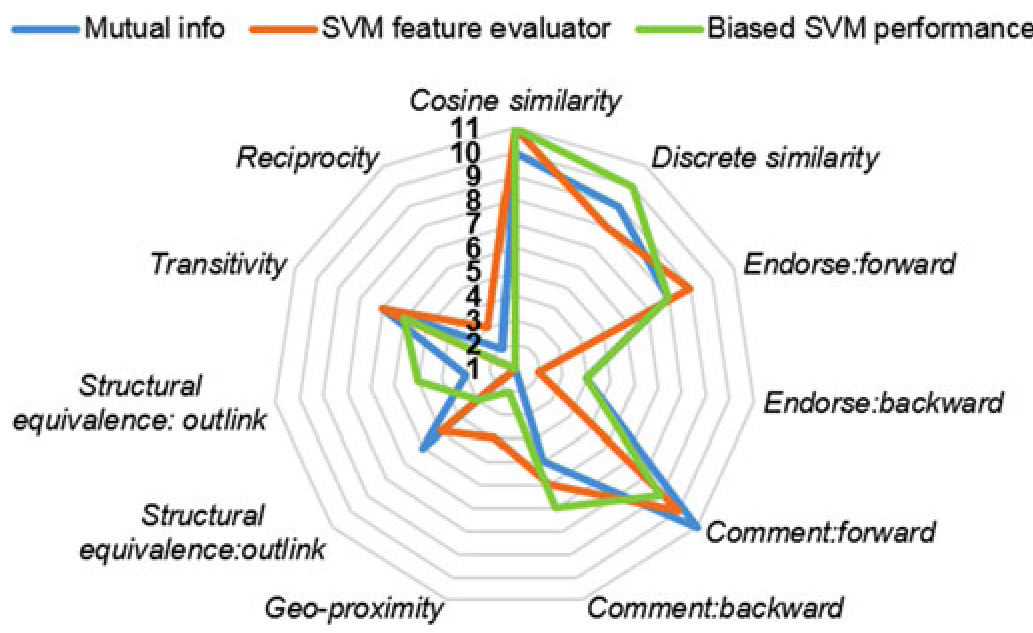 Figure 2: Feature importance ranking—Notice how Reciprocity and Geo-Proximity dominate the structural and behavioral features.
| Method | Precision (Following) | Recall (Following) |
|---|---|---|
| Standard SVM | 0.860 | 0.822 |
| Biased SVM (PU) | 0.891 | 0.863 |
| Table 1: Performance of various classifiers in identifying onsite offline friends. |
Critical Insight & Conclusion
The study proves that our physical lives are mirrored in our digital behaviors with high fidelity. The Biased SVM provided the best generalization, reaching an F1-score of over 0.92 on validated survey data.
From a product perspective, this research has massive implications for Privacy Settings (automatically grouping "real" friends for private stories) and Local Recommendations. However, a notable limitation is that it focuses only on "onsite" friends—long-distance friends who were once close but now live far apart might be missed by this specific geo-tag analysis.
Takeaway: If you want to know who someone's real friends are, don't look at what they say they like; look at who follows them back and who they share a physical city with.