
Data-Driven Governance: Revitalizing the Cultural Industry and City Branding
4570_The Effect and Influence of Government Purchase Service on Promoting Cultural Industry and Building City Brand in A Scientific Way under The Big Data
This paper explores the strategic integration of Big Data analytics into the government procurement of public cultural services to stimulate industrial growth and enhance city branding. Using Province A as a case study, the research demonstrates how data-driven administrative reforms transition public services from rigid administrative control to a market-oriented, high-efficiency model, resulting in over 64,600 annual performances in a single province.
TL;DR
In the era of Big Data, the "how" of government spending is as critical as the "how much." This paper examines how shifting from direct administration to a data-informed government purchase model for cultural services can revitalize struggling art troupes and boost city branding. By analyzing Province A (Hubei, China), the study reveals a massive surge in cultural output—over 64,000 performances in one year—driven by a systematic integration of data mining and market-oriented procurement.
Background: Sorting the Signal from the Noise
The cultural industry often struggles with a "valuation gap"—the difficulty of quantifying the social and industrial value of live performances. Historically, government intervention was either too rigid (administrative orders) or too loose (subsidies without evaluation). The authors position this work as a bridge between Data Science (Mining/Analytics) and Public Administration, arguing that cultural vitality is a byproduct of efficient, scientific procurement.
The "Scientific Way": Big Data Methodology
To move away from "Extensive Management," the authors propose a rigorous data mining workflow to identify public needs and evaluate service providers:
- Data Preprocessing: Handling noise and mismatched data from diverse cultural sources to ensure a "clean" view of public demand.
- Regression & Factor Analysis: Using mathematical formulations to understand the interdependence of variables like population density, ethnic diversity, and cultural consumption.
The core logic is captured in the relationship: Where represents the success of cultural impact, and variables represent observable factors like geographic advantages or minority population ratios.
 The study emphasizes that data mining must be human-oriented, translating complex patterns into actionable "IF-THEN" rules for policy makers.
Case Study: The "Province A" Transformation
The research focuses on a province characterized by high ethnic diversity and a rich history. By implementing a "Government Purchase, Social Force Operation" model, the province saw a dramatic shift in productivity:
- Public Welfare Performances: Over 22,000 "Drama to the Countryside" events were purchased, reaching 20 million citizens.
- Market Vitality: Instead of waiting for administrative orders, art troupes now compete for government-backed performance contracts, creating a self-sustaining ecosystem.
- Unified Operations: Outsourcing management of museums, libraries, and theaters to social forces led to professionalized security, curation, and audience engagement.
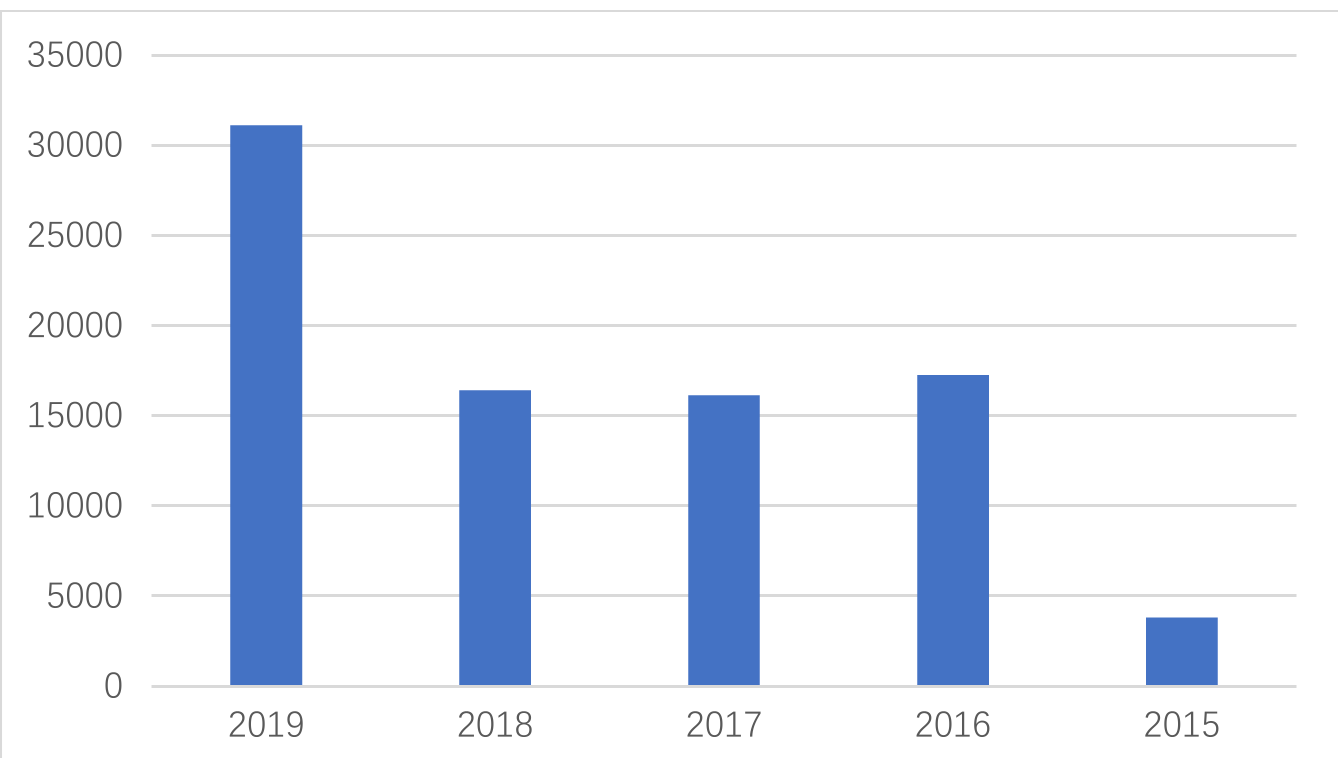 Figure 1: Performance income of professional art groups (Hubei Province case). The rising trend reflects the success of purchasing services as a primary revenue driver.
Critical Insight: Why This Matters
The most profound takeaway is the separation of management and performance. By acting as a "purchaser" rather than a "manager," the government introduces an Inductive Bias toward quality and efficiency. When the government uses big data to determine where a play is needed most, the "deadweight loss" of unwanted cultural projects is minimized.
Limitations & Future Work
While the quantitative results are impressive, the paper notes that data inconsistency across different counties remains a hurdle. Future research should look at how Real-time Big Data (e.g., social media sentiment or mobile heat maps) can be used to dynamically adjust cultural procurement in real-time.
Conclusion
Building a city brand is no longer just about logos and slogans; it is about the density of cultural interactions. By leveraging Big Data to facilitate government-purchased services, cities can create a vibrant cultural fabric that is both socially inclusive and scientifically optimized.