
4D CH World: Resurrecting History from the Noise of Social Media
4D Modelling in Cultural Heritage
The paper presents a comprehensive framework for 4D digital modelling of tangible Cultural Heritage (CH) by integrating temporal variations into precise 3D reconstructions. It leverages "in the wild" unstructured data from web repositories and Twitter to reconstruct monuments through a pipeline involving automated event detection, image clustering, and Spatio-Temporal assessment.
TL;DR
Researchers have developed an innovative 4D modeling pipeline that breathes life into Cultural Heritage (CH) preservation. By mining "noisy" data from Twitter and Flickr, the project reconstructs 3D monuments across time, allowing users to navigate through history using a specialized 4D viewer. This work turns unstructured internet "trash" into high-fidelity digital treasures.
Problem & Motivation: The Chaos of "In the Wild" Data
Digitalizing cultural monuments is a race against time, as weather, disasters, and human conflict constantly degrade our physical history. While 3D scanning is common, it usually captures a single moment in time and requires expensive, professional equipment.
The authors identify a massive, untapped goldmine: the millions of "unstructured" images uploaded to social media. However, this data is "wild"—it contains tourists blocking the view, varying lighting, no GPS metadata, and low resolution. The academic challenge lies in how to filter the signal from the noise to build scientifically accurate models that include the fourth dimension: Time.
Methodology: From Tweets to 3D Points
The core of the 4D-CH-World project is a multi-stage pipeline designed to handle the heterogeneity of the web.
1. Semantic Event Detection
Before reconstruction, the system must identify what is being looked at. The authors improved traditional document metrics by introducing Weighted Conditional Word Tweet Frequency (WCWTF). Unlike standard TF-IDF, this accounts for social signals like retweets and follower count to determine the "authority" and relevance of a text-image pair.
2. Robust Outlier Removal
The researchers developed the CSP (Clustering for Structure from Motion) scheme. By using local descriptors (ORB) and dense-based clustering, the system automatically removes images that don't belong to the monument (e.g., a photo of a nearby cafe or a selfie in front of the gate).
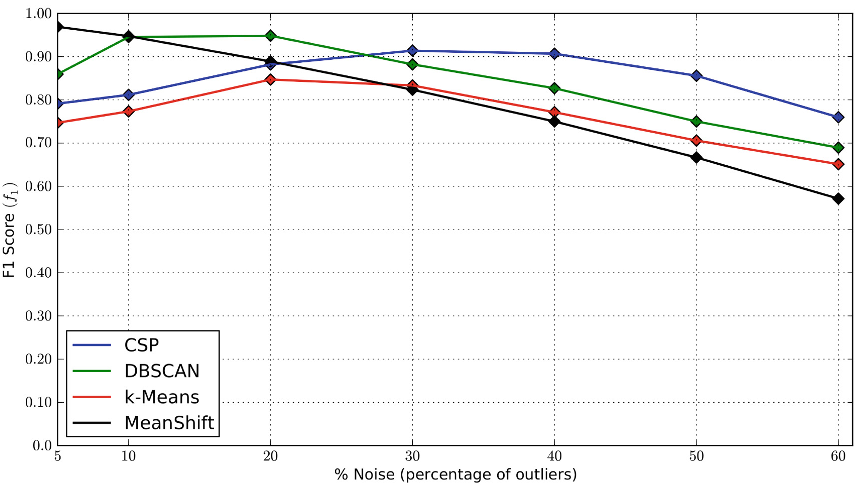 Figure 1: The 4D Reconstruction Workflow, from search engine to 3D structure extraction.
3. The 4D Viewer and Recommendation Engine
To make the data useful for curators and researchers, the team implemented a semi-supervised Distance Metric Learning (DML) algorithm. This engine learns user preferences to suggest specific views of monuments, while the 4D viewer allows users to "scroll" through different centuries of a building's life.
Experiments & Results: The Calw Case Study
The framework was rigorously tested on the historic city of Calw, Germany. By fusing Terrestrial Laser Scanning (TLS) with aerial imagery and crowdsourced photos, the team achieved remarkable accuracy.
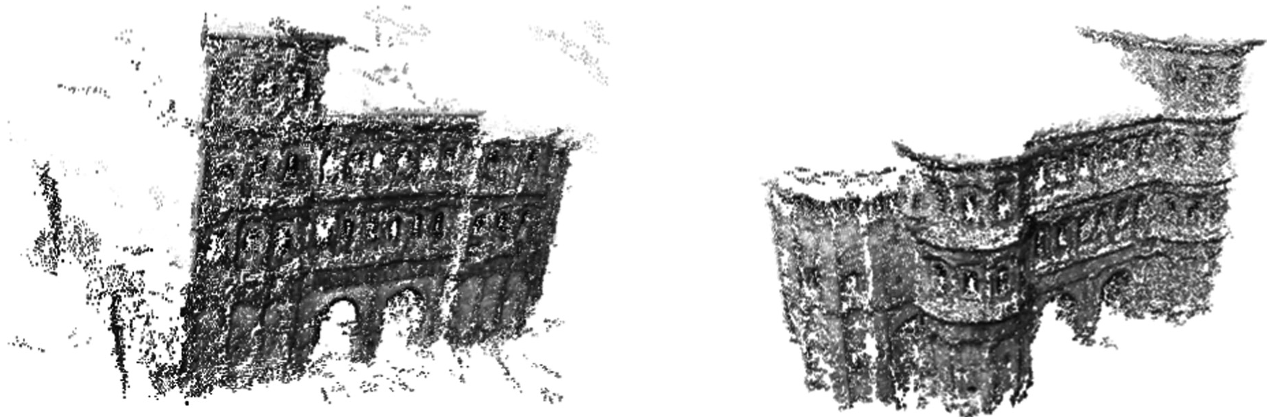 Figure 2: 3D reconstruction of Porta Nigra using only 30 images with high outlier rates, demonstrating the robustness of the CSP algorithm.
The results proved that:
- Accuracy: High-detailed models of churches (e.g., St. Peter and Paul) were successfully reconstructed by merging disparate point clouds via the Iterative Closest Point (ICP) algorithm.
- Efficiency: The smart selection of "key images" significantly reduced the computational time required for Structure from Motion (SfM) processing compared to brute-force methods.
Critical Analysis & Conclusion
The 4D-CH-World project represents a major shift in digital humanities. It moves away from the "perfect scan" towards resilient data fusion.
Takeaway
By adding the temporal dimension, we don't just see a building; we see its story—its restoration, its damage, and its survival. The integration of social media signals (Twitter) with geometric computer vision is a masterstroke in tackling the data scarcity of lost monuments.
Limitations & Future Work
While the system handles noise well, it still relies on a minimum density of images. Monuments in remote areas with low "social media footprints" remain difficult to reconstruct. Future research could investigate using Generative AI (Neural Radiance Fields/NeRFs) to fill in the missing gaps where no historical photos exist, potentially moving from 4D to a more predictive 5D model involving material degradation simulations.
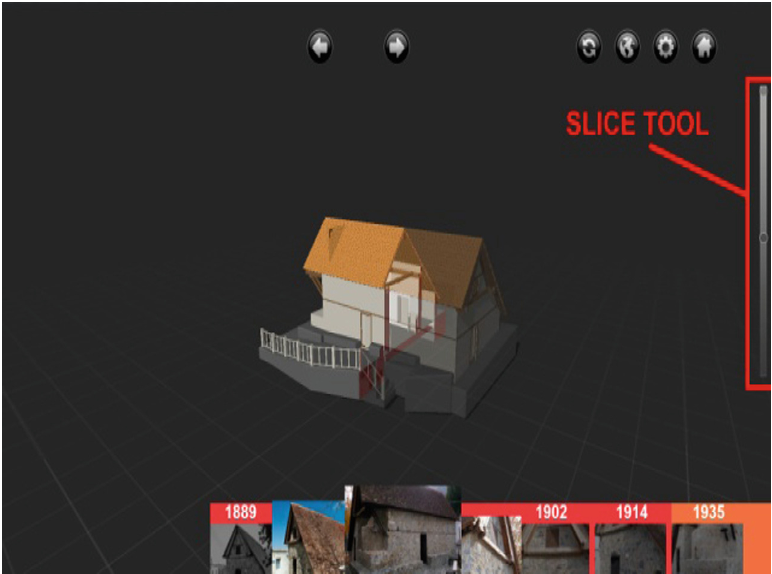 Figure 3: The 4D Viewer's slice tool, allowing researchers to inspect the interior geometry and temporal changes of heritage objects.