
Can We Trust Infinite Models? The Fragile Stability of Coevolutionary Dynamics
5316_Complex Coevolutionary Dynamics - Structural Stability and Finite Population Effects.
Summary
Problem
Method
Results
Takeaways
This paper rigorously investigates the structural stability of coevolutionary dynamics using the Replicator Equation framework and the Shadowing Lemma. It proves that common selection mechanisms (e.g., (μ, λ), truncation, and linear ranking) in finite populations fail to shadow infinite population models when complex or chaotic regimes exist.
## TL;DR
Coevolutionary Algorithms (CEAs) are often analyzed using the "infinite population" assumption of Evolutionary Game Theory (EGT). However, this paper proves a disturbing reality: for most standard selection mechanisms, the dynamics of finite populations—no matter how large—may never align with theoretical infinite models. Due to discontinuities at equilibrium points, these systems lack the **Shadowing Property**, making computer-simulated "chaotic" trajectories potentially unrepresentative of any real physical system.
## Background: The Gap Between Theory and Simulation
In the world of coevolution, we often use differential or difference equations to describe how strategies (like "Hawk" vs "Dove") evolve over time. These models usually assume an infinite number of players. In reality, we use finite populations and finite-precision floating-point arithmetic.
The standard scientific defense is that a large enough population "approximates" the infinite one. This paper, however, uses high-level dynamical systems theory to show that this bridge is broken.
## The Core Problem: The Shadowing Lemma
The **Shadowing Lemma** is a cornerstone of chaos theory. It asks: *If I have a numerical trajectory (a pseudo-trajectory) corrupted by tiny errors at every step, does there exist a "true" theoretical trajectory that stays close to it?*
If a system has the shadowing property, our computer simulations are meaningful. If it doesn't, the simulation might just be "nonsense"—a path that no real population could ever actually follow.
## Methodology: Discontinuity as a Barrier
The authors prove that for a system to lack the shadowing property, it doesn't even need to be fully chaotic; it just needs to be **discontinuous** at a fixed point (equilibrium).
They define an **η-isolating point of discontinuity**. If the selection mechanism causes the population ratio to "jump" away from the equilibrium $p_{EQ}$ even slightly, the system becomes structurally unstable.
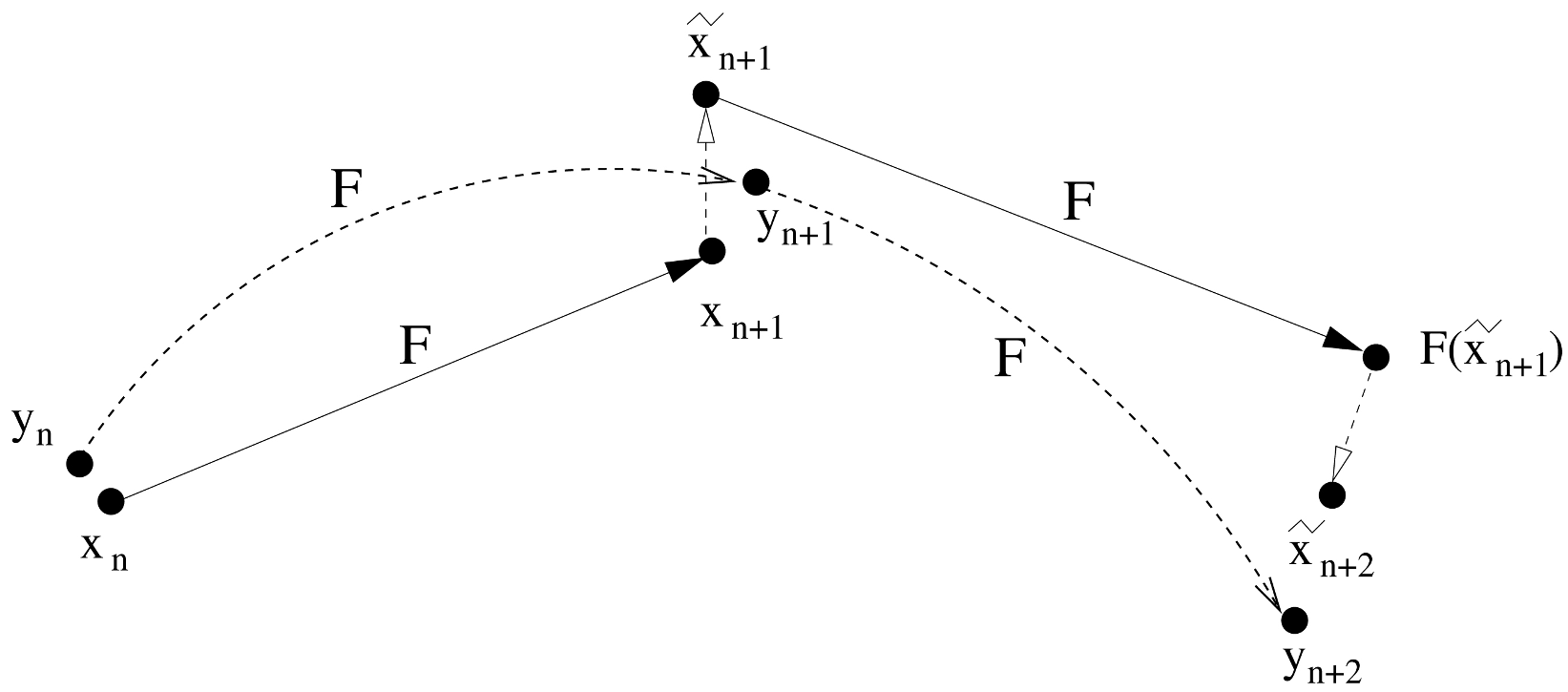
*Fig 1: Visualization of a true trajectory vs. a pseudo-trajectory. In non-shadowing systems, the gap $\epsilon$ cannot be bounded.*
### Case Study: Standard Selection Mechanisms
The paper meticulously analyzes several selection operators:
1. **(μ, λ)-selection**: Often used in Evolution Strategies.
2. **Truncation Selection**: Keeping only the top percentage of performers.
3. **Linear Ranking**: Selecting based on sorted order.
For each of these, they derive the **Replicator Map** $f(p)$. They find that at the polymorphic equilibrium $p_{EQ}$, these maps are frequently discontinuous.
## The Hawk-Dove Example
Consider a classic Hawk-Dove game where the cost of injury is high ($C=2G$). The infinite model predicts a polymorphic equilibrium at $p=0.5$. However, applying a $(\mu, \lambda)$ selection creates a map that acts like a "left-shift" on binary digits.
```text
f(p) = 2p (if p < 0.5)
f(p) = 1 + 2(p - 1) (if p > 0.5)
```
This map is a variant of the Bernoulli shift, which is famously chaotic. Because of the discontinuity at $0.5$, a finite population (which can only represent rational ratios) will eventually deviate completely from the "infinite" theoretical path.

*The discrete map $f(p)$ highlighting the split behavior at the equilibrium point.*
## Experiments and Results: The Non-Shadowing Proofs
The paper provides formal proofs (Theorems 2 through 5) for all major selection types. The "key战绩" (key achievement) here is mathematical:
* For **Linear Ranking Selection**, the system is proven to be non-shadowable for any error smaller than $\frac{\kappa(1-\kappa)}{1+(1-\kappa)}$.
* This means that even if your population size is 1,000,000, the "noise" from being finite is enough to push the system into a state that doesn't correspond to the infinite-population theory.
## Critical Insights & Conclusion
### Why It Matters
Many researchers point to "chaotic oscillations" in coevolutionary simulations as a sign of complex strategic depth. This paper suggests a more sober interpretation: those oscillations might be artifacts of the finite population interacting with selection discontinuities, rather than a fundamental property of the game itself.
### Limitations
The paper focuses on **Best-of-Selection** without mutation. In many practical EAs, mutation (adding Gaussian noise) might "smooth out" these discontinuities, potentially restoring some form of statistical stability, though not necessarily the shadowing property itself.
### Future Outlook
This work warns us: **Approximate models can be deceiving.** When designing coevolutionary systems for critical applications (like missile defense or automated trading), we cannot rely solely on infinite-limit EGT. We must analyze the specific discrete dynamics of the finite population.